
Steinmeyer Mechatronics
Stack, gantry or gantry?
Positioning tasks are rarely carried out in one direction only. Rather, applications often require movement in both the Y and Z directions in addition to movement along the X axis. What are such multi-axis systems like?
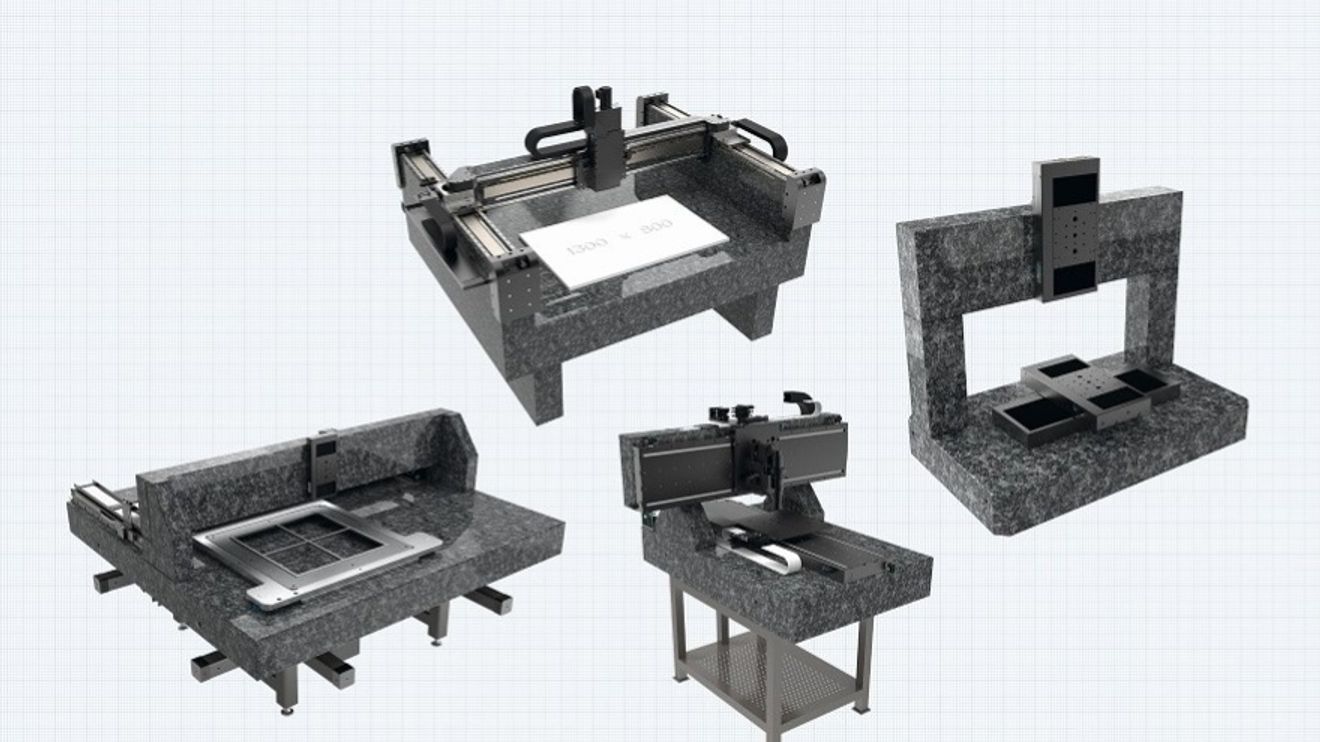
XYZ three-axis arrangements can be found in machine tools, measuring machines and laser processing systems, among others. They are also used in a variety of devices such as 2D and 3D printers, copiers, assembly systems and, in very large versions, overhead cranes. If a three-axis system is to be set up, the vertical axis is usually mounted on a supporting structure above the XY axes. Typically, the linear tables with the longer travels are positioned horizontally. In principle, three basic concepts can be described: stack, gantry and gantry. Which architecture is best suited to the respective application depends on the specific task. Several aspects are taken into consideration: In addition to installation space, natural frequency, dynamics and accuracy, the requirements for the controller and the overall costs are decisive.
Three basic architectures
Whether stack, gantry or gantry - no architecture achieves the best values in all areas, and every construction method has its advantages and disadvantages. However, a few simple correlations can be made: The higher the natural frequency, the more precisely and quickly the positioning system can be adjusted and the easier it is to shield against disruptive vibrations from outside (caused by machines, vehicles, fans, pumps or people walking, for example). The natural frequency is primarily determined by the mechanical structure and in the drive direction - particularly in systems with a linear motor - by the control rigidity. A high natural frequency due to the appropriate basic architecture is also a prerequisite for fully exploiting the potential of linear motors for high accelerations and therefore high speeds. The achievable speed is the measure of the process time and is particularly critical for automated production lines. However, the higher the speed, the higher the demands on the rigidity of the system and the performance of the controller. The controller requirements also increase with the increase in accuracy.
Finally, the accuracy is mainly determined by the pitch errors of the individual axes. Together with the influence of temperature, this error component is almost always one dimension higher than the errors of the feedback systems used. For example, the individual axes can bend when moving under load, which has a negative effect on the desired values. Misalignments and large distances between the individual axes also lead to systematic errors, which can be reduced by selecting the optimum architecture.
The stack
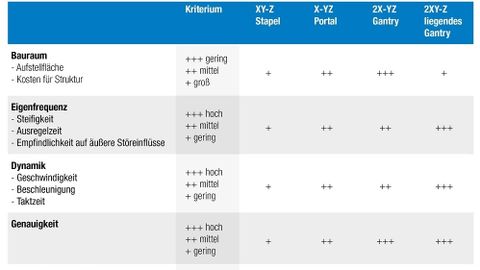
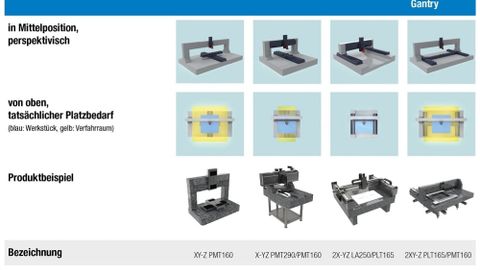
Whether stack, gantry, gantry or horizontal gantry - the optimum architecture depends on the task in hand.
© Steinmeyer MechatronicsIn the stacking architecture, two linear tables are mounted on top of each other, crossed in the direction of travel. As the workpiece is moved on both the X and Y axes, a lot of installation space is required - twice the surface area of the workpiece. The charm of the stack design lies in its simplicity and cost-effectiveness, and the requirements for the controller are also minimal. Another advantage is that there is no overdetermination between the individual tables. However, stacking the two tables on top of each other also results in reduced rigidity and therefore reduced natural frequency of the overall system.
The high moving mass also means that the dynamics quickly reach their limits. The overhanging of the loaded individual tables leads to high pitch deviations and thus to limited accuracy. In addition, all cables have to be moved in two directions. This makes the stack particularly suitable for short travel distances, lightweight parts and applications in which the objects are smaller than the travel distances. This architecture can be found, for example, in devices such as microscopes.
The portal
Unlike the stack, the axes in the portal architecture are not connected to each other, but are mounted individually at right angles to the base and to a crossbeam in the direction of travel. As both tables are connected to the structure, the individual systems achieve high values for rigidity and natural frequency. The result is a high natural frequency of the overall system. The portal design also scores highly in terms of dynamics, flatness and accuracy. In addition, there are no overdeterminations between the individual tables and, compared to the stack, cable routing is simpler in just one direction.
Portals are particularly suitable when large areas need to be traversed and both the object to be measured and the sensor can be moved. Applications with heavy measurement objects also benefit from the gantry design. As the workpiece is only moved in the X direction, the drive can be smaller than with a stack. Even heavy parts can be positioned quickly and precisely with gantries.
Gantries for stationary measurement objects

Elger Matthes is Head of Product Management at Steinmeyer Mechatronik in Dresden.
© Steinmeyer MechatronicsWith the stack and gantry architecture, the object to be measured is also moved. However, if the workpiece must not be moved during measurement, the gantry is the right choice. Here, one or both horizontal directions of movement are formed by two synchronously moving linear tables. Similar to a gantry crane, for example, a laser or a sensor is moved across the surface. The gantry architecture is characterized by high rigidity and natural frequency.
Decoupling measures avoid the design-related overdetermination between the individual tables. As at least one pair of drives must be electronically synchronized, the demands on the controller are correspondingly high. On the other hand, the pair of axes ensures high dynamics as well as good flatness and low pitch and yaw deviations, as the transverse axis is supported on both sides. This results in accuracy in the higher range. A particular strength of gantries is their minimal space requirement - they require the least installation space of all basic architectures.
Horizontal gantry with air base
Horizontal gantries with an air base, such as those found in wafer steppers, are a special form. They are considered the 'premier class of positioning technology'. In the horizontal version, the Y-axis is in the same plane as the two X-axes and forms the letter 'H' with them. The highlight: air bearings support the load on the base plate. This enables the best possible values to be achieved in terms of accuracy, rigidity, dynamics and flatness, as decoupling measures mean that only the geometry of the high-precision base plate is decisive. Straightness, pitch, yaw and roll are therefore in the top league. However, a lot of installation space is required, as at least one pair of drive axes surrounds the movement space and the workpiece is also moved.


You might also be interested in
Embedded community votes for favorites
In addition to the coveted 'embedded award', the 'community choice award' will also be presented for the first time at embedded world. The special feature: The award winner is determined by the embedded community.
 read more...
Preview on embedded world 2024
Inference can be as Compute Intensive as the Training
With CPUs, GPUs and FPGAs, AMD has all architectures that are used for AI. embedded world Keynote Speaker Dr. Salil Raje shares his view on AI.
read more...International meeting places for the embedded community
From April 9 to 11, the embedded industry will meet in Nuremberg - but not only there, because embedded world will also take place in China and the USA in 2024. How did it go in China? What can we expect in Nuremberg? And a look ahead to the 1st...
read more...In focus: Artificial intelligence
The e-paper of the January 2024 issue
ChatGPT has given artificial intelligence a huge boost over the past year - especially in terms of public perception. In this issue, we want to take a closer look at AI and categorize it in more detail for potential industrial users.
read more...AI boosts the performance of software engineers
New "superpower" for software developers: An AI-supported programming assistant is set to revolutionize the development landscape.
read more...ERP trend forecast for 2024
Unit4 forecasts the most important ERP trends for the year 2024. Claus Jepsen, Chief Product and Technology Officer, names nine points that he considers relevant.
read more...These are the AI trends for 2024
Artificial intelligence is changing the entire IT world forever and is having a huge impact on how data is understood, analyzed and used. AI is also taking data management to a new level. Five AI trends have been identified for the year 2024.
read more...Open Industrie 4.0 Alliance on App Store
The OI4.0 Alliance and the app stores
Shaping the future of Industry 4.0 together is the goal of the Open Industry 4.0 Alliance. Flecs has been chairing the 'Application Management' working group for a year now. Samuel Greising, Managing Director at Flecs and head of the working group,...
read more...Software in online direct sales
Flecs entered the market two years ago with a new business model: it wants to automate the installation and updating of industrial apps on control systems. Patric Scholz, Co-Founder, explains the innovations for the SPS.
read more...