
Fraunhofer IPA
Gripper for multi-variant production
Adapting grippers quickly and cost-effectively to changing products is made possible by a new process developed by Fraunhofer IPA.
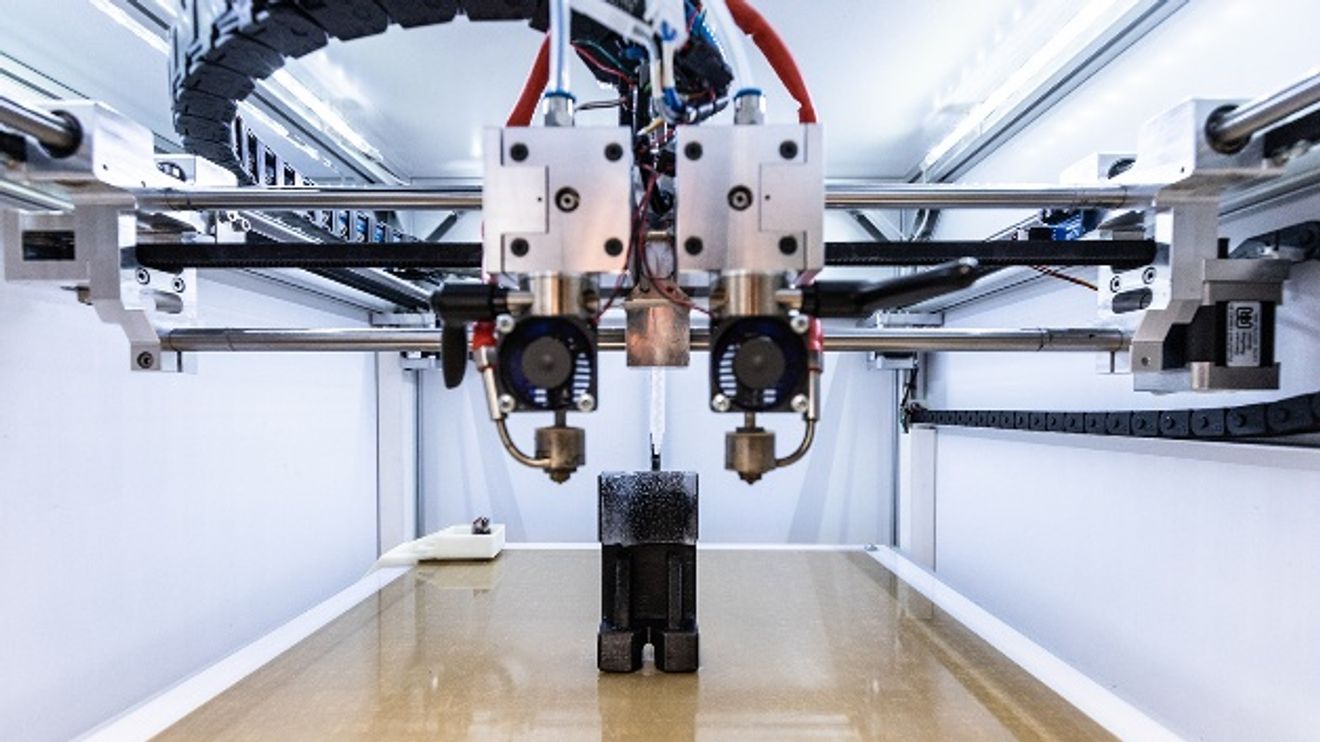
Developing and manufacturing grippers for handling tasks involving small quantities is time-consuming and expensive. Especially when the product to be handled is constantly changing. To meet these challenges, researchers from the Center for Additive Production (ZAP) at Fraunhofer IPA have developed a process that allows multi-component grippers to be manufactured quickly and cost-effectively.
The requirements of the industry
The project began at Henkel in Düsseldorf. At the industrial and consumer goods manufacturer, robots remove plastic bottles from a filling line and take them for further processing. They are equipped with a two-part gripper, the base body of which is made of aluminum. The gripper jaws are made of an elastomer to prevent the bottles from being damaged or slipping off. As Henkel's product range is constantly evolving, the grippers have to be replaced time and again. Previously, the molds used to manufacture the elastomer gripper elements had to be produced separately for each gripper. A fitter then screwed the gripper jaws to the base body by hand.
Automated production process reduces costs
The scientists at ZAP have therefore developed a process that allows the grippers to be manufactured faster and significantly more cost-effectively in a single production step: additive freeform casting, a combination of 3D printing and gravity casting. Manufacturing process largely automated Two print heads and a dosing unit are used during production. The base body of the gripper and the support material are printed using the FFF (Fused Filament Fabrication) process and form the rigid part of the gripper and a casting mold. The researchers use thermoplastics such as acrylonitrile butadiene styrene copolymer (ABS) as the printing material for the base body. The support structure, on the other hand, consists of a water-soluble plastic such as polyvinyl acetate (PVA).
In order to be able to cast the two-component silicone for the gripper jaws during the manufacturing process, the scientists have integrated a special dosing unit into the 3D printer. This uses silicones from Henkel that are viscous enough to fill details and cavities and also meet the requirements for dripping and curing time. Once the manufacturing process is complete and the silicone has cured, the support structure is removed in a water bath. The result is a component with both rigid and elastic material properties. "Additive freeform casting is a manufacturing process that is largely automated," says Jonas Fischer, one of the researchers involved at Fraunhofer IPA. "You only have to send the CAD data to the 3D printer and then it can manufacture the gripper independently. Post-processing by hand is not necessary and waste is avoided as far as possible."
Removing the gripper from the printer and placing it in the water bath is the only work step that currently still has to be done by hand.


You might also be interested in
Low code for service robots
Launched in 2017, the SeRoNet project aims to significantly simplify the design, development and use of service robots. With 'xito.one', an open IT platform is currently being created for users, solution providers, robotics and component...
 read more...
Programming via drag & drop
A weighty argument that is often put forward against the purchase of an industrial robot - in addition to the price - is the effort required for programming. But what if this could be done via software as easily as setting up a smartphone?
read more...Under stress
Drag chain and robot applications are pure stress for the cables used, which have to cope with highly dynamic movements in all directions - in the tightest of spaces and often under extreme environmental conditions. How do suitable cables have to be...
read more...Highly sensitive wafers moved safely
Until now, the transport of wafers from one workstation to the next with the help of robots has been hampered by the lack of precision with which mobile robots move and grip. A solution from Kuka and Cognex aims to change this.
read more...Surface gripper for vacuum tube lifter replaced
Schmalz is launching a new generation of vacuum grippers for its JumboErgo range of vacuum tube lifters. The modular FMP replaces the previous FM gripper.
read more...Complete testing tasks fully automatically
The modular QBIC systems with integrated IOTA from Cretec are a new generation of mobile, fully automated work platforms based on cobots, which according to the provider are easy to operate, very fast and can be used individually.
read more...Use in aseptic environments
The Scara robots of the TS2 series from Stäubli have a wash-down-capable hygienic design and will also be available in a Stericlean version in the future.
read more...Flexible handling of cylindrical objects
The company OnRobot has launched its first three-finger gripper as an alternative to conventional, pneumatically operated three-finger grippers.
read more...International Federation of Robotics
Starting the upswing with robotics
The IFR is certain that robotics is necessary for the economic upturn. However, there is a lack of suitable training and further education opportunities.
read more...