
Fraunhofer IFF
Mobile assistance robots in flow production
Together with partners from industry and research, robotics experts at the Fraunhofer IFF have developed new technologies that enable mobile assistance robots to perform assembly tasks even on moving objects, such as in flow production.
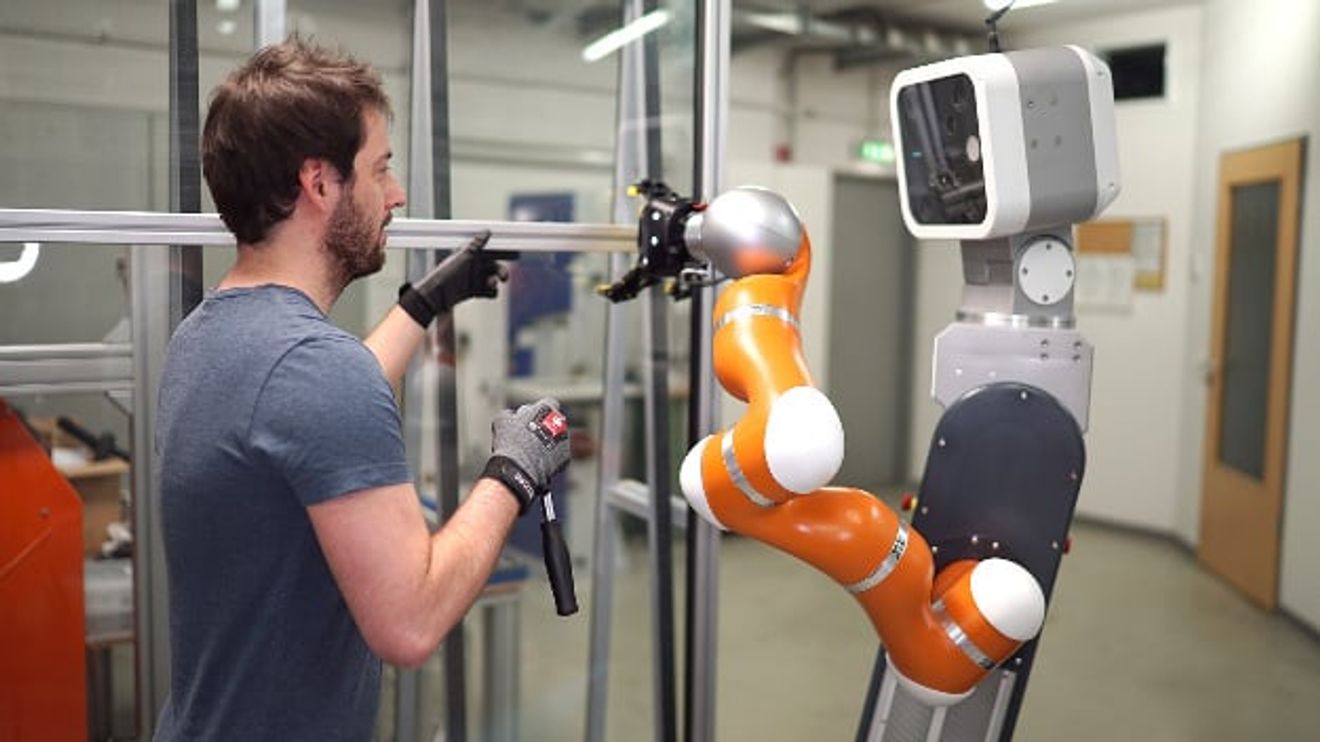
Intelligent, mobile assistance robots could not only enable new production methods for industry.
© Fraunhofer IFFSo far, mobile assistance robots have not been able to establish themselves in the industrial environment. One of the main challenges is the versatility of the robot for a wide range of activities with no or minimal programming effort. In addition, today's systems are too slow to even begin to demonstrate human-like capabilities - for example in object recognition and handling. One solution would be wirelessly networked, distributed control systems.
However, for tasks involving mobile manipulation in particular, i.e. the free movement and handling of various objects, robots must be able to continuously perceive their environment and adapt independently and immediately to a dynamically changing environment. Special software is required for this independent planning of actions and movements, the recording and evaluation of a wide variety of sensor data and the utilization of extensive amounts of data. This type of 'intelligent' robotics forms the basis for a wide range of applications outside of classic automation and for the design of highly flexible automation solutions.
A team of robotics experts from the Fraunhofer IFF and partners from industry and research have succeeded in overcoming the associated challenges. As part of the 'fast robotics' research project of the BMBF-funded 'zwanzig20' initiative, they have developed a solution consisting of wirelessly networked, distributed control systems that allow decentralized real-time control of intelligent mobile robot systems.
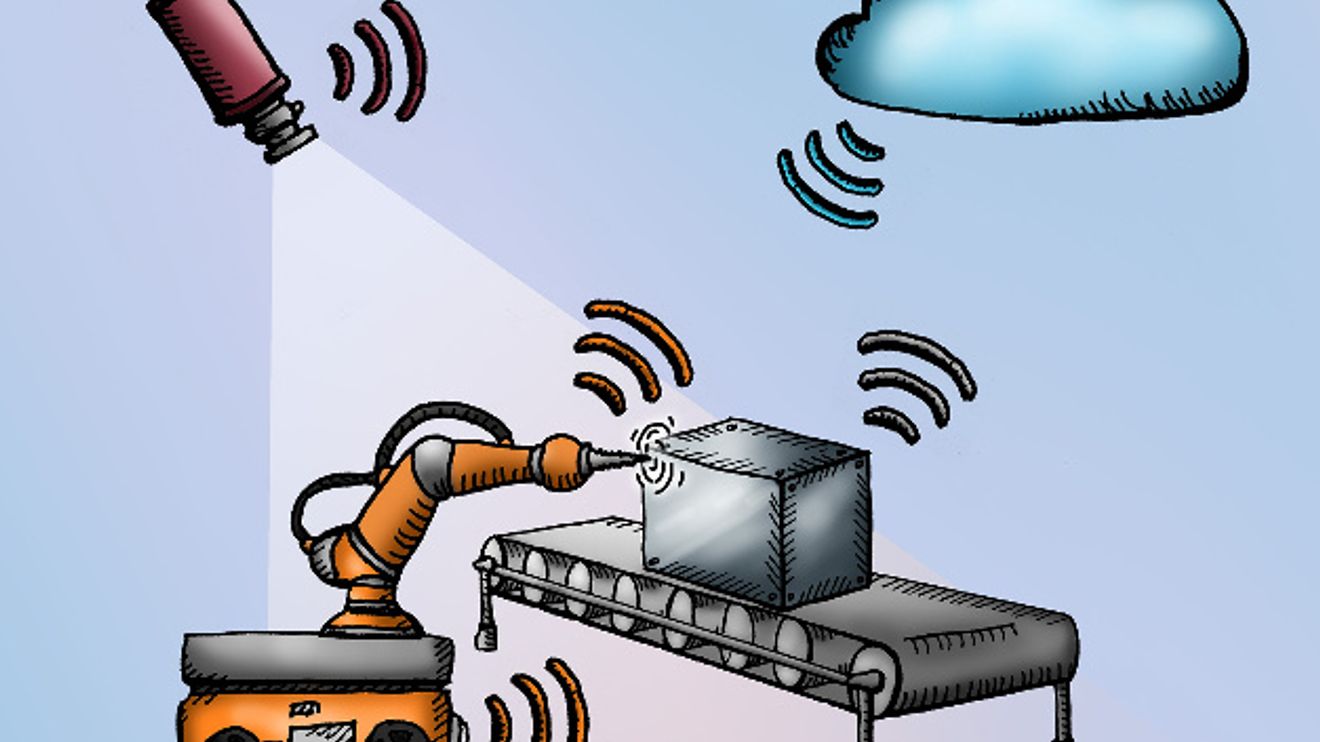
The 'fast robotics' project: almost all communication between robots, ambient sensors, components and control technology takes place wirelessly, decentrally and in real time via cloud solutions with the help of the new solution.
© Fraunhofer IFFIn terms of software systems, their approach is based on a transformation of the previously strictly hierarchically organized automation pyramid into a highly networked system. In addition, they have equipped assistance robots with intelligent basic skills that can only be realized through the interaction of networked, outsourced IT services on powerful computing technology. The Fraunhofer IFF engineers developed the necessary hardware and software themselves.
Prof. Norbert Elkmann, Head of the Robot Systems Business Unit at the Fraunhofer IFF and coordinator of the 'fast-robotics' project: "Our goal was to implement wireless real-time communication between decentralized, mobile robot applications and the surrounding infrastructure using powerful radio technology. The necessary computing technology can now be outsourced to external servers and core robot functions such as sensor data processing and motion generation can be provided via cloud solutions. For the demonstration, we deliberately opted for the very demanding 'assembly in flow operation' scenario. It is far more complex than with stationary objects and underlines the performance and practicality of the developments."
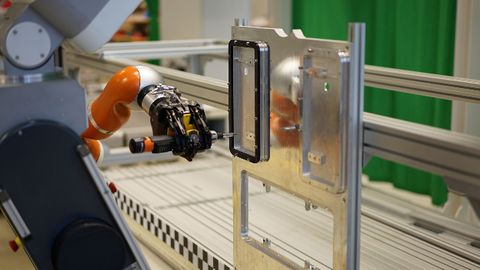
In the 'fast robotics' project, the robotics experts at the Fraunhofer IFF and the development partners involved have developed a new, wireless control architecture for mobile assistance robots that can even be used in assembly line production.
© Fraunhofer IFFIn order to achieve their goal, the researchers had to rethink and redesign the entire process of information transmission between the participants in such a network. Christoph Walter, project manager at the Fraunhofer IFF, explains: "Among other things, we were able to improve the statistical reliability and response behavior of wireless communication channels and cloud services. We also developed application-specific fault tolerance strategies for controlling the robots. This has resulted in a new robot control architecture that is based on the pre-calculation of relevant action variants at runtime and thus combines fast response times with higher-quality detection and planning functions."
As a result, mobile and stationary robots can now be monitored, localized, configured and controlled wirelessly in real time using a radio infrastructure. This also simplifies the integration of external sensors, such as stationary cameras for monitoring the robot environment and services based on this. In addition, lighter and more flexible mobile robots and manipulators can be built, as they no longer have to carry their entire computing technology and energy supply with them.


You might also be interested in
TQ-Group supplies Kea Robotics
First industrial robot based on the modular principle
With the ILM-E frameless motor, the TQ Group supplies the heart of the world's first modular industrial robot. The plug & play robots from Kea Robotics are assembled according to the modular principle.
 read more...
Robotics for schools and training companies
In many professions, knowledge of robotics will be a prerequisite for a successful application in the future. This is why schools and training companies are now integrating robotics into their curricula - including in the form of special robot...
read more...These 5 trends will shape robotics in 2021
Robot density is increasing rapidly in all industries worldwide. With new application possibilities, robots are also learning new tricks and helping to reduce the CO2 footprint. The 5 top trends in robotics.
read more...Market-ready gesture control for robots
The Fraunhofer IWU reports: Industrial gesture control for robots is now ready for the market. It complies with the applicable guidelines on machine safety and data protection.
read more...Robot density according to IFR
Germany among the top 10
Robot density in the manufacturing industry has reached a new record worldwide with an average of 113 industrial robots per 10,000 employees. Germany is by far the largest industrial robot market in Europe.
read more..."Charter of Robotics" published
The European mechanical engineering association EUnited has published a charter for future cooperation between robots and humans and identified ten areas of action. The overriding principle: the focus is on people.
read more...Human-robot collaboration / cobots
New ISO standard for the measurement of collision forces
In collaboration with numerous international partners, robotics experts at the Fraunhofer IFF have developed a new ISO standard that shows how contact forces and pressures on cobots will be measured in a standardized way in the future. The ISO...
read more...Robotics&AUTOMATION 3/2021
Is an industrial robot without a cage really safe? What needs to be considered in the planning phase of human-robot collaborations? And what does a gecko have to do with robotics? The latest e-paper from Robotics&AUTOMATION provides the answers.
read more...Safe HRC from the planning phase
Without collision measurement and biofidelic measurement systems, it has not yet been possible to determine the maximum permissible speeds of a cobot. This is now set to change.
read more...