

Schneider Electric
Material flow automated with mobile robotics
Schneider Electric has implemented a 'MiR500' from Mobile Industrial Robots at its plant in Bukowno, Poland. The autonomous robot autonomously transports finished products between the warehouse and production.
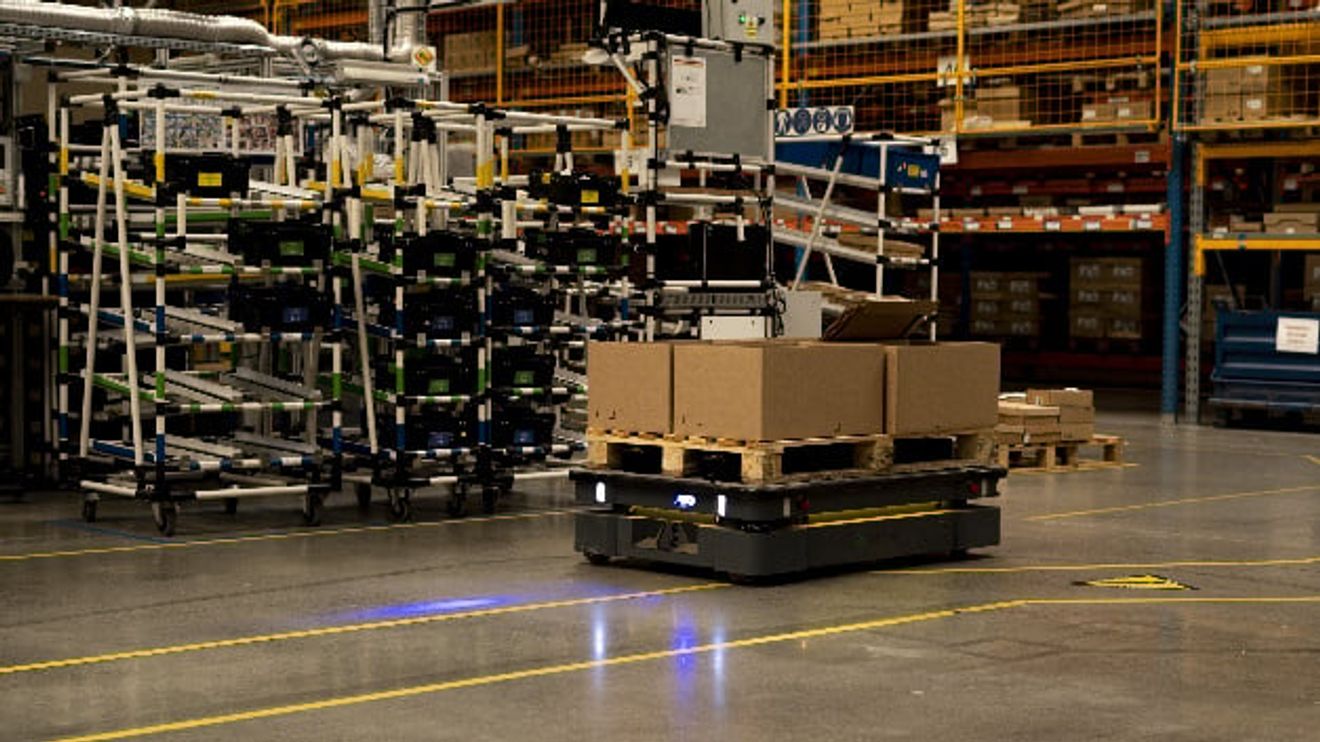
The autonomous robot from Mobile Mobile Industrial Robots (MIR) transports pallets with up to 400 kg of goods between production and the warehouse. As a result, it optimizes internal logistics, reduces transport costs and increases occupational safety for employees. It works around the clock in three-shift operation and travels eight different routes, which are on average 140 m long. During a shift, the robot covers a distance of between 5.5 and 6 km. "The mobile robot transports two layers of goods on a pallet at once. This allows us to transport more material in one trip," explains Agnieszka Należnik-Jurek, Manager of the Technology Department at Schneider Electric. "This also means we need fewer pallets and save costs." With this in mind, the company expects a quick return on investment.
With the help of the 'MiR Pallet Lift' add-on module, the robot can independently pick up and unload pallets from the 'MiR Pallet Rack' device. After a warehouse employee has given it an order, the mobile robot takes an empty pallet from the warehouse and brings it to the production line. There it places it on a 'Pallet Rack', picks up a full pallet of finished products and takes it back to the warehouse. If there is no new order waiting for it, it automatically moves to the loading station.
The robot is connected to the plant's WLAN and transmits its position. This allows employees to track the path of the pallets at any time. Information about all of the robot's orders and missions is available in the plant's own Andon system.
Thanks to two 360° laser scanners, two 3D cameras and eight proximity sensors, the robot always has its surroundings in view and can move freely within them. In contrast to the AGV used previously, it reliably recognizes people, machines and other objects in its environment and reacts by braking or swerving depending on the situation.
The previously used AGV lane did not allow for spontaneous changes. The entire process had to be reconfigured each time. The MiR robot, on the other hand, thanks to its sensors and software, does not require lane guidance and can therefore be flexibly adapted to changing processes.
The robot also increases work safety with light and sound signals: before it enters a room with people, it announces itself with an acoustic signal. It only enters after waiting for a pre-programmed time. It is also equipped with a blue light - a mandatory feature for moving machines at Schneider Electric.


You might also be interested in
Safety controller functionally expanded
Schneider Electric has expanded the functionality of the Modicon MCM series of safety controllers. In particular, the processing capacity of the function blocks in the CPU has been significantly increased.
 read more...
New appointments to management positions
Schneider Electric has appointed Barbara Frei as the new Executive Vice President of the global Industrial Automation business unit. With immediate effect, the manager will take over the position from Peter Herweck, who was appointed CEO of Aveva on...
read more...***** ENG ***** Automation of complex machines
Schneider Electric has developed PacDrive 3, a technology platform for the automation of very complex machine applications.
read more...Automation of complex machines
With PacDrive 3, Schneider Electric has developed a technology platform for the automation of very complex machine applications.
read more...3D measurements with high accuracy
Creaform is launching automated quality assurance solutions in the R-Series range, including the 'MetraScan-R Black|Elite' and the addition of four different models of the 'Cube-R' 3D scanning measurement device.
read more...New Regional Sales Director Western Europe appointed
Since December 1, 2020, Andrea Alboni has headed the Western Europe region for Universal Robots (UR) and, as Regional Sales Director, is responsible for all of the cobot pioneer's activities in Germany, Austria and Switzerland.
read more...Cyber security for industrial robots
Kaspersky and Alias Robotics have entered into a partnership to jointly improve the cyber security of robots used in OT networks.
read more...The e-paper of the November 11 issue
The e-paper of issue 11 is here. Among other things, you can read about Huawei's position in relation to the company's accusations of spying, why TSN is "a symbol of the standardization of fieldbuses" and how Single Pair Ethernet will change process...
read more...Danish robotics pioneer with new management
On August 1, 2020, Mobile Industrial Robots (MiR) will have a new CEO: the parent company Teradyne appoints Søren E. Nielsen (51) as President of the company.
read more...