

Waste collection in space
How start-ups want to clean up the universe
Earth's orbit is becoming increasingly crowded. Metal parts are buzzing around the planet and pose risks to space travel. That's why they need to be removed. Some companies see this as a future market.
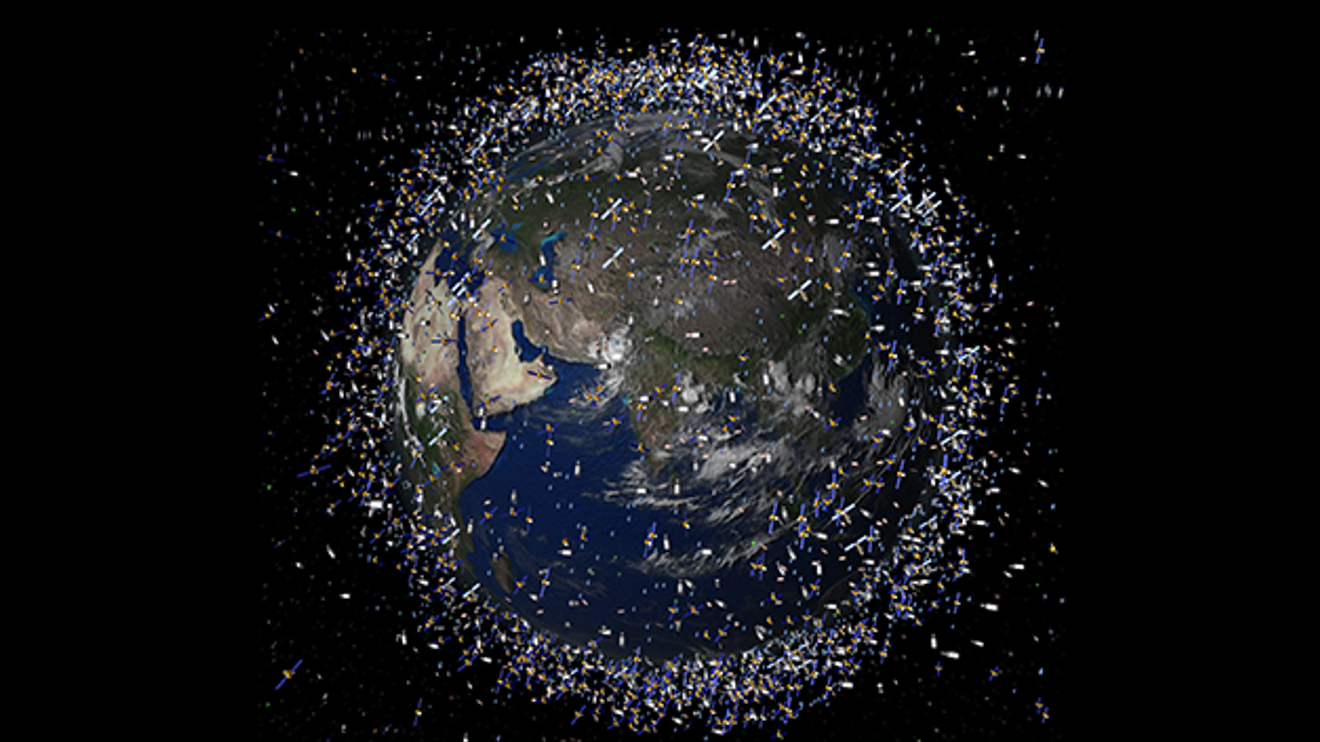
The computer-generated image from the European Space Agency (ESA) shows space debris from previous space missions orbiting the Earth alongside intact satellites (undated photo). Earth's orbit is becoming increasingly crowded. Pieces of metal are buzzing around the planet and pose risks to space travel. That's why they need to be removed. Some companies see this as a future market.
© ESA/ESA/dpaThey are needed for cell phone reception, banking transactions or navigation systems: satellites in space have long been used for more than just research. However, many of the missiles are now inoperable and orbit the earth as space debris. With the help of start-up companies, the European Space Agency (Esa) wants to bring more order. Some companies are hoping for good business.
Together with the Swiss start-up Clearspace, Esa wants to send a robot into orbit that will use its gripper arms to remove debris and defective satellites. Clearspace-1 is due to be launched into space for the first clean-up operation in 2025. "The market is still in its infancy, but we need to promote it," explains Holger Krag, Head of the Space Security Program at Esa. The agency is investing more than 100 million euros in the project. Private investors are also involved in the mission.
There are currently more than 35,000 missiles in space that are larger than ten centimetres. 130 million pieces are smaller than one centimeter. "As with all environmental problems, you have to prevent waste before you clear waste. Are we good at prevention? No," emphasizes Krag. That's why a clean-up campaign is needed. The plan is for the waste to burn up as it enters the earth's atmosphere. In the future, waste should be prevented immediately, says the expert. "We are calling for the object to disappear at the end of every mission from 2030."
Expensive clean-up missions
"Of course, we need several providers. This creates a competitive landscape," explains Krag. The project is still relatively expensive. "Of course, space travel is expensive. A clearance mission is also very expensive, especially the first one," reports the expert. In this area, similar to car production, the focus is on the development of routines. "However, the costs remain in the millions in any case."
Manuel Metz from the German Aerospace Center also sees clean-up missions as a future business model. "The idea is very clear: there should be a prospect of implementing commercial services and applications with it."
Lucrative market for industry?
Octopus-like robots that fish garbage out of orbit are not enough on their own, explains Metz. Rather, there needs to be an interplay between different technologies. "I have the impression that the industry sees a market perspective here. There are various approaches being tested in several countries." Some satellites are already being fitted with specific handles to make it easier to remove the missiles later on. Observation technologies are also important in order to precisely localize the objects.
The Hessian start-up Vyoma, for example, is pursuing such a monitoring strategy. The company wants to use its own satellites to collect real-time data that can localize space debris. In Earth orbit, there are many satellites that have to make evasive maneuvers because the data is sometimes up to 48 hours old, reports co-founder Stefan Frey. Real-time data would improve the prediction of possible collisions with space debris and enable active removal. For example, the data provides information on whether and how fast an object is rotating.
However, collecting data is not cheap. "With ground-based sensors, the price is between 2,500 and 90,000 dollars per month for constant monitoring of an object," reports Frey. The start-up does not want to limit itself to one object, but wants to monitor several. "We have a scaling effect," says the entrepreneur. The monitoring of one object should cost a few hundred euros per month, so that several of them can be monitored.
The first of the two Vyoma satellites is due to be launched in 2024. There are already commercial and institutional customers. "That will be enough to build up a catalog of objects larger than 20 centimetres," says Frey. Ten more monitoring satellites will then follow. After a mission, the satellites will be placed in a specific orbit in order to come down and burn up in the Earth's atmosphere. "We don't want to clutter up space ourselves."
Space debris in the Earth's environment
The latest figures on space debris, provided by the ESA Space Debris Office at ESOC in Darmstadt. The information was last updated on December 22, 2022.
| Number of rocket launches since the beginning of the space age in 1957 | Approximately 6,340 (excluding failures) |
| Number of satellites put into orbit by these rocket launches | Approximately 14,710 |
| Number of satellites still in space | Approximately 9,780 |
| Number of these satellites that are still functioning | Approximately 6,900 |
| Number of debris objects regularly detected by space surveillance networks and included in their catalog | Approximately 32,500 |
| Estimated number of breakups, explosions, collisions or anomalous events leading to fragmentation | More than 640 |
| Total mass of all space objects orbiting the Earth | More than 10,500 tons |
| Not all objects are tracked and cataloged. Estimated number of debris objects in Earth orbit based on statistical models (MASTER-8, future population 2021) | |
| Space debris objects larger than 10 cm | 36.500 |
| Space debris objects from more than 1 cm to 10 cm | 1.000.000 |
| Space debris objects from more than 1 mm to 1 cm | 130 million |


You might also be interested in
Alexander Graham Bell died 100 years ago
With the very first telephone, Alexander Graham Bell, who died 100 years ago, ushered in a completely new era of communication - which has since led to the age of smartphones.
 read more...
KIT researcher sends voice message from the Titanic
Around 3800 meters below the surface of the sea, you can watch the Titanic disintegrate. How it rusts and how underwater creatures eat away at it. A computer scientist from Karlsruhe has now used a mission to the wreck for something completely...
read more...Solar storms can paralyze Earth's high-tech
They move through the solar system at breakneck speed and are not actually a danger to the Earth. But solar storms can be devastating for human technology. Are we facing an extreme space weather event in the next ten years?
read more...Digital Material Selection reduces CO₂ Emissions
Using an industrial gripper as an example, Schunk and CADFEM demonstrate that simulation-based material selection can reduce CO₂ emissions from secondary materials and additive manufacturing by up to 40%.
read more..."AKIMI" Research Project develops AI for Flexible Robotics
The AKIMI research project is launching at the WZL at RWTH Aachen University. The goal is to develop agent-based AI that simplifies the programming and reconfiguration of robotic systems for small and medium-sized enterprises.
read more...Barcelona Declaration on Robotics and...
Robotics Associations Adopt Global Automation Strategy
The global robotics industry is stepping up its collaboration. The associations AER Automation, A3, IFR, and VDMA Robotics + Automation have formed a long-term alliance by signing the “Barcelona Declaration on Robotics and Automation 2026.” The...
read more...Humanoid Robotics at BMW in Spartanburg
"Physical AI" combines digital AI with real machines and robots. This allows intelligent systems, such as humanoid robots, to be integrated into real-world production processes. Following the successful deployment of the Figure 02 humanoid robot at...
read more...SensoPart and Cambrian Robotics
Partnership for 3D-Guided Robotics
Cambrian Robotics and SensoPart are jointly developing an AI-powered solution for 3D-guided robotic applications. The combination of vision sensors and AI is designed to simplify gripping and positioning processes.
read more...IFR Elects Jane Heffner as President
Jane Heffner is the new president of the International Federation of Robotics. Adrien Brouillard has been appointed vice president of the global federation.
read more...