
AI makes it possible
KIT researcher sends voice message from the Titanic
Around 3800 meters below the surface of the sea, you can watch the Titanic disintegrate. How it rusts and how underwater creatures eat away at it. A computer scientist from Karlsruhe has now used a mission to the wreck for something completely different.

During an expedition to the sunken Titanic, computer scientist Alex Waibel tested a voice technology with video function from a submarine. He used sonar to send texts to the surface, where they were converted into spoken language and video using artificial intelligence (AI). The researcher from the Karlsruhe Institute of Technology (KIT) reported to the German Press Agency that they were able to get through some of the dialogs. "We were able to see that it really works."
This is how it works
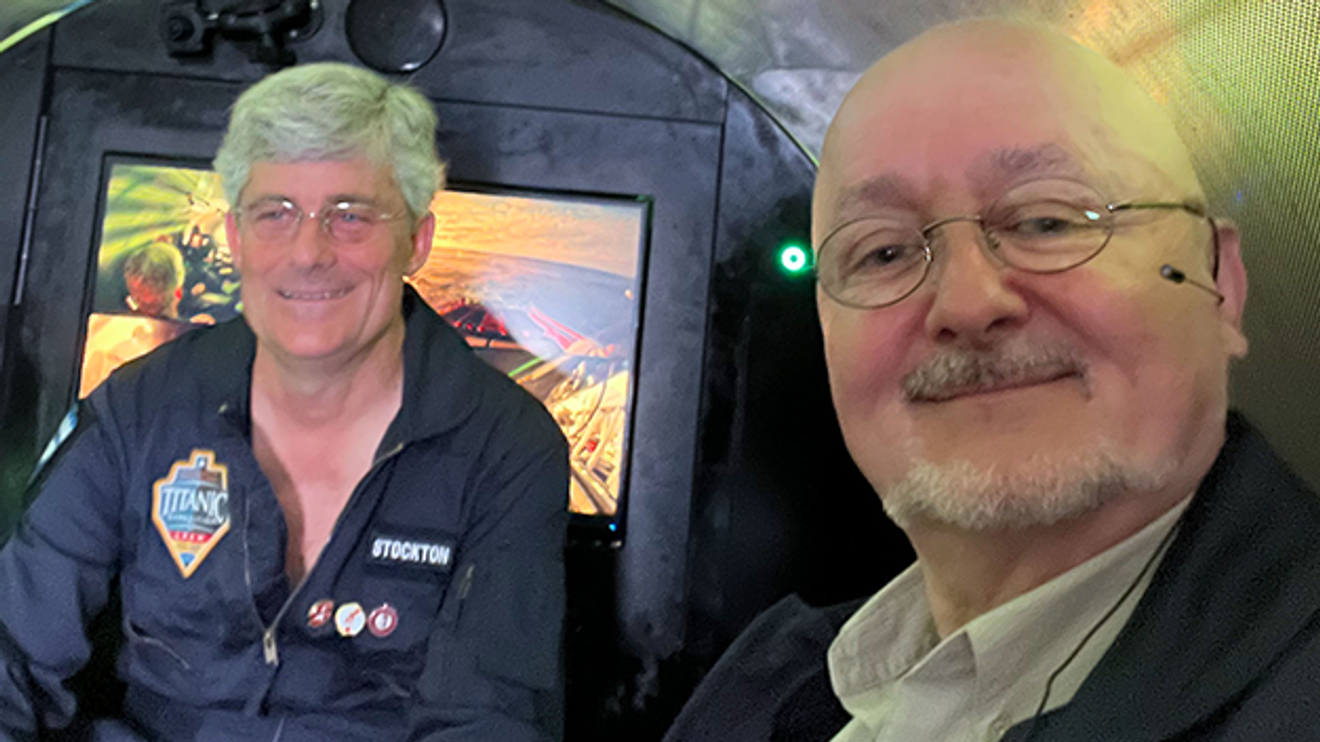
KIT researcher Axel Waibel (right) in the submarine with the founder of OceanGate, Stockton Rush. The company carries out submarine missions to the Titanic.
© Axel Waibel/KIT/dpaThe tested technique works as follows: Before the dive, Waibel and participating colleagues recorded videos and voice samples of themselves. When text messages reach the computer system, the AI converts them so that the video looks and sounds as if the person is speaking - including lip movements.
What sounds like a PR gimmick by tech-savvy scientists, especially in the context of the Titanic expedition, has a serious background: "There are enough places in the world where the bandwidth is so poor that only text transmission is possible," said Waibel. The new technology could make video communication possible one day.
However, the mission also revealed the pitfalls: one of two sonar devices failed, said Waibel. As a result, only part of the dialog could be transmitted from the submarine. He also came up with new ideas: Submarine crews, for example, work a lot with abbreviations to compress texts. Another goal is to reduce the size of the technology so that it fits in a pocket. All in all, Waibel was satisfied: "We've made a good start."

Incidentally, one of the biggest challenges in converting the texts into videos has nothing to do with language, the scientist revealed: "If the person doesn't say anything, it's surprisingly difficult." Then the lips in the videos hardly move at all.
Waibel was part of a larger mission with biologists and archaeologists, among others. Such expeditions to the Titanic take place again and again.
The researcher has been working on AI and machine learning in speech and communication technology for more than 30 years. Among other things, he developed what KIT claims to be the world's first automatic simultaneous translation service at a university. The "Lecture Translator" automatically records the speaker's lecture and simultaneously translates the speech signals into English, which is then displayed as subtitles. Students without any knowledge of German can follow the lecture via laptop, smartphone or tablet.


You might also be interested in
Google wants to make its devices even smarter with AI
Google is the number 1 in web searches and develops the most widely used smartphone OS, Android. In competition with rivals such as Apple, the company's products are set to become smarter. It recently announced a pair of glasses that display live...
 read more...
How whiskey makes artificial intelligence tangible
Artificial intelligence can do work for humans. Lübeck researchers are working on its use in medicine. And demonstrate the strengths of AI with whiskey.
read more...Electronic nose sniffs out mint scents
If you want to distinguish plants in nature, you need a lot of experience, an identification book or a good nose: in this respect, technical support could soon be available in the literal sense.
read more...The top articles in July 2024
Innovative spirit and entrepreneurial thinking characterize the most-read articles from July. Find out more about competitive advantages through AI, click through award-winning developments and read more about model-based design and quantum sensor...
read more...Robotics Institute Germany founded
Together, the leading locations for robotics in Germany will establish the Robotics Institute Germany (RIG), which is to become the central contact point for robotics in Germany in the future.
read more...Karlsruhe Institute of Technology
The EDAI project
In the EDAI project, researchers at the Karlsruhe Institute of Technology (KIT) are combining the design of AI algorithms and AI chips. EDAI is based on open source software to facilitate access to AI-based solutions, particularly for small and...
read more...Focus on the sustainable future
Under the title 'Research for a sustainable future', the Karlsruhe Institute of Technology (KIT) is showcasing exhibits and presentations at the Hannover Messe - in the Future Hub in Hall 2 and at the Energy Solutions in Hall 13.
read more...Sustainability is digital
The motto of Hannover Messe 2024 is Energizing a Sustainable Industry. With numerous research projects, the FZI Research Center for Information Technology presents the possibilities of digitalization on the way to a sustainable and more...
read more...Intelligent robots thanks to AI
Festo hosted the conclusion of the Flairop research project, which worked on making order picking robots more intelligent using distributed AI methods. The project was funded by the German Federal Ministry for Economic Affairs and Climate Protection.
read more...