
Franka Emika
From web store to robotics platform
As if the development of robots were not challenging enough in itself, the sale and management of products and the networking of partners also demand valuable resources from the manufacturers of robotic solutions. One approach taken by robot manufacturer Franka Emika.

The deep-tech company Franka Emika, headquartered in Munich, has made a name for itself with its industrial robot arm. This arm was developed with the aim of making robotics solutions more widely accessible. Companies of various industries and sizes should be able to entrust tedious, time-consuming, monotonous and potentially dangerous work to their one-armed helpers and thus automate themselves - regardless of whether it is a matter of large-scale production or customized low-volume custom scenarios for a wide variety of application scenarios.
The application is kept as simple as possible. The robot is programmed using predefined code blocks in app format. This means that even users with no programming knowledge are able to upload these blocks to the robot arm and combine them into modular task chains. The entire process takes place via a compact browser interface and can also be carried out using a smartphone. This interface is part of a system with functionality spanning various areas called 'Franka World'.
The 'Franka World' platform was initially created with the aim of automating Franka Emika's commerce processes, which were still completely manual at the time - from order acceptance to order processing and shipping. The main objective of the entire process was to minimize time to market.
Launched as a commerce platform
In the course of an initial concept, an attempt was made to merge various components - stand-alone commerce and storefront technologies, Amazon Web Services and various other external services - into an overall structure. However, this resulted in a fragmented tooling landscape that would have made additional extensions and scaling efforts highly complex - and complexity was exactly the opposite of what was wanted.
The solution for Franka Emika was to cooperate with the international e-commerce company commercetools, also headquartered in Munich. Their cloud-native headless technology - i.e. the clear focus on backend processes that can be connected to any customer-side frontend - provided the framework for the platform that Franka Emika envisioned. Here, APIs build flexible connecting bridges between the backend and frontend areas. This allows users to access services at the front end without disruptions such as time delays. It is also comparatively easy to make changes to the platform and introduce new features more quickly.
Issues relating to shopping carts, correct tax calculation or promotion integration no longer need to be processed manually. Features are modular and can be freely adapted and integrated, which makes scaling easier. This is how Franka Emika developed an initially simple commerce platform into a complex catalog and finally into a platform for partner onboarding and enablement as well as a community. By outsourcing the technical commerce processes to commercetools, the company not only saved upfront development costs, but also incremental costs for order and product management. This allowed the robot manufacturer to focus entirely on robotics.
Integration of partners in the next version
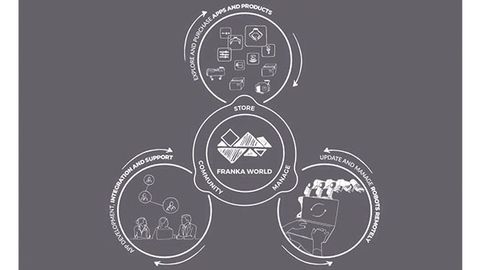
'Franka World' serves as the center of the Franka-Emika ecosystem and as a link between customers, partners, scientists and robots. It links the three sub-areas Shop, Manage and Community Hub.
© Franka EmikaThe launch of 'Franka World' as a commerce platform took place in 2017, and the next goal was to integrate the company's numerous partners. These partners primarily develop the apps for robot programming and play a key role in the sales model, as they also act as primary resellers and system integrators.
In addition to market transparency, the platform should establish the testing processes and the structured management of processing rights. In a further step, which was implemented within a year, 'Franka World' was expanded to include a management center for the remote control of entire robot fleets.
Cloud connection realized
The current version of the platform was released in 2020 with a key innovation: cloud connectivity. This important, long-term planned and prepared step enabled the existing AWS implementation. As this is based on common industry standards such as MQTT and TLS as well as open source technologies, there is strong interoperability, which is particularly crucial for IoT issues. After all, not only should Franka-Emika technologies be networked, but data from systems from a wide range of manufacturers should also be exchanged. The company offers open source interfaces for research institutions in the ROS framework, for example, which can also be integrated with various robots. The ROS Library, for example, enables the embedding of Franka-Emika robots with ROS applications. Extensions for designing 3D printable fingerprints for the robot arm and integrations with MatLab and Simulink from Mathworks are also available.
Open source world for free exchange
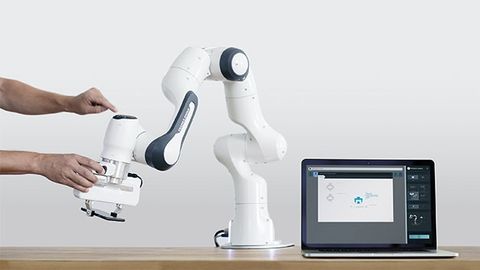
Workflow-based programming, thanks to which apps - encapsulated task packages - can be strung together like a modular system, allows complex work orders to be carried out with the robot and adapted to the situation at any time.
© Franka EmikaAs open source is of crucial importance for research, the otherwise proprietary robots can be controlled with the open source library 'libfranka'. Franka World also contains various manuals and video tutorials. The robotics platform is now home to a large user community that exchanges information and supports each other with practical experience. It is a place where research results are published, which contributes to continuous innovation and joint development.
This article was based on material from commercetools and Franka Emika.


You might also be interested in
Franka Emika is sold to Agile Robots
The insolvent Munich-based robotics start-up Franka Emika is being sold. The buyer is the German-Chinese company Agile Robots.
 read more...
Mechanics meets digitalization
The robotics industry meets at Automatica in Munich and showcases the latest trends and topics relating to the mechanical helpers. Included: megatrends such as digital transformation, artificial intelligence, sustainable production and man and...
read more...On course for growth with a new management team
The robotics company Franka Emika sets course for growth with the appointment of Dr. Alwin Mahler as CEO.
read more...Helmut Schmid takes over management
Cobot expert and DRV founder Helmut Schmid is the new Managing Director of cobot company Franka Emika.
read more...Robotics&AUTOMATION 1/2021
The latest Robotics&AUTOMATION special is here! The e-paper provides you with practical information on current trends and developments - as well as first-hand information on the extent to which robots can secure Germany as a technology location.
read more...Digital Material Selection reduces CO₂ Emissions
Using an industrial gripper as an example, Schunk and CADFEM demonstrate that simulation-based material selection can reduce CO₂ emissions from secondary materials and additive manufacturing by up to 40%.
read more..."AKIMI" Research Project develops AI for Flexible Robotics
The AKIMI research project is launching at the WZL at RWTH Aachen University. The goal is to develop agent-based AI that simplifies the programming and reconfiguration of robotic systems for small and medium-sized enterprises.
read more...Barcelona Declaration on Robotics and...
Robotics Associations Adopt Global Automation Strategy
The global robotics industry is stepping up its collaboration. The associations AER Automation, A3, IFR, and VDMA Robotics + Automation have formed a long-term alliance by signing the “Barcelona Declaration on Robotics and Automation 2026.” The...
read more...Humanoid Robotics at BMW in Spartanburg
"Physical AI" combines digital AI with real machines and robots. This allows intelligent systems, such as humanoid robots, to be integrated into real-world production processes. Following the successful deployment of the Figure 02 humanoid robot at...
read more...