
Survey
The networked employee is coming
The networking of man and machine is one of the future trends for manufacturing companies. This is the conclusion of a survey conducted by Accenture among 500 decision-makers, who want around a quarter of all research and development expenditure to flow into this area.
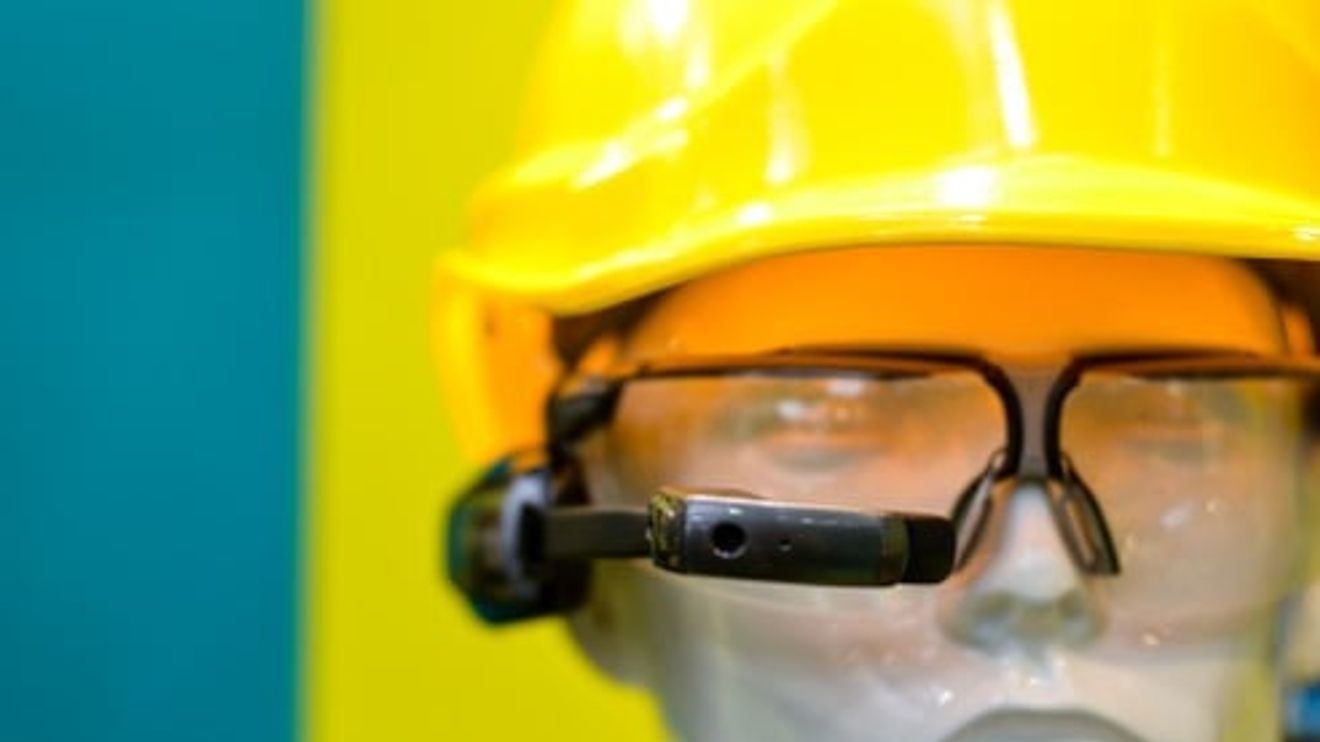
Augmented reality systems such as data glasses are also an important technology for connecting employees with the machines.
© AccentureMore than 500 decision-makers in Asia, Europe and the USA who are responsible for networking and digitalization in production at their companies took part in the "Machine dreams: Making the Most of the Connected Industrial Workforce" survey. It is intended to demonstrate the shift towards a close integration of machines, artificial intelligence and employees in the manufacturing industry. According to Accenture, a so-called 'connected industrial workforce' is emerging, which is supported in its work by a combination of mobile technologies such as wearables, security and tracking technologies and analytics.
The study shows that the networking of employees in production is already an integral part of the business strategy for the vast majority (94%) of the industrial equipment suppliers and automotive manufacturers and suppliers surveyed: Over the next five years, the companies surveyed plan to invest around a quarter of their total research and development expenditure - i.e. up to EUR 220 billion - in the networking of man and machine. This would amount to an investment sum of EUR 181 billion for companies in the automotive industry and EUR 39 billion for industrial suppliers.
Hesitation during implementation
Although the manufacturing companies surveyed see advantages in the networking of man and machine, they have so far been hesitant to implement concrete projects. For example, less than a quarter of companies (22%) have already implemented comprehensive solutions for the 'connected industrial workforce' in their own production facilities. 85% of study participants see their company as a follower or even laggard in the use of digital technologies, but not in a leading position.
One of the stumbling blocks is the technical implementation in the networking of man and machine: more than three quarters (76%) of all managers surveyed see the lack of data security as a medium or major risk. 72% of those surveyed classify the complexity and the associated risks as a medium or major risk. For seven out of ten decision-makers (70%), the lack of sufficiently qualified employees represents such a risk.
Focus on automated guided vehicles
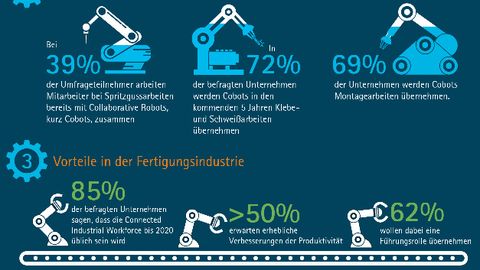
The vast majority (85%) of the companies surveyed believe that the focus in production will increasingly shift towards human-machine interaction. Driverless transport vehicles in particular - mobile robots that move materials back and forth in the factory or warehouse - play an important role here. More than half of the companies surveyed are already investing in such robot technologies. Over the next five years, companies are also planning to increase their spending on robots that work hand in hand with humans and outside of cages (collaborative robots, or cobots for short). There will also be investments in augmented reality systems such as data goggles or smart helmets, i.e. helmets equipped with mini-computers and screens.
In order to counter the security risks of the connected industrial workforce, many companies are also investing in the expansion of their existing IT infrastructure. Furthermore, 89% of all companies that, according to the study, see themselves as pioneers in the networking of man and machine have already started to specifically recruit experts with qualifications that were not previously available in the workforce.
Automotive industry as a pioneer
Of the manufacturing companies surveyed, car manufacturers and their suppliers show the greatest interest in collaborative robots, driverless transport vehicles and augmented reality devices such as data glasses or smart helmets. For a car manufacturer with an annual turnover of EUR 50 billion, the networking of man and machine could increase profitability by EUR 500 million by 2020, according to Accenture's calculations. Of this, 50 million euros will be spent on research and development, 415 million euros on production and logistics and a further 30 million euros on service and customer service.
The study also shows differences between countries: companies in the USA are planning to invest 40% of their total R&D expenditure in the development of solutions for the connected industrial workforce. Chinese companies follow in second place, allocating 23% of their R&D budget to this area. Companies in Germany and France plan to invest 20% and 19% of their R&D budgets in this area respectively. Of all the countries surveyed, Japanese companies plan to spend the least on R&D for the Connected Industrial Workforce, at just 17% of the total budget.


You might also be interested in
Your own hand as an interface
Buttons and keys become superfluous. The 'Soli' radar technology from Google ATAP and Infineon enables devices to be controlled by hand movements. Two prototypes were presented at the Google I/O developer conference in Mountain View, USA.
 read more...
Germany's role in IoT and Industry 4.0
Where does Germany stand internationally in terms of the Internet of Things (IoT) and Industry 4.0? What are the resulting forecasts? The VDE surveyed its 1,300 member companies and universities in the field of electrical engineering and information...
read more...Hans Seifert to Become Chief Sales Officer
Sigmatek has appointed Hans Seifert as Chief Sales Officer (CSO). His area of responsibility includes international sales, marketing, application engineering, and support.
read more...High Performance for the Industry of Tomorrow
With the Sinamics S220, Siemens sets new standards in performance and safety. The new multi-axis control unit CU320-3 significantly increases computing power and response speed. As part of the Siemens Xcelerator portfolio, the drive system supports...
read more...For Multi-Monitor-optimized Production Processes
R. Stahl offers two methods when companies need a solution with multiple screens: Dual Monitor or Shared Keyboard.
read more...Safe Wireless HMI for Profinet/Profisafe
The 'KeTop T150/T155 Safe Wireless' mobile handheld control units from Keba are suitable for mobile machine and robot operation.
read more...Remote front ends for Modbus
For use on Modbus systems, Display Visions offers displays from the 'EA HMI' series in four sizes from 2.8 to 10 inches.
read more...Increase added value, ensure security
The 'zenon' software platform from Copa-Data supports companies in making their production safe, efficient and future-proof, regardless of machine age, manufacturer or industry boundaries.
read more...Companies focus on Usability, but struggle with limited Resources
Nine out of ten companies in mechanical and plant engineering already take usability and user experience (UX) into account. However, according to a recent VDMA study, they often lack budgets, expertise, and management support.
read more...