
Accenture study
Growth spurt through artificial intelligence
Corporate profits will rise sharply thanks to artificial intelligence: This is the conclusion of an Accenture study. But which sectors will benefit the most?

The study highlights the enormous growth potential of artificial intelligence.
© Fotolia, monsitj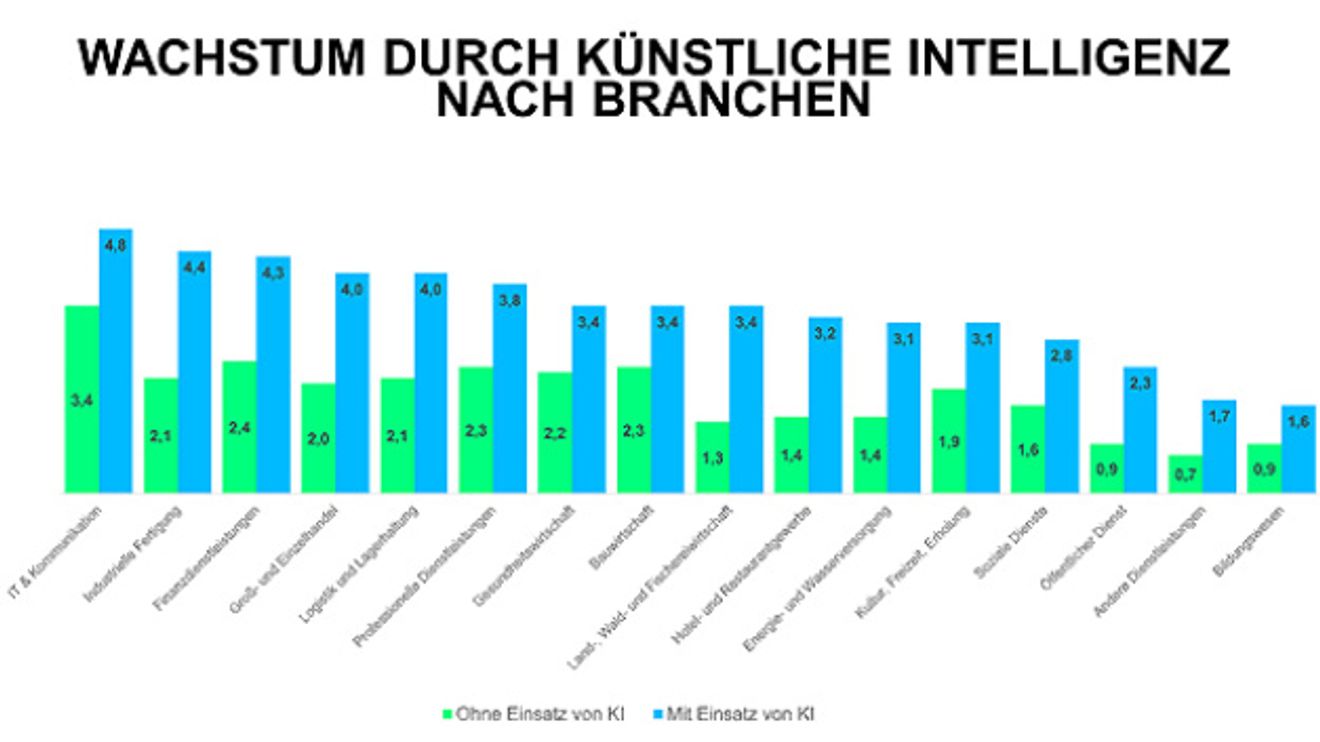
Manufacturing can benefit the second most from AI technologies in terms of gross value added, with a growth potential of 4.4% by 2035. Without the use of AI, growth of just 2.1% is forecast.
© AccentureThe consulting firm Accenture has conducted a study on the future impact of artificial intelligence (AI) on corporate profits. According to the study, additional increases of 38% on average by 2035 are possible with the successful use of artificial intelligence. Furthermore, the study forecasts a potential growth spurt of 12.5 trillion euros from AI in terms of gross value added over the same period for the 16 sectors examined in twelve industrialized countries, including Germany.
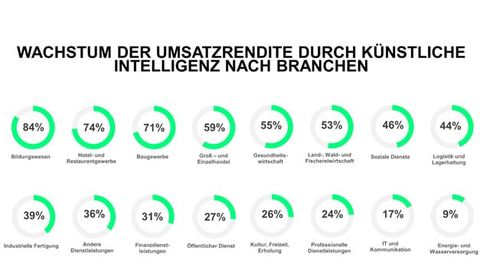
The forecast up to 2035: Corporate profits of companies in the manufacturing technology sector are expected to increase by 39%.
Which sectors will benefit?
The IT and communications sector, the manufacturing industry and the financial services sector could benefit the most from artificial intelligence compared to all other sectors examined. According to the study, their gross value added has a growth potential of 4.8%, 4.4% and 4.3% per year respectively up to 2035. This means that these three economic sectors alone could generate additional gross value added totaling 5.38 trillion euros in the aforementioned period.
Even in employment-intensive sectors such as education and social services, where productivity growth is traditionally low, the use of AI technologies could generate an additional EUR 98 billion and EUR 194 billion respectively by 2035.
The targeted analysis of future company earnings by sector shows the diverse areas of application for artificial intelligence: In employment-intensive sectors such as wholesale and retail, AI complements the skills of employees. Profits here could increase by almost 60 % through more efficient use of the workforce alone. This requires continuous upskilling in the workplace, for example by developing skills in dealing with intelligent machines. Significant increases in efficiency are also possible in capital-intensive sectors such as production: thanks to predictive maintenance of machines and better plant utilization through AI, profits could increase by 39% by 2035, according to the forecast.


You might also be interested in
Study on artificial intelligence
More jobs and rising sales
The consulting firm Capgemini has surveyed companies worldwide on the topic of artificial intelligence. The results clearly show that both companies and their employees benefit from the technology - but it is often still being used incorrectly.
 read more...
Artificial intelligence in USB format
Intel presents a USB stick that accelerates deep learning algorithms with the help of a VLIW processor. It processes the data locally in real time and is therefore particularly suitable for systems without a connection to the cloud.
read more...Artificial intelligence for edge devices
Researchers at Microsoft Research Labs are currently developing machine learning services for microcomputers such as Raspberry Pi or Arduino. The aim is to make artificial intelligence usable for edge devices. An initial prototype of the software is...
read more...Hannover Messe 2017 / Industry 4.0
"The time for field trials is over"
The really exciting topic at this year's Hannover Messe is not so much new technologies, says Eric Schaeffer, industry expert at Accenture. In this interview, he explains what he will be paying particular attention to in Hanover.
read more...The projects in the Industry Lab
IBM opened the Watson IoT Center in Munich on February 16, 2017. Computer&AUTOMATION was able to take a look inside the Industry Lab, where IBM is working with partner companies on a wide range of Watson projects.
read more...Watson technology for Mindsphere
Siemens and IBM plan to integrate Watson technology into the Mindsphere platform. The aim is to further simplify the use of data analysis functions for customers.
read more...The networked employee is coming
The networking of man and machine is one of the future trends for manufacturing companies. This is the conclusion of a survey conducted by Accenture among 500 decision-makers, who want around a quarter of all research and development expenditure to...
read more...The factory that thinks for itself
IBM wants to drive Industry 4.0 forward with Watson IoT. Melanie Schauber, Head of the Watson IoT business unit at IBM for the DACH region, explains what is behind the technology and what role it will play in production.
read more...Edge AI HPCs for Vision AI and GenAI
Advantech has announced the 'AIR-410' and 'AIR-420', next-generation compact Edge AI high performance computers (HPCs). Combining AMD Ryzen 7000/8000/9000 series processors, scalable GPU support and Advantech's 'Edge AI SDK' software, the systems...
read more...