
Infineon
Augmented reality for smartphones
Google's Tango technology gives devices spatial perception. Lenovo has now unveiled the first smartphone with a 3D image sensor chip from Infineon.
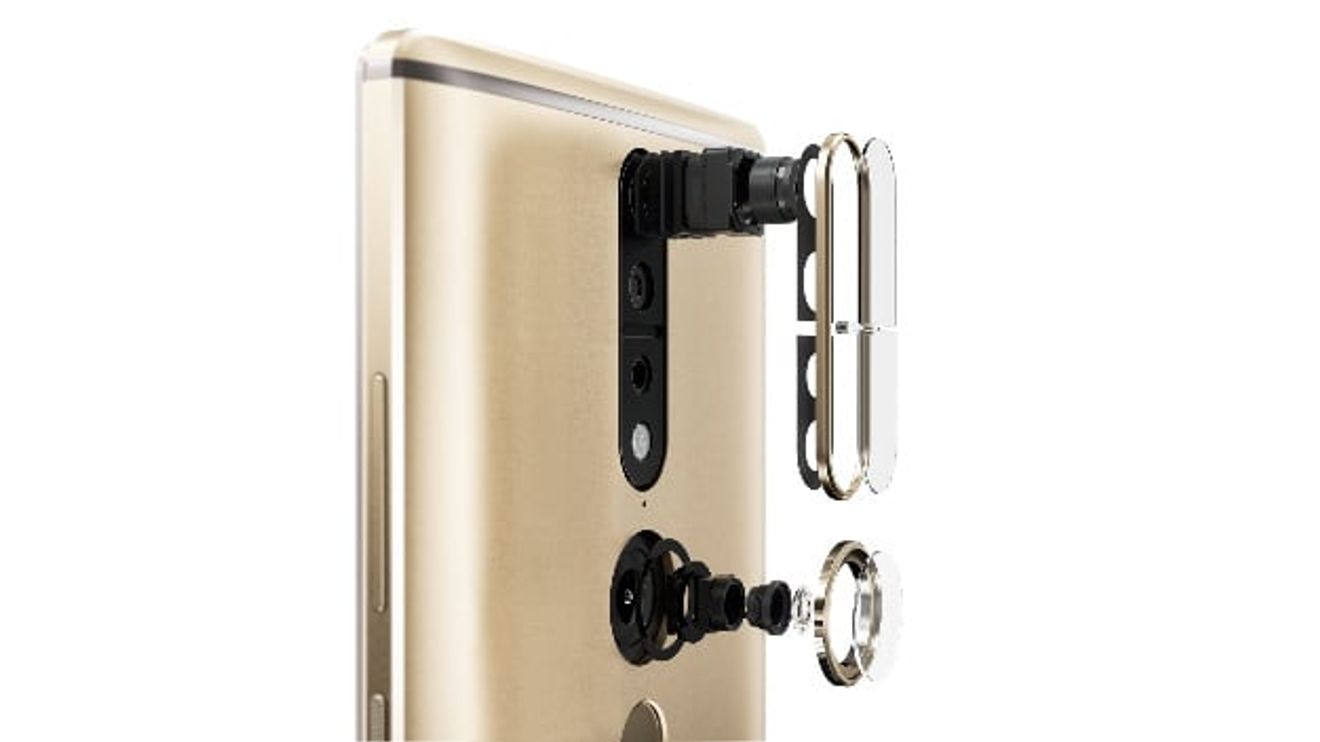
According toInfineon, it is the only supplier worldwide to provide the image sensor chip in accordance with Google's requirements. Based on the time-of-flight principle, the 3D image sensor chip "Real3" enables a three-dimensional image of the surroundings in real time.
"With the Tango-enabled 'Phab2 Pro', we are entering a whole new era of mobile applications," said Hua Zhang, Vice President, Lenovo Android/Chrome Computing Business Group. "Infineon's Real3 image sensor chip is a core component for Lenovo's Phab2 Pro." Thanks to its capabilities, the smartphone enables direct access to augmented reality: it reacts to changes in position through motion tracking, depth perception measures the distance of objects and spatial learning allows the device to recognize locations once they have been detected, the statement continues.
"The ability of devices to see in three dimensions will lead to a multitude of new applications for end consumers and in the automotive industry," adds Jochen Hanebeck, President of the Automotive Division at Infineon. "Depth perception and motion tracking, as used by Tango devices today, can also be used for driver monitoring or gesture recognition in vehicles."
The functional principle of Time-of-Flight
The image sensor chip comes from Graz in Austria. This is where Infineon develops semiconductor solutions for analog and digital signal processing with high data rates. The image sensor chip combines pixel matrix, control circuit, ADCs and the digital high-speed interface on a single chip. It was developed together with Pmdtechnologies, a leading provider of time-of-flight technology.
How it works: The detection of the environment is based on infrared light. For each pixel, the 3D image sensor chip measures the time it takes for the emitted light to travel from the camera to the object and back again. In addition, each pixel records the brightness values of the object. Compared to other methods, Pmdtechnologies' ToF technology offers the best spatial resolution and maximum robustness - both mechanically and with regard to background light, Infineon explains the collaboration. The Cloud: Nevertheless, it has the lowest power consumption and the smallest dimensions.
At the Google developer conference "Google I/O", Infineon's involvement in the Soli project already attracted attention: Google and Infineon had developed a sensor chip that enables gesture recognition. The Soli project uses 60 GHz microwaves, while Tango is based on the transmission and reception of infrared light signals. This sets it apart from conventional 3D imaging methods. These either use a stereo camera, which requires a minimum distance for triangle measurement and higher computational effort. Or they generate 3D images with structured light - but at the expense of a lower object resolution and higher material costs.


You might also be interested in
View through the clouds
Rescue helicopter missions are almost impossible and dangerous in bad weather. Augmented reality could help the pilots. A new helmet vision device from TUM enables them to see obstacles at an early stage, even in extremely poor visibility.
 read more...
The networked employee is coming
The networking of man and machine is one of the future trends for manufacturing companies. This is the conclusion of a survey conducted by Accenture among 500 decision-makers, who want around a quarter of all research and development expenditure to...
read more...'VisiWin' jetzt auch für Datenbrillen
Inosoft setzt auf Augmented Reality: Die Version 7.1 der Prozessvisualisierungs-Software 'VisiWin' eignet sich nicht nur für herkömmliche Mobilgeräte wie Smartphones oder Tablets, sondern auch für Virtual-Reality-Brillen. Auf der SPS IPC Drives...
read more...Augmented-Reality wird real
Was schon vor Jahren angekündigt wurde findet nun Einzug in Standard-Softwareprodukte. Iconics hat in seine neuen Version der 'MobileHMI'-App eine Augmented-Reality-Lösung integriert.
read more...Die Neuheiten auf dem Developer Forum 2016
Intels CEO Brian Krzanich stellte beim Intel Developer Forum in San Francisco eine Reihe technologischer Innovationen vor. Darunter Neuerungen im Bereich Wearables sowie Speicher-Lösungen auf Basis der 3D XPoint-Technologie.
read more...The steep rise and sudden fall of the IBM PC
40 years ago, IBM launched a new era in the history of technology with its first personal computer. The IBM PC 5150 was neither the first nor the best computer. But no other computer had as much influence on the industry as the first IBM PC.
read more...WEKA Ad Award 2019
They came, saw and won: the winners of the WEKA Ad Award 2019. The winners were announced in the cool ambience of the old congress bar in Munich.
read more...Search terms as a mirror of the recent past
Sometimes it's "schüler vz", sometimes "coronavirus": the trends among Google searches show very clearly which topics Germans have shown particular interest in over the years.
read more...