
Siemens
The Glass@Service project
A consortium of six companies and institutions led by Siemens has spent the last three years researching augmented reality (AR) in industry. - The results of the Glass@Service project.
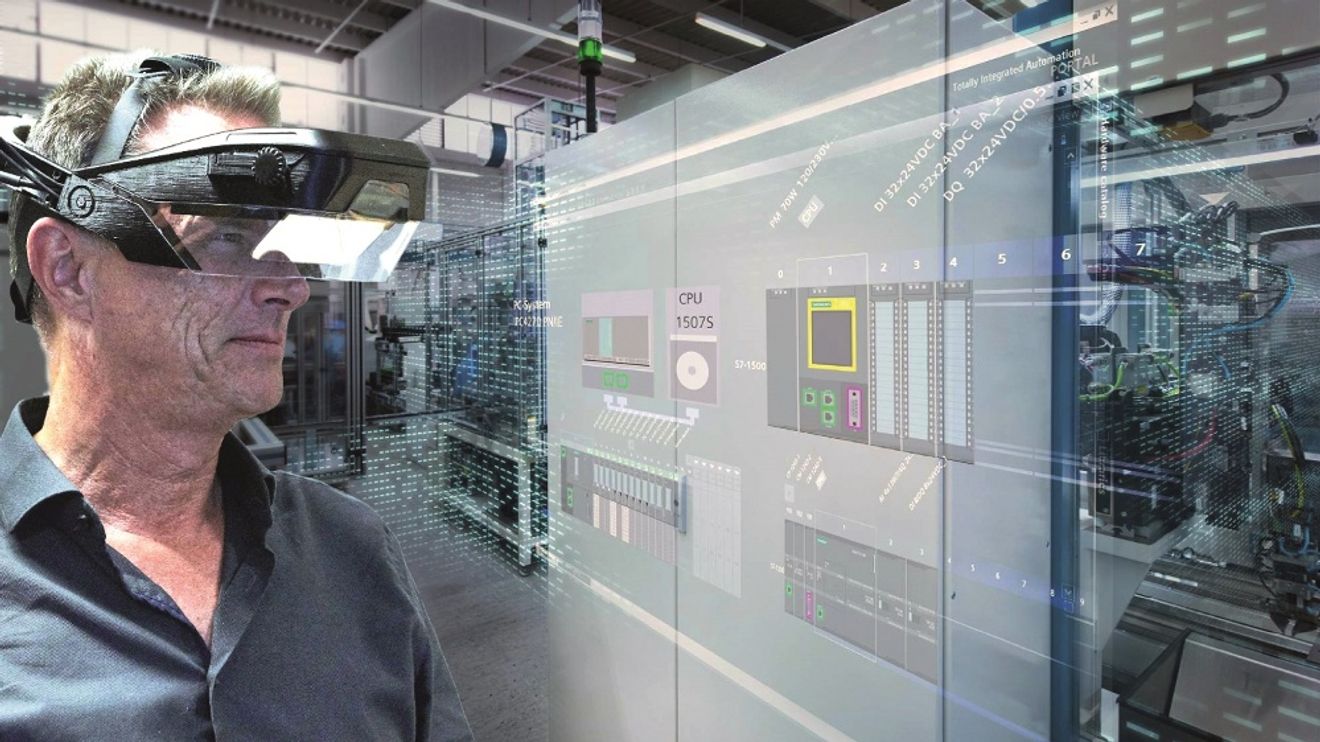
Digitalization is increasingly penetrating manufacturing. However, in some areas - especially when retooling machines and picking orders - employees often still work with printed lists, print labels in stock to identify materials and then laboriously record all the data in the ERP system. For this reason, the extent to which AR could be used in these areas has been under investigation for several years. However, the technological components required for this, such as micro-displays, controller electronics, 3D cameras and sensors, are only now mature enough to be combined into a new type of human-machine interaction and integrated into the IT landscape of a factory.
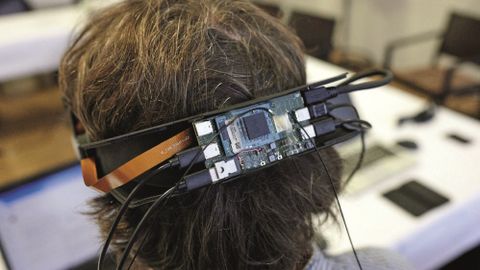
Against this backdrop, the partners in the Glass@Service project have set themselves a common goal: To use smart data glasses as personalized information systems by combining them with novel interaction options such as eye and gesture control as well as innovative IT services. During the three-year project, there were two main work streams - on the one hand, the software integration into the company's IT systems and, on the other, the development of a corresponding prototype demonstrator.
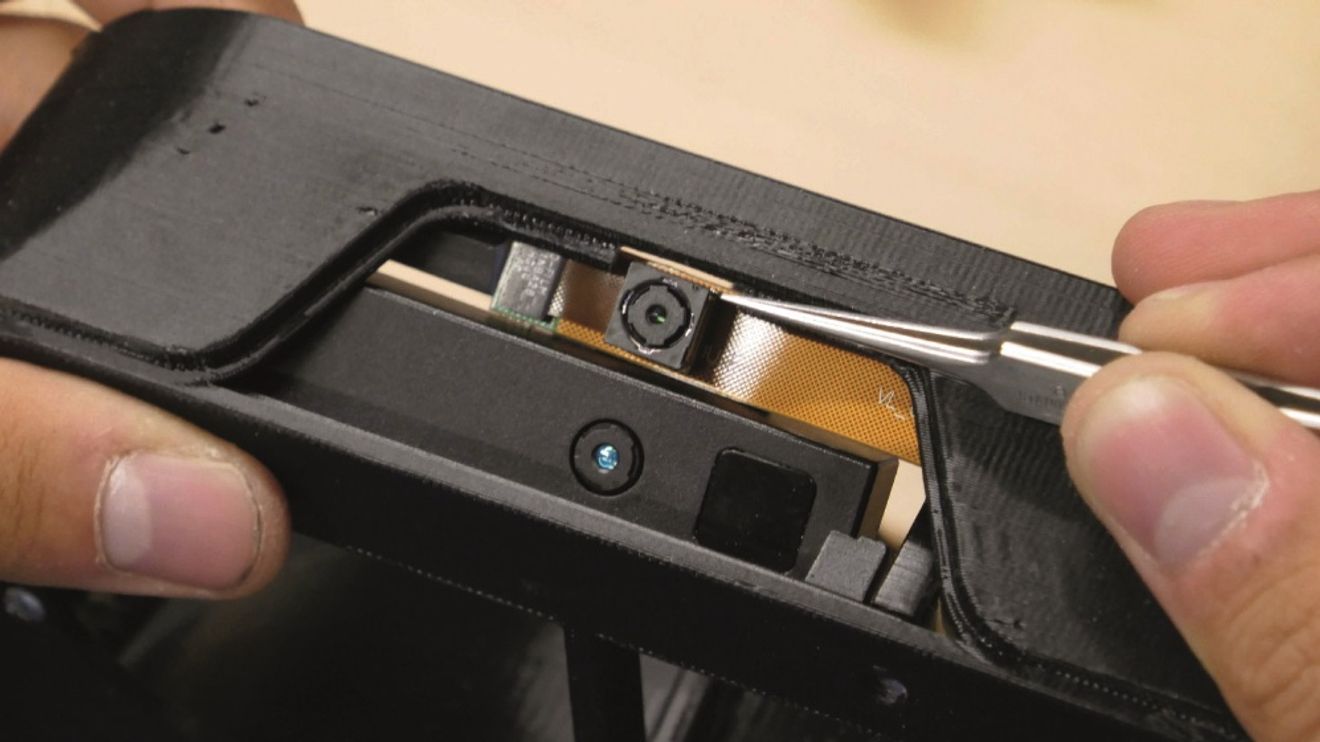
For use in an industrial environment, the data glasses had to be designed for specific requirements. To this end, a comprehensive requirements analysis was first carried out for the scenarios. Aspects such as robustness, use by trained technicians (but not experts) and reliable operation over a period of more than eight hours within a shift were mentioned here as examples. Furthermore, factors such as weight, temperature development, balance, field of vision shielding, eye tracking, etc. also played a role in this context. Although data glasses already existed and still exist on the market, particularly in the consumer sector, they were not suitable for industrial applications. As already mentioned, the reasons range from unsuitable ergonomics, short runtimes and insufficient viewing angles to issues of data protection and data security.
Keyword IT security: Within the project, a concept was developed for integrating the data glasses and their sensors into the local process IT, taking into account the local information security guidelines. In this context, the keywords user acceptance and personal rights must also be taken into account. After all, AR and wearables must not be used to document work performance. For this reason, the entire project was actively supported by the Federal Institute for Occupational Safety and Health, which also prepared an expert opinion on data protection. The works council at Siemens, for example, was also informed about the project from the outset and is closely involved in the evaluation of the initial results.
The various use cases
Three specific 'use cases' were ultimately selected for the implementation of the project:
1. order picking in the central warehouse at the Siemens Manufacturing site in Fürth
The use of smart glasses can increase efficiency, particularly in warehouse management. In this specific use case, the focus was on enhanced support for material retrieval. The employees were guided through the picking sequence, supported by information that was displayed directly in the AR glasses or on other mobile devices. This includes, among other things, moving to the correct storage location, removing materials, transferring/acknowledging to subsequent processes and printing labels and tracer labels using a mobile printer. The use of AR glasses in combination with other mobile devices (smart watches, mobile handheld scanners and mobile printers) significantly shortens the throughput times for a wide variety of picking processes, while at the same time increasing efficiency and quality.

Use cases 'Logistics': The employee scans the delivery bill, prints a barcode on the component reel and 'links' it to the delivery note data; all relevant traceability data is then recorded when the component reel is set up at the pick and place machine.
© Siemens2. setting up SMD placement machines at the Siemens electronics plant in Amberg
The employee who is responsible for the continuous work process on an SMD line is currently informed on a monitor about any activities that need to be carried out. This means that the employee has to keep an eye on the monitor at all times. However, this is not possible at times when he is setting up or procuring new material on the line, for example. Here, data goggles that constantly display the latest information in the employee's field of vision can make work much easier and significantly reduce the risk of line downtime.
When detailing the solution requirements for the 'set-up' use case, it was recognized that it would not make sense from an ergonomic point of view to implement the entire set-up process with data glasses. The use case was therefore implemented with a suitable mix of wearables: a smartwatch to notify workers of upcoming refill orders and AR glasses to support the actual set-up process.
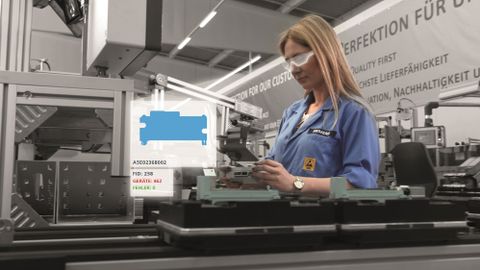
Use cases 'Testing': The employee receives the assembly and testing instructions in the smart glasses and can virtually operate the assembly and testing processes hands-free.
© Siemens3. teach mode device visual inspection
This is probably the most demanding of the three use cases examined. Recognizing the position of the test part is very demanding and computationally intensive. During the visual inspection, the employee must compare a component in front of them with a target specification. Until now, the employee has been trained either in person or interactively using computer programs before the inspection. During the inspection, the operator's gaze and attention must constantly switch between the component in front of him and the visual inspection plan. This is tiring and error-prone. The idea behind the support provided by smart glasses is to replace the time-consuming training with interactive work with the smart glasses on the one hand and to facilitate the quality inspection through targeted overlays in the employee's field of vision on the other.
They can be controlled by the blink of an eye or by tracking the user's line of vision using an eye-tracking system integrated into the glasses. The user can then, for example, acknowledge the test step after a 'positive' or 'negative' test by a gesture or blink. A data sheet could also be scrolled or virtual buttons activated by consciously controlling the direction of gaze, for example.


You might also be interested in
Augmented reality for the "little man"
Augmented reality can be used to optimize products and processes, but its use requires a high level of expert knowledge. The AcRoSS research project proposes a platform concept that also enables smaller companies to use AR applications for...
 read more...
Wearables in the industry
Trend topics such as big data, AI and IoT are currently much discussed in companies. They are intended to optimize work processes and ensure greater flexibility. Assisted reality (AR) and virtual reality (VR) play a central role in this context.
read more...Platform-independent remote access
Usually, the control of processes with a PLC runs fully automatically after the initial parameterization. In some applications, however, it is necessary for the operator or technician to be able to call up and set the process data at any time.
read more...Siemens and UL Solutions digitize certification process
For the first time, an industrial product was certified for the USA after some of the required tests were digitally simulated and the results confirmed by physical tests. This was made possible with the help of the digital twin.
read more...Strong finish to the 2023 financial year
According to Siemens, revenue and order intake increased by 10% and 6% respectively on a comparable basis in the fourth quarter of 2023. In the Industrial Business, Siemens recorded its highest earnings and profitability figures ever.
read more...Security test suite for industrial networks
Siemens has expanded its industrial cybersecurity portfolio by launching an all-in-one security test suite for industrial communication networks.
read more...Innomotics launches as a Siemens subsidiary
Siemens is bundling its range of motor and large drive systems under the name Innomotics. The company was launched in Germany on July 1, 2023 as a wholly owned Siemens subsidiary.
read more...Cooperation expanded
Prostep and Siemens Digital Industries Software have expanded their collaboration: Now the Siemens software Polarion ALM and Teamcenter Manufacturing from the Siemens Xcelerator portfolio can also be connected to Prostep's OpenPDM integration...
read more...Plus 27 % in industrial business
Siemens has continued its strong growth momentum with comparable order growth of 20% since the beginning of the fiscal year, as CEO Roland Busch explained on the occasion of the publication of Siemens' quarterly figures. The figures in detail.
read more...