
Lone worker protection
Safe working in isolated locations
The following should apply in every industrial company: The safety of employees comes first! Lone worker protection concepts can now be implemented cost-effectively and efficiently using a smartphone or tablet.
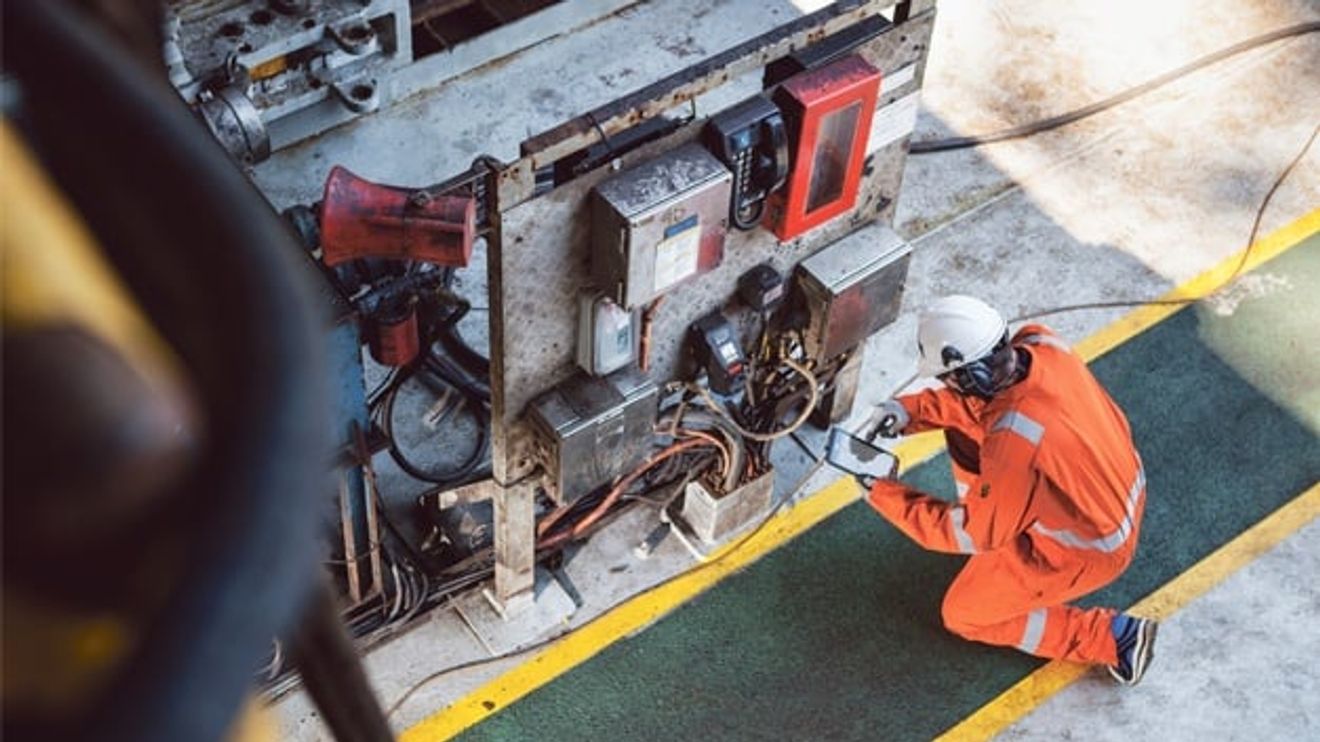
Companies must ensure the safety and protection of their employees or contractors for lone workers, i.e. employees who carry out their work in places out of earshot and sight of other people. This is particularly challenging in industries with extensive factory premises or potentially explosive atmospheres. These employees are exposed to higher risks and are dependent on rapid assistance in the event of an emergency. A personal emergency signal system is recommended if there is an increased risk or is even mandatory if the risk is critical. Deficiencies in 'safety at work' can lead to injuries, accidents and consequential damage to people and equipment.
With intrinsically safe 4G/LTE Android smartphones, tablets and ex-mobile phones certified up to Zone 1/21, Ecom is now merging modern communication solutions with personal emergency signal devices. In conjunction with professional partner applications, the company offers a practical and secure mobile solution. This makes lone working more attractive for employees - and where two people were previously necessary for safety reasons, one is now sufficient.
The rescue chain must be guaranteed
When people are working in hazardous areas or on extensive sites, companies must ensure that the rescue chain is always guaranteed. It must also be triggered if the injured person is incapacitated and no one has witnessed the accident. Ecom smartphones and featurephones are the components of a lone worker protection solution tested and certified in accordance with BGR-139 or a personal emergency signaling system from Swissphone. They are equipped with dedicated side buttons for one-touch access to PTT services such as the yellow PTT button and the red emergency call button.
In conjunction with the lone worker protection software 'SOS Mobile' - Lone Worker Protection from Swissphone Wireless AG and other well-known applications on the market - the mobile solutions reliably protect and document users. In an emergency, the smartphone or tablet sends an emergency signal to the control center by pressing a button (intentional personal emergency call) or automatically by triggering the position or impact sensor (intentional personal emergency call). Automatic call set-up in the event of a triggered alarm is one of the standardized procedures for checking the employee's constitution. This ensures that an accident is always reported immediately, the injured employee is found quickly and assistance measures can be initiated.
With BLE beacons specially developed for hazardous areas, employees can even be located indoors or warned in the event of a source of danger. This is because it is difficult to locate people indoors using GPS - an alternative technology is required: Bluetooth beacons have a range of 10 to 30 meters indoors. This makes it possible to pinpoint the location of a specific person very quickly. How many beacons are needed depends on the area of the room and the desired accuracy of the location to be achieved. Even three-dimensional localization is possible with Bluetooth beacons. This means that the floor on which a person or object is located can also be specified and passed on to the central navigation system of the control center. The combination of such solutions and the triggered rescue chain thus ensures a comprehensive safety system for all employees and provides rescue workers with crucial information for navigation and positioning.
Automatic emergency call
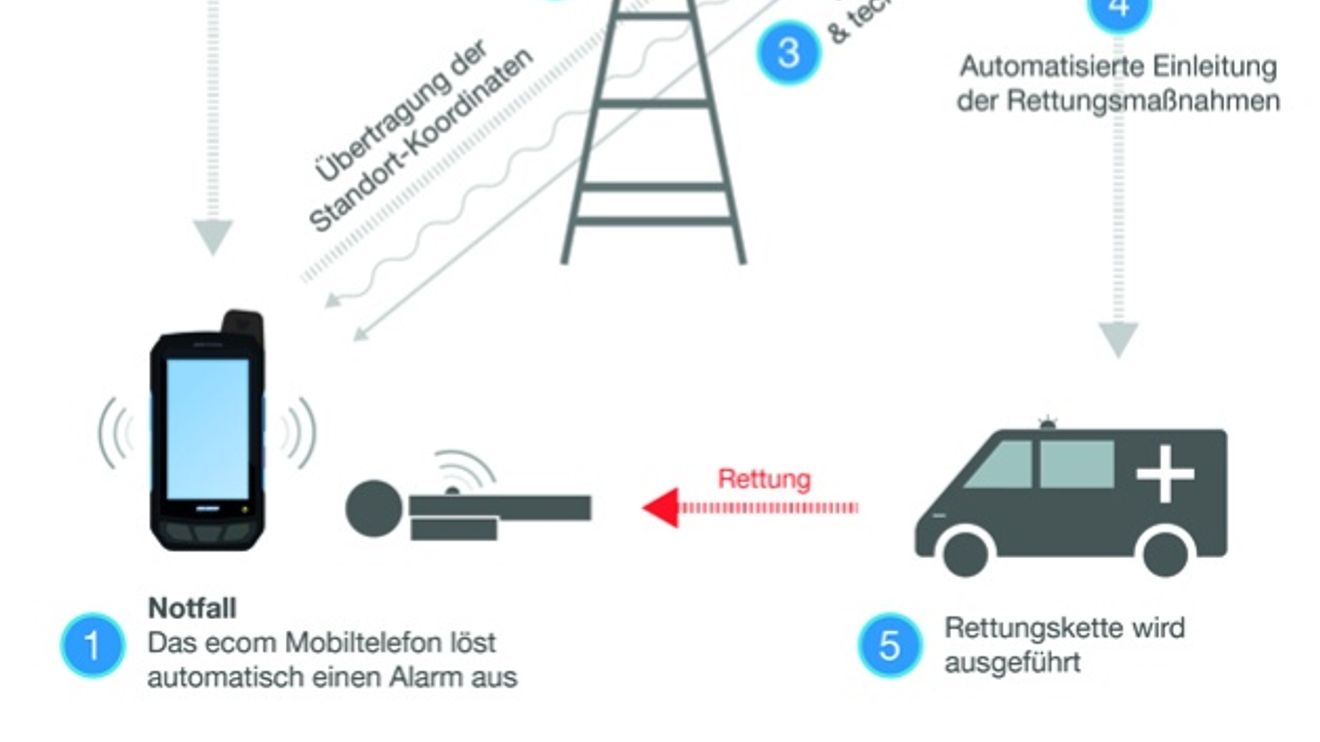
If employees are equipped with mobile devices and have a corresponding lone worker protection application installed on their smartphone or tablet, programmable 3D motion sensors for tilt, impact and escape alarms as well as motionlessness in the event of an accident or hazardous situation trigger the correspondingly selected alarm modes for an automatic personal emergency call. The 'Smart-Ex 01' smartphone, the 'Tab-Ex 01' tablet or the Ex cell phone with LWP then automatically makes an emergency call. The emergency call can be made to up to five different recipients and any type of telephone. At the same time, a voice connection is automatically established to a defined emergency call recipient telephone. This makes it possible to determine whether the injured employee is still responsive or the nature of the injuries. A text message contains the GPS coordinates so that the emergency call receiver can independently initiate the rescue chain and coordinate further measures to recover the employee.
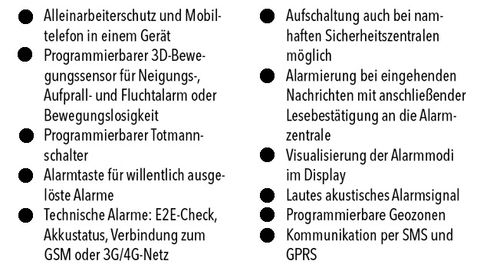
A comprehensive lone worker protection system consists of personal emergency signal terminals PNG (cell phone, radio), personal emergency signal system PNS (software on server) and a connection between the PNS and PNG (telephone or radio network). For lone worker protection solutions, it is therefore important that mobile devices can be easily integrated into cloud server systems. The 'System Mode', the combination of end device and server-based software, provides additional functions to the basic function of a call to a control center, such as documentation of alarms, display of sensors active in the event of an alarm, geo-zone overview, logged-in employees and coupling with push-to-talk systems, which are implemented via a server. The user is given access to a cloud system that they can connect to via a PC workstation. A smartphone, tablet or featurephone in turn automatically sends an alarm to an internal control center or an external security service. In addition to the transmission of coordinates, the accident location is visualized on a separate terrain map. This makes it immediately clear where the employee is located. In system mode, the processing (organization and coordination) of the emergency call is ensured and documented.
Save costs
Industrial companies are under constant pressure to increase operational efficiency and employee productivity without having to compromise on safety. Mobile communication solutions as components of a personal emergency signal system also meet business requirements: many tasks can be carried out by a single person, as there is no need for another person to provide security. This results in high cost savings and an ROI after just a few months.
Equipping employees in the field with mobile devices also has many other advantages. Mobile workers and employers know that they can rely on a safe lone worker protection solution that is precisely tailored to the requirements of the industry and ensures rapid rescue in all cases. The documentation of the entire rescue chain makes the process evaluable and thus provides an effective basis for the optimization of alarm processes, but also for legal certainty. In addition to the constant availability and accessibility of the mobile devices themselves, information can also be exchanged at any time, regardless of location. Users also benefit from all components of mobile solutions such as cameras, barcode scanners and large, interlinked software solutions for greater efficiency and productivity. For example, warnings and tasks can be distributed to employees in a targeted manner. The Ecom app library offers a large selection of professional software partner applications for industrial use that have been tested by application engineers.
Author:
Dietmar Deppisch is an application engineer at Ecom Instruments.


You might also be interested in
Safety first
The development of cobots into a commodity product is closely linked to the issue of safety in robotics - a challenge that needs to be mastered efficiently.
 read more...
Locking with need for clarification - help with risk assessment
DIN EN ISO 1419 has already been available for five years. However, there are always uncertainties regarding the actual safety functions of a guard locking device, which the machine manufacturer must evaluate based on his risk assessment. Here is...
read more...Safe operation via radio - (how) does it work?
Many machine builders want to use tablets in addition to the existing machine operation. Demanded features such as WLAN, camera, multi-touch and much more are available here - but if safety functions are required, these devices reach their limits.
read more...Heavy-duty HRC requires new safety approaches
The topic of HRC is not just for 'lightweights'. In the field of heavy-duty robotics, solutions will also be in demand in the future that allow humans and robots to work together directly without the need for a safety fence. However, this requires...
read more...Secure hold in the slip ring
Transmitting safety-relevant data via slip rings is no trivial matter. Motion control experts from Kollmorgen have developed a TÜV-certified safety solution, including UL approval, together with slip ring manufacturer Stemmann-Technik.
read more...Validation neglected
EN ISO 13849 is decisive for the integration of safety-related control functions in machines. However, the part of the standard relating to validation is often neglected in practice - a major shortcoming.
read more...Dangerous movements well secured
How can dangerous movements be safeguarded? A challenge for the user, as there are a wide variety of functional and normative requirements. An overview.
read more...The intelligent safety switch
Safety modules and safety switches that communicate at I4.0 level simplify troubleshooting. However, the communication capability also has interesting potential for predictive maintenance and tamper protection.
read more...The vampire effect of quantification
There are always controversial discussions regarding the determination of risks for products and systems. But which approaches actually make sense in the context of safety and security? What approach does the new framework for safety and security -...
read more...