
Carlo Gavazzi
Precise control of infrared heaters
In order to support manufacturing companies that use industrial heating applications in their orientation towards Industry 4.0, systems that can precisely switch these special heating loads and also take over the complete monitoring of the load circuit are helpful.
Infrared heaters enable the use of heating for machining and processing in manufacturing: In the glass industry, infrared heaters are used to shape glass, in medical technology for sterilization processes and in semiconductor production systems for sintering processes. Other areas of application can be found in the automotive industry for adhesive and paint drying processes (coating) and in the packaging industry in shrink tunnel systems. Infrared emitters supplement or replace the range of conventional processing options and support the development of new materials and processing methods. They are more energy-efficient than other heating technologies, as infrared rays reach the objects to be heated directly and can be directed specifically at the areas to be processed.
Monitoring and controlling heaters
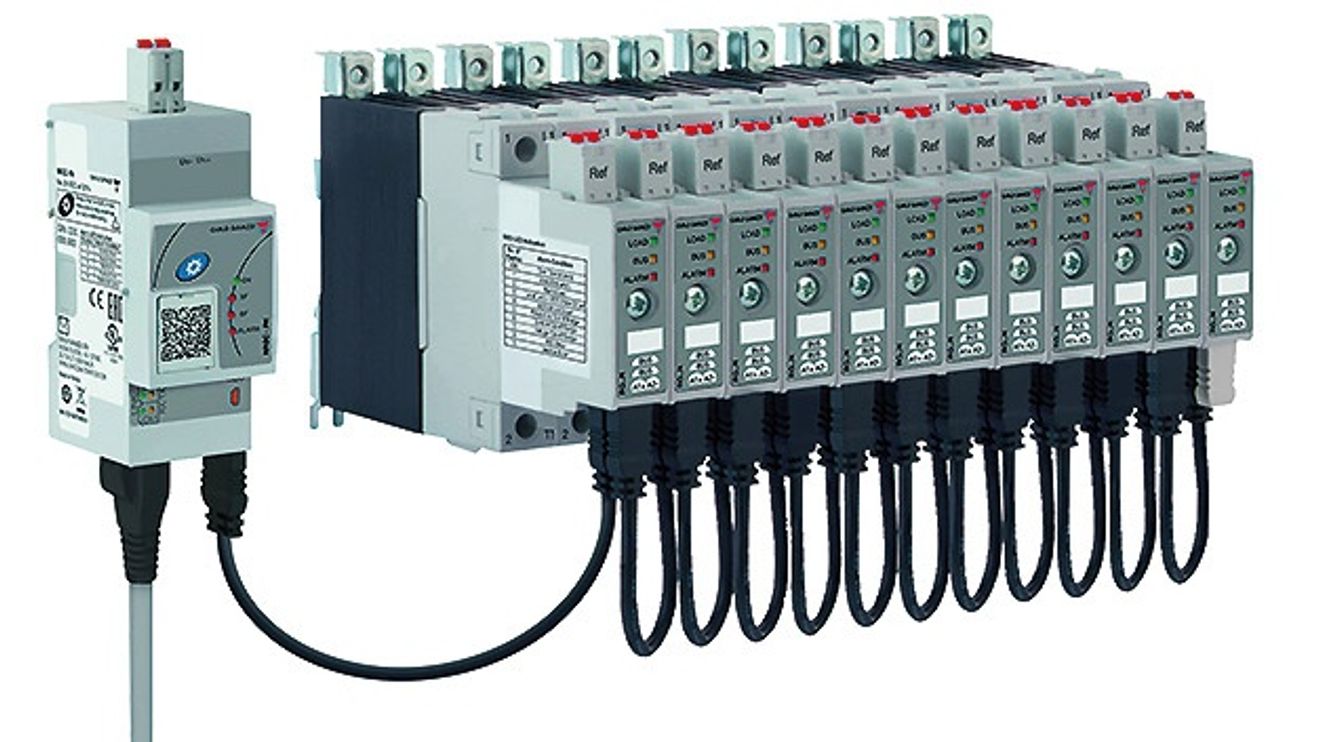
The NRG system consists of a control unit and several solid state relays. The control unit acts as a gateway for a subsystem with a maximum of 32 solid-state relays and as a master via which each individual solid-state relay in the chain can be controlled and switched on or off via the internal bus.
© Carlo GavazziMalfunctions or failures in the heaters usually only become apparent when the produced part does not meet the quality specifications. Reliable, precise and reproducible temperature control is therefore crucial for avoiding rejects. However, setting up a closed control loop that permanently monitors the function of the IR heaters is often difficult or costly. Carlo Gavazzi has developed the NRG system to reduce failures due to errors and malfunctions. It consists of a control unit and up to 32 solid-state relays that communicate via an internal RS485 bus. Proprietary internal bus cables with communication, supply and auto-configuration lines connect the control unit to the first and this to the other solid state relays in the bus chain; a terminating resistor is connected to the last connection.
Predictive maintenance and remote maintenance
The system enables preventive and planned maintenance through complete monitoring, thus preventing unplanned production downtimes. As impending faults can be identified at an early stage, an overhaul of the system or machine can be planned. For example, users can detect changes in the internal resistance of heating elements and thus their ageing. When set limit values are reached, a message is generated so that heating elements can be replaced before they fail. In conjunction with the PLC (or the IPC), remote maintenance is also possible, as all measurement data is transmitted to the PLC. The remote maintenance option enables on-site operators to receive remote support from the system or machine manufacturer.
Control unit and solid state relay

The control unit with a width of 35 mm is equipped with two RJ45 ports for the PLC-side interface, an RCRGN cable connection for the internal bus and a 24 VDC supply connection. LEDs indicate the device status: the supply voltage to the control unit and errors in the communication connections.
© Carlo GavazziThe NRG control unit acts as a gateway for Ethernet, Modbus, Profinet or Ethercat communication and enables data exchange with the PLC or IPC for the switching processes as well as for the transmission of monitoring and diagnostic information. Current, voltage, frequency, power and energy consumption of the load are monitored. Diagnostic data for the solid state relays and the switched load includes information on mains loss, load loss, load deviation and overtemperature, a short circuit in the load circuit of the solid state relay and its status outside the set limit values. In addition, the number of switching operations, the operating time and the power consumption are recorded for each switching device. This allows the operating hours and power consumption of the switched heating to be recorded precisely.
The solid-state relays are a series of five different 1-pole devices. They are implemented using auto-configuration, which allows them to be set up quickly during initial integration or replacement and prevents incorrect settings. Incorrect configuration is ruled out. LEDs on the front of the modules indicate the status of the switched load, communication and alarm. The type of alarm can be identified via the flashing sequence, simplifying troubleshooting.
The solid state relays provide the data of the monitored process variables. Each individual solid-state relay in the chain can be controlled directly from the PLC/IPC, switched on or off synchronously with the mains at voltage zero crossing or precisely controlled via phase control with a resolution in 1% steps. In addition, automatic mains voltage compensation keeps the output power supplied to the load stable by adapting the control stage to the voltage fluctuations. Compensation is proportional to the setpoint specified by the main heating control system. An algorithm calculates the compensation factor on the basis of a reference voltage set by the user. A soft start function, which can be programmed either as a start-up time or with an adjustable maximum current limit, limits the very high inrush current when the cold infrared heaters are switched on.
Operating modes for power control
In addition to direct control, users can choose between pulse packet, full-wave and extended full-wave control operating modes, which can be used to specify defined control variables for each solid-state relay and therefore each heating channel in the system. The different modes reduce the load on the PLC/IPC and reduce the communication effort via the fieldbus.

With pulse packet control, the time base can be set in a range from 0.1 to 10 s. The control value determines the percentage of the switch-on time. With a control value of 10 %, the output is switched on for 10 % of the time base and switched off for 90 %.
Control in full-wave control is based on a control value of 0 to 100 % in 1-% steps and a fixed time base of 100 full waves (2 s at 50 Hz). This switching function distributes the switch-on cycles of the full waves as evenly as possible over the time base.
The extended full-wave control works according to the same principle as the full-wave control, but distributes half-waves evenly so that a positive half-wave is always followed by a negative one. This prevents a DC load on the supply. Its advantage over pulse packet control is that it places less strain on the heaters, as the power supply is more even and, as a result, the temperature changes are smaller.
Another operating mode is phase angle control in 1% steps.


You might also be interested in
Energy meter portfolio expanded
Carlo Gavazzi is expanding its range of energy meters with the EM500 series: EM540 is designed for direct measurement up to 65 A, EM530 measures via external 5 A current transformers.
 read more...
Photoelectric sensors with IO-Link
Carlo Gavazzi launches the PD30...IO photoelectric sensor series with IO-Link communication.
read more...Keysight Expands Test Automation
Keysight is expanding its Eggplant test platform with the "Find by Description" feature. This feature identifies UI elements based on descriptions rather than screenshots, reducing the maintenance effort required for automated tests.
read more...Sensors and measurement technology
Application start for AMA Innovation Award 2026
The AMA Association for Sensors and Measurement (AMA) is inviting scientists and developers from industry and research to apply for the AMA Innovation Award 2026. We are looking for research and development results in sensor and measurement...
read more...Change in management
Althen Mess- und Sensortechnik will be managed by Edwin Goezinne in the future. He succeeds Dr. Timo Hartmann, who was at the helm of the company in Germany for six years.
read more...New composition of the Executive Board
The Management Board of the ifm group of companies presents itself in its new composition for the first time.
read more...A new generation of condition monitoring solution
With 'ibaCMS', Iba is presenting a completely revised condition monitoring solution following the acquisition of Hainzl's condition monitoring division in summer 2023.
read more...Test digital simulation live
On September 26 and 27, students at Amberg-Weiden University of Applied Sciences will be able to find out how computer simulation can be applied directly to research and development projects. CADFEM and Ansys invite you to the big live simulation...
read more...Standard-compliant, agile verification and validation
Model-based design simplifies the development of mechatronic systems by using virtual models from the outset. The second part of the article series highlights methods and functions in the area of software testing - also in relation to the IEC 61508...
read more...