
Fraunhofer IPA
Calculated leakages
Using calculation to generate compressed air leaks in a system was an unusual requirement for the compressed air and pneumatics specialist Mader, which commissioned Fraunhofer IPA to visualize the effects of compressed air leaks live.
Leaks are responsible for a large proportion of the losses in a compressed air system - on average, up to 30% of energy is 'blown away' via leaks. With 60,000 compressed air systems in Germany and an electricity consumption of 16.6 TWh per year, eliminating compressed air leaks alone could save as much electricity as Hamburg and Munich together consume each year.
For Prof. Sauer, Head of the 'Resource-efficient production' division at the Fraunhofer Institute for Manufacturing Engineering and Automation IPA and Director of the Institute for Energy Efficiency in Production (EEP) at the University of Stuttgart, this is reason enough to focus on compressed air leaks. Together with the researchers at Fraunhofer IPA, he wants to use AI to detect leaks in compressed air systems quickly and accurately. To this end, Fraunhofer IPA has worked with Mader to construct a compressed air demonstrator that provides the data basis for this. It is intended to create the basis for Fraunhofer IPA's data-driven production research, for example by training self-learning algorithms.
The leaky system
All measurement and sensor data is also automatically transferred to the Fraunhofer IPA's Industry 4.0 platform 'Virtual Fort Knox' via OPC UA and processed there for further analysis.
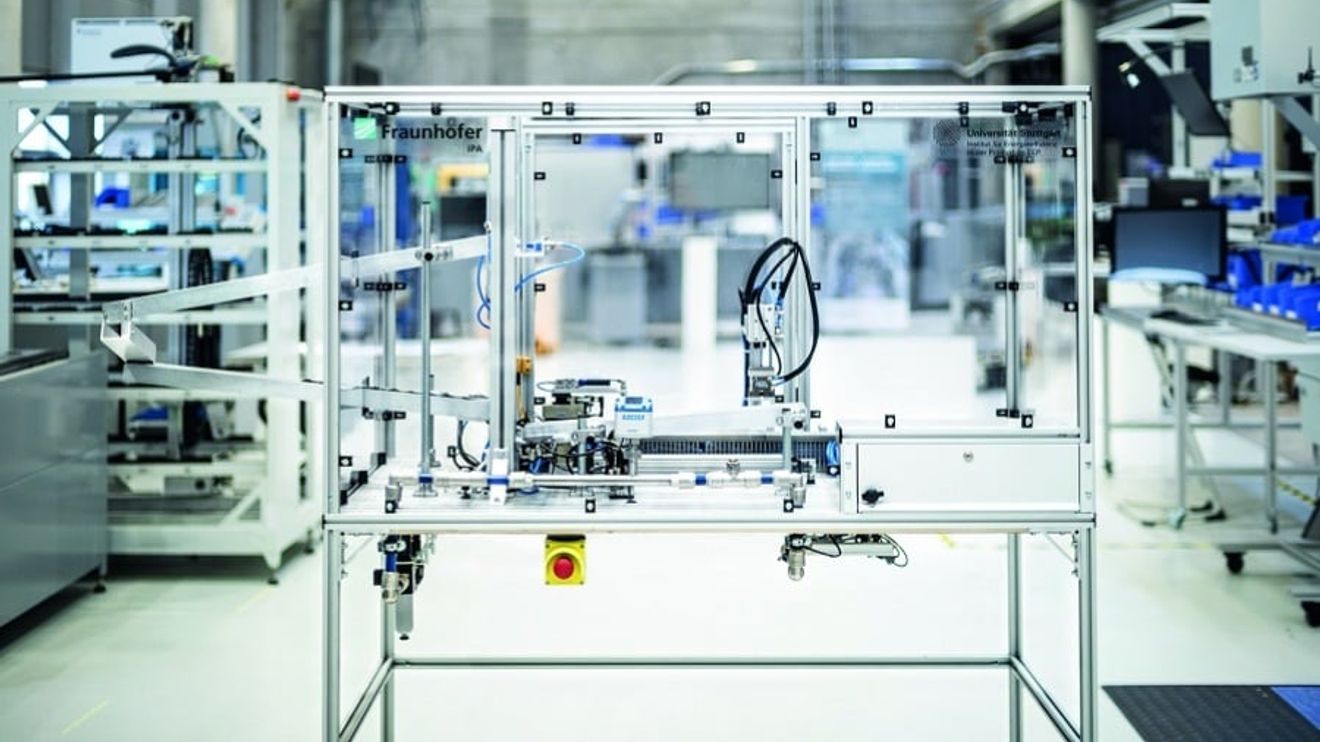
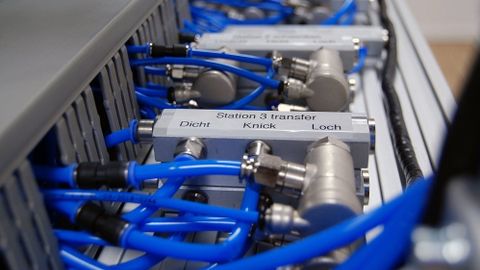
© Fraunhofer IPA / MaderIn order to understand how a leak in the system manifests itself, a handling system was first set up that simulates automated production. A maximum of four different scenarios can be selected at each of four stations - pressing, swiveling, vacuum pick-up and transporting: all tight, kink in the hose, hole in the hose and mechanical leakage. The measured values - volume flow and pressure - can be read off the display at any time.
Replacement for ultrasound?
All measurement and sensor data is also automatically transferred to Fraunhofer IPA's Industry 4.0 platform 'Virtual Fort Knox' via OPC UA and processed there for further analysis. However, since such IIoT projects rarely have a completely uncomplicated initial situation in which all sensors and measuring devices use the same interfaces and transmission protocols, both analog and digital sensors with an IO-Link connection can be found in the demonstrator. The particular challenge lay in synchronizing the transmission speeds in order to ensure smooth data transmission.
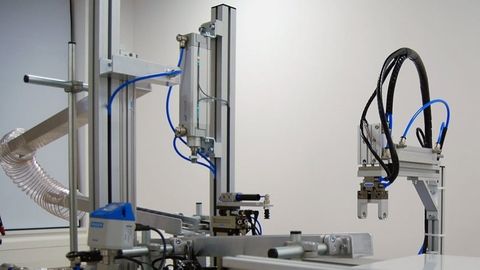
The measurement results for the current 'leakage scenario' can be read off the associated control system. They are also transferred to the Fraunhofer's own Industry 4.0 platform 'Virtual Fort Knox'.
© MaderUsually, leaks in the compressed air system are still detected using ultrasonic technology as standard, as ultrasound makes the 'whistle' of the smallest leak audible. Although this is possible during ongoing production operations, it requires a corresponding amount of effort, as the detection has to be carried out directly on site. Nevertheless, Mader says that locating and subsequently eliminating such leaks is profitable - both economically and in terms of CO2 savings.
Fraunhofer IPA has set itself the goal of further optimizing the process. The demonstrator creates the basis for data-driven production research, for example by training self-learning algorithms. In future, they will not only be used to identify and localize leaks, but also to display the name and order number of the affected component via an app. This will help to minimize downtimes in particular.
The article was based on documents from Mader, Leinfelden-Echterdingen.


You might also be interested in
Automated empties inspection
In contrast to conventional image processing systems, modern laser scanners not only check the completeness of the empties - they also determine whether the correct type of bottle is in the crate.
 read more...
For optical compartment fine positioning
With the IPS 400i camera-based positioning sensor for storage and retrieval machines, Leuze electronic is expanding its 'IPS' series with a variant for optical compartment fine positioning.
read more...Between analog and digital
When measuring with piezoelectric sensors, the charge amplifier is an indispensable link in the measuring chain. As automation progresses, this component undergoes its own evolution from analog to digital.
read more...Laser dot as aiming aid
With two auto-range devices, Datalogic now offers more flexibility for code reading in warehouse environments.
read more...Transfer multi-sensor data
With CopyLynx, b-plus offers a data copying station with 10 Gbit/s interfaces for easy handling of very large data volumes.
read more...Robotics Institute Germany co-founded
Fraunhofer IPA is a co-founder of the Robotics Institute Germany, which aims to bundle Germany's cutting-edge research into AI-based robotics.
read more..."Manufacturing-X data room preliminary study" presented
Manufacturing-X is seen as the next step on the road to Industry 4.0, but how could a data room be designed for the data ecosystem? A study presented by VDMA and ZVEI gets to the bottom of this question.
read more...How companies use data for product development
Where do companies stand when it comes to collecting data from products and using it to develop new products? Researchers from the Fraunhofer Institute for Manufacturing Engineering and Automation IPA have investigated this in a study.
read more...Fraunhofer project determines properties of coatings virtually
In the "PaintVisco" project, researchers at Fraunhofer IPA are modeling the development and processing of paints. The bat was the model for the development of a new simulation program that can be used to virtually determine the exact properties of...
read more...