
Smart production
The smart Robot Factory
Connecting a production cell to the cloud during ongoing production and providing it with all the features of a smart factory: Kuka has now achieved this goal with partners from the Open Industry 4.0 Alliance.
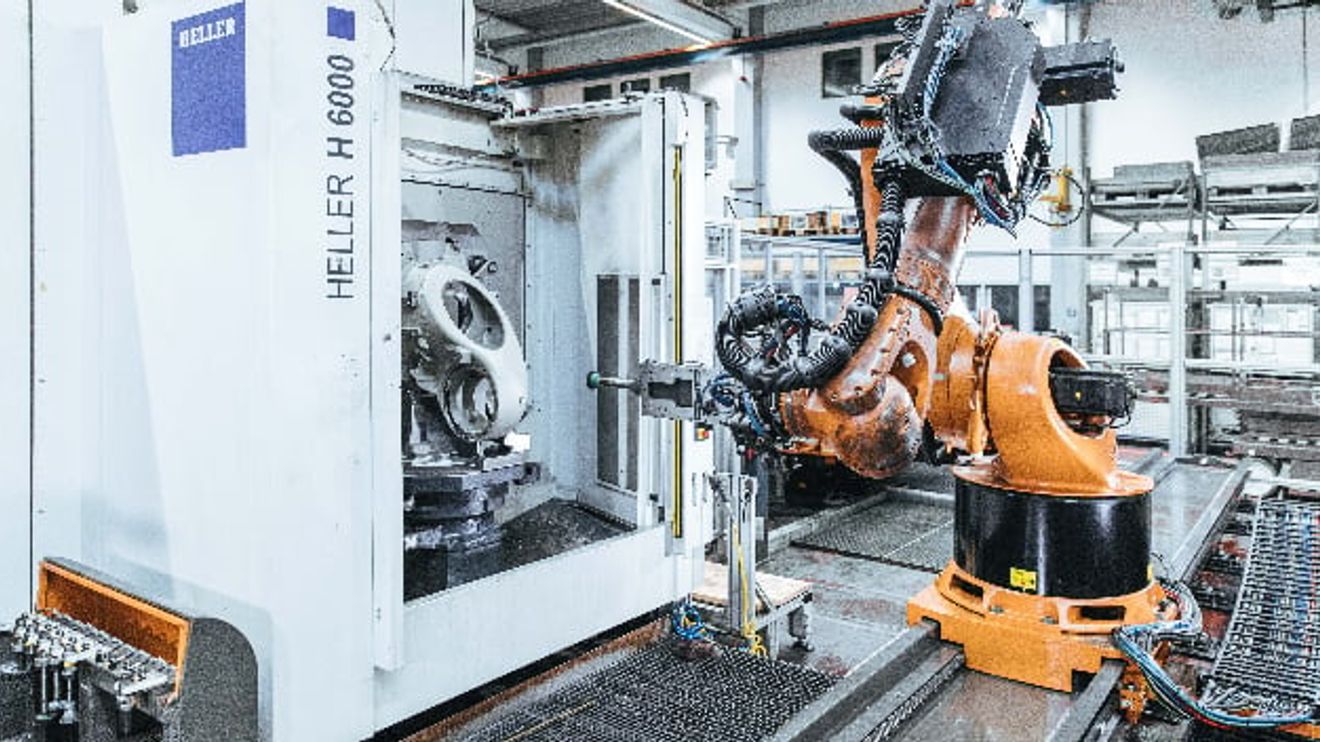
In a joint project, the Open Industry 4.0 Alliance has now put the reference architecture it developed in theory into practice at Kuka. Individual solutions were connected interoperably and existing silos were broken down. The discrete production of robot parts is now intelligently networked and should also work across manufacturers in the future. The processes in a production cell that has been in place for years have thus been fully integrated and made transparent via the cloud.
The Kuka production cell
"Our fully automated and networked robot cell combines the analogue and digital worlds of smart production," says Dr. Christian Liedtke, Head of Strategic Alliances at Kuka. A KR 500 L480-3MT robot picks up cast components with the help of pneumatic grippers from Zimmer and feeds them to one of the Heller machining centers. After the components have been drilled and milled, they are deburred by the robot in the outer position and then removed. The robot is installed on the KL 1500-3 linear unit so that it can supply both machining centers from a total of four feed stations. Altran's Senseforge can also be used to check the temperature and cooling time of the tools.
Kuka is relying on the Alliance's Industry 4.0 architecture to network the production cell with the CNC machines. "In simplified terms, this architecture can be described by four levels: Manufacturing Components - i.e. the systems, edge controller, IIoT platform and user interface," says Liedtke.
The connection to the digital world is established by networking all the components involved with each other and with the cloud. "The data is collected in an edge gateway from Fujitsu and forwarded to our operator cloud," reports Bastian Jehl, IIoT Solution Engineer at Kuka. "The cloud itself then provides services such as authentication, data processing, predictive maintenance and event evaluation. Our workers currently receive an overview of what is happening in the Heller machining centers via the 3d Signals tools," adds Jehl. Thanks to the architecture set up by the Open Industry 4.0 Alliance, the data runs via the customer's own cloud using an MQTT broker. The customer will use suitable dashboard tools to tailor the selection and presentation of data from a wide variety of sources to suit their needs. "The customer has data sovereignty and decides how the data flows," says Jehl.
Increase throughput, avoid downtime
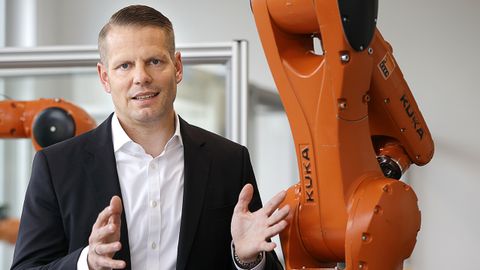
Dr. Christian Liedtke: "Our robot cell combines the analogue and digital worlds of smart production."
© Kuka GroupThe reference project at Kuka is divided into two phases: The first phase - the complete digitalization of the production cell from a brownfield perspective during ongoing production - has been completed. In the second phase, which is now underway, the processes are being continuously optimized on the basis of practical experience and predictive analysis methods. The aim is to sustainably increase the throughput and end-to-end utilization of the cell and keep it at a consistently high level. In addition, unplanned machine downtimes are to be detected at an early stage and avoided through countermeasures. The end-to-end digitalized workflow also allows a holistic view of the performance of the production unit, so that constant adjustments and improvements can be made at any time. In the long term, Kuka benefits from higher productivity of the system and significant cost savings.
Driving digitization forward

The results from the reference project will also be transferred to future, similar use cases within the Open Industry 4.0 Alliance. Once again, all stakeholders and addressees such as asset suppliers, producers and third-party providers of services and solutions will be involved in the projects. In this way, innovations can be initiated in other Alliance member companies, digitalization can be driven forward and production processes can be sustainably improved. Thanks to the common language and semantics of all companies involved in the alliance, end-to-end information flows are realized, enabling leaps in efficiency. In addition, interoperability and open standards further increase the chances of success of such projects.
The sparring partners
More than 85 national and global industrial companies have now joined forces in the Open Industry 4.0 Alliance. Alexandra Altermann, Senior Product Specialist Industry 4.NOW & Strategic Partnerships at SAP, says: "Our goal in these multilateral partnerships is to create holistic offerings. As a team, all partners share the ability to implement an Industry 4.0 scenario for their customers, which each of them could not offer on their own."
The alliance partners of the project:

Fujitsu acts as a system integrator with an edge platform and the integration of the SAP Asset Intelligence Network (AIN). On the hardware side, Fujitsu has also integrated a high-performance IPC device for monitoring the ongoing production process. "As the project manager, Fujitsu ensures end-to-end system integration of all components," says Thomas Bechtel, Project Manager Smart Factory at Fujitsu. On the software side, protocols and standards such as OPC UA and MQTT as well as proprietary protocols at the Fujitsu edge level are used. The processes are orchestrated on the Microsoft Azure IoT Edge cloud computing platform and forwarded to other instances, such as the 3d Signals Cloud, Siemens MindSphere and SAP AIN, via the MQTT broker message bus.
Digital twin increases project benefits

Alexandra Altermann: "Our aim in these multilateral partnerships is to create holistic offers."
© SAPThe 'digital twin' also plays a role in the project contribution of Alliance member SAP: the data of the physical product can ultimately be viewed and analyzed as a digital twin in the Kuka Cloud. Users gain access to the twin via the SAP AIN, where documentation, certificates and maintenance instructions are stored in addition to the twin. The benefits of the SAP AIN from the perspective of the Open Industry 4.0 Alliance: A manufacturer makes its master data available for a specific model. Customers who use the same machine simply adopt this data and link it to their existing data.
The 3d Signals solution from Israel comprises a cloud-based solution and an IoT device that uses real-time algorithms and AI to automatically detect the machine status and machining process for a variety of machines and processes. Data flows from a Connectivity Box device to Fujitsu Edge via Kuka Cloud and finally to 3d Signals. The 3d Signals cloud presents a dashboard that clearly summarizes data and processes in the Heller cell for the user. The specialists also took over the integration of the Heller processing cells using sensors, as Heller is not a member of the alliance.
In a very short time, the company's dashboard solution visualizes real-time data and analyses for the two Heller machines through a non-invasive and machine-independent installation of multifunctional sensors. The AI-based asset performance monitoring platform converts the collected data into actionable insights for Kuka and provides business intelligence and analytics tools in the cloud.
According to documents from the Open Industry 4.0 Alliance


You might also be interested in
Seeing cobots
Small and medium-sized companies are also successfully opening the door to the future with the help of collaborative robots or cobots. One of the key foundations for this is the seamless interaction between robots and image processing.
 read more...
Robots learn to assemble thanks to AI
Flexible robot programming for assembly tasks is still complex. The aim of the 'Rob-akademi' research project is to improve this.
read more...Division for software and digital business established
Kuka has founded a new business division. With 'Kuka Digital', the Augsburg-based company known for its orange industrial robots and automation solutions is expanding its software and digital business.
read more...Finalists for the Innovation Award 2025 have been announced
The motto of the Kuka Innovation Award 2025 is 'Medical Robotics Challenge 2.0'. Five international teams have made it to the final with their robotics ideas for the future of medicine. The winner will receive 20,000 euros in prize money.
read more...Great career opportunities for women in robotics
The IFR supports the career advancement of women in the robotics industry because, according to a World Bank forecast, the gross domestic product per capita would increase by almost 20 percent worldwide if the employment of women reached the same...
read more...Cobot assistant for SMEs
A user-friendly cobot application for small and medium-sized companies that can be used without programming - a team of researchers from Belgium received the Kuka Innovation Award 2024 for this concept.
read more...Handles handling and spot welding
The 'KR Fortec' from Kuka is an energy-efficient and dynamic heavy-duty robot that can be used in particular for tasks such as handling and spot welding.
read more...The top articles in March 2024
New technological developments lead the most-read articles in March. Motors that redefine energy saving, a plastic wheel that discovers the road, a new Ecolabel and, last but not least, the arrival of ChatGPT in the industry. Read for yourself.
read more...Cobot in quality assurance
The 'Ligre' brand is conquering the consumer sector with the function of grinding coffee to the exact gram, which was previously reserved for coffee machines for the catering trade. Gronbach relied on Cobot support in the test setup for quality...
read more...