
Cowen
Robot boom
The implementation of robots in companies is also expected to increase in Germany in the medium term. Which trends will accelerate this development? An assessment by the investment banking consultancy Cowen.
The robotics sector is a market worth billions that continues to grow very dynamically. There are various reasons for this: on the one hand, technological progress in terms of sensor technology and software with artificial intelligence is opening up new areas of application for automation. On the other hand, there are more and more growth drivers - for example, the e-commerce sector, which urgently requires automated solutions in logistics and order processing. But the advancing de-globalization of value chains is also playing into the hands of the use of robots in this country. Just a few years ago, robots were only used in protected and segregated work areas. This will no longer be the case in the future: robots will soon be able to move around more freely and will not only be networked, but also fully integrated into their respective working environments.
New fields of application through innovations
Robots are increasingly able to take on very complex tasks. They can now also work hand in hand with humans and are becoming increasingly easy to train. While robots were mainly used in the automotive and electronics industries in the past, completely new sectors are now emerging for their use: one of these is the logistics industry, where order processing is increasingly being fully automated. The whole thing is being driven by the e-commerce sector and the healthcare sector, among others. The latter is increasingly using robots in operating theaters or for patient care, for example.
The cultivation and harvesting process is also being rethought in the agricultural industry as part of 'smart farming': for example, robots are being used to carry out soil measurements fully automatically. And in the military, machines are now taking on dangerous tasks such as defusing and disposing of explosive devices. These are just a few examples of possible applications for robot-based automation solutions.
Backlog demand in industrialized nations
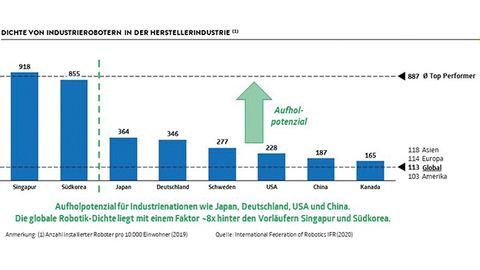
Singapore and South Korea have by far the highest density of industrial robots in relation to their population. There is considerable potential for most countries to catch up - especially Germany.
© CowenMost industrialized nations are already realizing that they need to catch up with the leading countries in the robotics segment: The pioneers Singapore and South Korea have an eightfold higher density of industrial robots in the manufacturing industry compared to industrialized nations such as Germany, Japan, the USA and China. This is a factor of 8 higher number of installed robots in relation to the number of people in employment. This can serve as a kind of compass for the automation potential in most countries - but without taking technological innovations, demographic or political influences into account.
A number of trends are additionally accelerating the growth momentum of the robotics sector.
E-commerce
What began with books and other handy items now extends to an ever-increasing number of goods: robots have become an integral part of logistics in e-commerce and the online purchase of items. They make it possible to automatically handle the complex variety of items in modern distribution centers. Robots pick the goods from the warehouse independently for specific orders and also carry out picking, packaging and labeling up to dispatch independently.
De-globalization of value chains

Between 2010 and 2019, the turnover of the top 20 suppliers for automated material handling more than doubled. The trend continues unabated.
© CowenDue to increasing de-globalization, companies will increasingly settle in domestic regions again in the future in order to make supply chains more resilient. One of the starting points is the security of supply of essential goods, for example in the medical sector. The local supply of such goods is often difficult or even impossible in turbulent times such as pandemics. Companies should therefore prevent supply chains from collapsing by shortening them and controlling them more closely. For this reason, it seems sensible to bring industrial production back to Europe after the pandemic. For countries with high wage levels, such as Germany or Denmark, however, relocating production facilities from emerging Asian countries only makes sense if the industrial processes in this country can be highly automated. This is the only way companies can offer competitive prices and retain customers. The de-globalization of supply chains will lead to a further increase in the level of automation across Europe in the medium to long term. However, if value creation is brought back from low-wage countries, two challenges need to be addressed: How can manufacturing costs be kept under control? And how can the increasing shortage of labor be resolved? In both cases, the solution lies in automating the value chain.
The ageing population

In Germany, both the death rate and the birth rate are falling, which means that the population is ageing and shrinking slightly at the same time.
© CowenThe population is getting older and older and fewer young people are following, making human labor in industry scarcer. However, demand continues to rise. This is not the only reason why there is an urgent need to return value chains to relevant industries. However, this can only be achieved through further automation and innovative robot solutions. Modern sensor technology and robots equipped with artificial intelligence can already communicate and collaborate with humans today. For example, mobile robots can perform simple tasks when caring for people: They bring drinks to those in need of care or assist with rehabilitation. This relieves the burden on care staff and allows them to concentrate on essential, interpersonal tasks.
Software replaces hardware
In the past, it was always necessary to achieve maximum precision in robot components or drives. Software solutions are now replacing this required level of precision and ultimately helping to simplify the robot systems behind them.
Haptic sensor technology
In many cases, robots today are neither dangerous nor spatially shielded - as was more or less always the case just a few years ago. Innovations in sensor technology combined with intelligent image recognition systems have created machines that are able to find their way around their environment and interact directly with humans. However, the fine motor skills of the human hand remain the measure of all things, to which the world of robots is coming ever closer. This is always the basis for human-machine interaction.
Simple commissioning
Robots will be used more and more in companies for automation and thus support the trend towards de-globalization. This is another reason why there is a focus on developing autonomous systems that are easy to install. The reasons are obvious: the robots can be adapted to the respective requirements with significantly lower resources such as capital and installation costs. In future, it will no longer be necessary to call in specialists to commission a robot. So-called teach-in software simplifies the first steps. The environment is integrated through networking and GPS solutions and self-learning algorithms enable robots to perform their tasks quickly. Robots will soon be standard.
Robotics accessible to more and more SMEs

Robots will increasingly be used for automation in SMEs, which make up a large part of the economy in this country. One focus of innovations in the field of robotics is on the development of easy-to-install and autonomous systems that can be adapted to the respective requirements with reduced use of resources. This trend is leading to a further spread of robotics, as the machines also pay off for smaller companies and less scaled activities. Production in low-wage regions could thus become increasingly superfluous.


You might also be interested in
The intelligent power suit
The 'Cray X Power Suit' from German Bionic provides active support for lifting loads in logistics workstations. In addition, manual work in the warehouse is integrated into digital processes, optimized and made safer.
 read more...
The robot as an edge device
The strengths of robots come to the fore when they work alongside and not in the absence of humans. It can help to perceive the robot as an edge component. An assessment.
read more...Robotics&AUTOMATION 2/2021
The 'robot colleague' is establishing itself - in large companies, in SMEs, in private and public spaces. What trends are accompanying its appearance? What are the benefits of swarm robotics? How can it help to understand it as an edge component?...
read more...Robot boom
In Germany, too, we can expect to see increased implementation of robots in companies in the medium term. Which trends will accelerate this development? An assessment by the investment banking consultancy Cowen.
read more...Digital Material Selection reduces CO₂ Emissions
Using an industrial gripper as an example, Schunk and CADFEM demonstrate that simulation-based material selection can reduce CO₂ emissions from secondary materials and additive manufacturing by up to 40%.
read more..."AKIMI" Research Project develops AI for Flexible Robotics
The AKIMI research project is launching at the WZL at RWTH Aachen University. The goal is to develop agent-based AI that simplifies the programming and reconfiguration of robotic systems for small and medium-sized enterprises.
read more...Barcelona Declaration on Robotics and...
Robotics Associations Adopt Global Automation Strategy
The global robotics industry is stepping up its collaboration. The associations AER Automation, A3, IFR, and VDMA Robotics + Automation have formed a long-term alliance by signing the “Barcelona Declaration on Robotics and Automation 2026.” The...
read more...Humanoid Robotics at BMW in Spartanburg
"Physical AI" combines digital AI with real machines and robots. This allows intelligent systems, such as humanoid robots, to be integrated into real-world production processes. Following the successful deployment of the Figure 02 humanoid robot at...
read more...SensoPart and Cambrian Robotics
Partnership for 3D-Guided Robotics
Cambrian Robotics and SensoPart are jointly developing an AI-powered solution for 3D-guided robotic applications. The combination of vision sensors and AI is designed to simplify gripping and positioning processes.
read more...