
Digitization
Kontron's transformation into an IoT solution provider
Industry 4.0 is not only changing factories. The suppliers themselves must also adapt to the digital transformation. This article uses the example of Kontron to show how the product portfolio, corporate structure and orientation can change.

Kontron has a long history of adapting to technological trends: founded in 1959 by the Swiss start-up financier and investor for high technology Branco Weiss, the company has developed a wide range of products for industry in its 60-year history. In addition to medical devices and laboratory measurement technology, these have included micro and mini computers for controlling industrial machines and devices as well as the associated middleware and software since the 1980s.
Under the ownership of BMW, the focus in the 1990s was on the development of control hardware and software for the emerging x86 processor technology. After the spin-off from BMW and for the IPO in 2000, Kontron coined the buzzword 'Em-bedded Computing', which has become a term for the entire industry. Embedded technologies are still part of the company's core business today.
On the pulse of time
The company's eventful history reflects the development of the computer industry, especially manufacturing in Germany: until the 1990s, it was worthwhile producing the required quantities of industrial computers and professional electronic equipment for industry exclusively in Germany. However, attempts to establish mass production of electronic devices in Germany famously failed. In addition, with the growing demand for electronic end devices such as PCs, notebooks, smartphones, tablets and other devices, contract manufacturers have established themselves in Asia, which can offer large quantities of the same products - mostly in the consumer sector - at very low prices.
High-quality electronics suppliers such as the Taiwanese company Foxconn emerged under the strict requirements of Western brand companies such as Apple. Today, Foxconn is an anchor shareholder in S&T AG, Kontron's parent company, through its subsidiary Ennoconn. And for good reasons: In contrast to the shrinking traditional PC market, the market for embedded computers is growing by an average of just under 10% per year and the IoT market offers additional double-digit growth opportunities.
In addition, companies such as Foxconn are themselves interested in solutions for their own Industry 4.0 production, such as those developed and marketed by the S&T Group.
For the S&T Group, Ennoconn's participation also brings advantages: On the one hand, the Group benefits from the electronics manufacturing expertise; on the other, a partner of this size opens up access to the growing Asian markets.
And yet Kontron still primarily manufactures standard and customer-specific modified products in Germany with a large number of variants and in small and medium quantities. Their production would not be worthwhile in fully automated production, as they involve difficult manual activities and short-term flexibility when customer requirements change. As an original design manufacturer (ODM), Kontron develops products precisely according to the customer's specifications and design requirements.
The digital transformation
What began with the internet in the 1990s has also found its way into established mechanical engineering and manufacturing companies as part of the digital transformation. In many manufacturing companies, IT-supported processes are now being moved to the cloud.
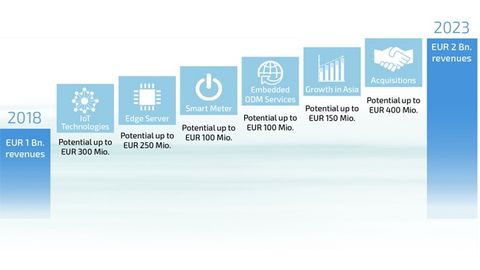
By consistently focusing on the areas of IoT and Industry 4.0, Kontron's parent company S&T aims to double its turnover to EUR 2 billion in the five years from 2018 to 2023.
© KontronThe level of operational technology is also changing faster due to Internet standards and IT technologies, which are penetrating right through to the machinery in the factory. The previously separate worlds of information technology (IT) and operational technology (OT) must be brought together.
Thanks to the merger with the S&T Group in 2017, Kontron believes it is well positioned for this task: Kontron itself offers industrial IoT hardware and the IoT software framework SUSiEtec, which connects the individual levels and offers everything from software consulting and development to cloud hosting, comes from the S&T Group. All of a sudden, the former hardware developer finds itself in the world of autonomous driving, artificial intelligence, machine learning and cloud-based applications. Formerly labeled as 'boring', the embedded computer is becoming a crucial piece of the digital transformation puzzle.
Computer networks and machinery merge
This approach is paying off today: just like standard office notebooks or gaming PCs at home, all machines that are controlled via embedded computers can be connected to the internet. Every machine thus becomes an IoT device. In order to bridge the gap between IT and OT, appropriate IT infrastructures and industry standards are needed to enable secure communication between the world of machines and the world of computers in real time. Both have received a boost in recent years. The concept is called edge computing in combination with the Open Platform Communication Unified Architecture (OPC UA) and Time Sensitive Networking (TSN) standards.
Edge computing and OPC UA over TSN have the power to break down decades-old concepts of machine control and plant networking. OPC UA ensures that machines, control devices and software from the OT area can communicate directly with IT. No one in the industry now doubts that the standard will prevail. In the fall of 2018, 21 of the world's leading industrial automation companies announced their support for the standard. At the same time, the new TSN specification gives the standard Ethernet known from IT networking properties that are necessary for the deterministic and secure communication and control of networked machines, such as high availability and data transmission in real time. This enables the machine and IT levels to be connected via a homogeneous network, initially up to the controller level and later also up to the field level. This eliminates the need for complex gateways and heterogeneous networks with many manufacturer-specific interfaces in the long term.
From the edge to the cloud
Powerful embedded computers that can be seamlessly integrated into a network and have sufficient memory can perform a wide range of tasks on the machines that go far beyond machine control. For example, they can pre-process, filter and, if necessary, analyze data on the machine using machine learning and artificial intelligence in order to make quick decisions on site. The continuous increase in processor speed and memory capacity will ensure that there is always sufficient computing power available in embedded computers at the 'intelligent edge'.
Embedded computers will become the gateway to the cloud, allowing the concept of cloud computing, which has not been very popular in the industry to date, to come into its own. This ensures that only selected data reaches the cloud, eliminating potential security risks. Latencies - delays caused by runtimes - that occur when connecting to a cloud can then also be countered with appropriate concepts. The upcoming 5G mobile communications standard, which will be a significant driver of fast, flexible and, above all, location-independent networking, is creating high expectations here.
For example, Kontron is using the IoT Edge Services of the Microsoft Azure Cloud to exploit completely new machine control concepts. This allows huge amounts of data generated during machine operation to be stored in the cloud, for example for historical analysis of downtimes, AI applications or other tasks. At the same time, machines can be given digital twins, i.e. virtual copies, that simulate machine operation based on the real data in the cloud. Data can be exchanged for machine control and realistic adaptation of the digital twin if a stable and fast connection is established between the cloud and the edge computer. New IT concepts, such as container technology, ensure that entire applications can be encapsulated and transferred in compressed form. This means that the OT level also benefits specifically from cloud applications and security-critical data does not have to leave the company premises if it remains on the edge computer or is only transferred to a private or embedded cloud in the company.
Edge computing and standards such as OPC UA over TSN are ushering in a new era in the industry. This will not only increase the efficiency of machine use, but also enable rapid adaptation to market changes and new data-based business models. Service models are conceivable here, in which the user only pays for the use of the machine (pay-per-use) and the machine remains the property of the manufacturer. Or support for individual small batches down to batch size 1, which accommodates the personalization of products. Overall, digital transformation offers enormous growth potential for many industries.
Author: Norbert Hauser is Vice President Marketing at Kontron.
The transformation to an IoT solution provider
Kontron has transformed itself from a traditional embedded computer manufacturer into an IoT solution provider. The product range has become much broader.

The product portfolio starts with solder-on SOMs (Systems on Modules) the size of a 2-euro coin, which achieve remarkable performance in terms of visualization and computing power in a chip with three cores of the Dual Cortex A7 and Cortex M4 processors.

They are equipped with Intel server-class processors and are suitable for edge servers and are also used in the field of autonomous vehicles, in robust servers such as the Kontron EvoTRAC-S1901 platform with numerous interfaces and up to four 10 GbE ports and wireless connections.

The SMARC-sAMX8X or Qseven-Q7AMX8X module based on the NXP i.MX8 is characterized by low energy consumption and is therefore particularly suitable for use in networked end devices in applications such as automation and robotics technology as well as HMIs. The compact 2.5-inch embedded single-board computer in Pico-ITX format with the cost-optimized NXP i.MX8M is characterized by its high graphics performance and extended connectivity.

At the top end of the product range is the IoT software framework SUSiEtec from the S&T Group, which connects the individual automation levels and offers everything from software consulting and development to cloud hosting. The SUSiEtec AI plugin for image recognition via Edge AI from S&T Technologies, for example, includes a prepared training environment consisting of an embedded server together with corresponding pre-installed open source software, such as Keras and Tensorflow with a focus on visual machine learning. This package alone saves companies around six weeks of preparation and training time. Special, simplified software interfaces, which are also provided by SUSiEtec, ensure that .NET and Java developers can also derive the corresponding OpenVINO middleware from Intel for the inference part of classic training results. Unlike with C or C#, only a few lines of code are required in .NET and Java with SUSiEtec AI.


You might also be interested in
The first steps towards digitization
Real-time transparency in the material flow: this was the goal set by Miba when it set out to digitalize its internal logistics processes. But how successful was the close link between ERP and MES in the end? - A field report.
 read more...
How will the IoT change companies in 2020?
How will network technology in companies change in 2020? Axel Simon, Chief Technologist at HPE Aruba, takes a look into the crystal ball
read more...Digital twin revolutionizes maintenance
As virtual representatives of real machines, digital twins open up new possibilities for maintaining and servicing complex industrial plants and systems. A project report.
read more...You can't do without Edge and Swarm
The IoT has changed the requirements for processing data provided by machine sensors and actuators. This needs to happen as quickly as possible - preferably where the data is generated. Edge nodes and swarm computing systems take on this task.
read more...Online machine data under control
Turning huge amounts of data into valuable information - how can this smart industry approach be implemented? Linking PC-based controllers with Matlab and a cloud-based IoT analytics service can be a viable approach.
read more...From modeling directly into the PLC
Despite digitalization and I4.0, the technical functions in a process plant do not become simpler if you break them down to the smallest detail. Nevertheless, the high level of difficulty can be overcome by combining the right tools in the right way.
read more...Where are the new business models?
The necessary new business models are repeatedly cited as the hallmark of an Industry 4.0 environment. But to date, very few companies have seen any of this. Schneider Electric now has a few models up and running.
read more...Why predictive maintenance?
Investments in predictive maintenance systems are worthwhile in order to proactively detect damage. Not only does this increase the service life of a machine, it also opens up new business models for machine manufacturers.
read more...First customer projects via BaSys 4.0
The BMBF project 'Basissystem Industrie 4.0' expired at the end of June 2019. Together with NetApp and Objective Partner, Fraunhofer IESE now offers Industry 4.0 solutions with support and adaptation to customer systems on the basis of this project....
read more...