
AI in Smart Manufacturing
Eight Areas of Application for Physical AI
From intralogistics to humanoid robots: Physical AI opens up new possibilities for manufacturing. Eight real-world examples show how companies can increase efficiency and flexibility.
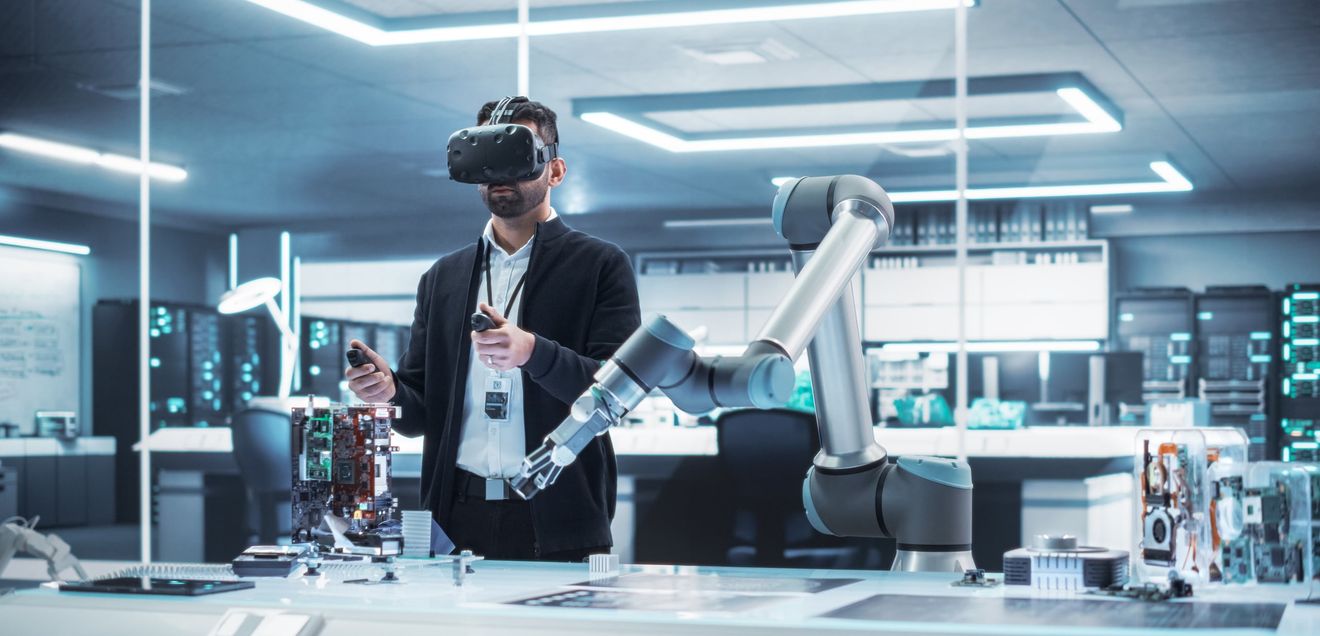
The history of manufacturing automation goes back many decades, but AI and robotics are currently opening a whole new chapter because automation is no longer limited to highly standardized processes. Even complex tasks and processes with high variability can be automated more and more effectively, and even unforeseen events no longer throw manufacturing off track. The key is Physical AI, which enables intelligent, real-time control of physical systems and is thereby revolutionizing their adaptability. Its use is particularly promising in the following areas:
1. Intralogistics for Small and Very Small Production Runs
Products manufactured in small quantities or on a custom basis have traditionally posed a logistical challenge. With Physical AI, however, it is possible to deliver the right parts at the right time to where they are needed. Autonomous Mobile Robots (AMRs) pick them up independently in the warehouse and transport them to the machines. In doing so, they select the best possible route, avoid obstacles, and, if necessary, prioritize rush orders that come in at short notice. They also handle the transport of semi-finished products between individual production stations, ensuring that there is no downtime and that unfinished products do not accumulate anywhere. This reduces lead times and improves on-time delivery, while at the same time allowing companies to maintain smaller inventory buffers, as demonstrated by various projects that NTT Data has already implemented in the automotive and mechanical engineering industries. Since AMRs continuously learn from feedback during the ongoing process (closed loop), they do not need to be retrained regularly based on recorded data.
2. Custom Machine Control
Small and very small production runs require many custom adjustments to machines, but Physical AI can make these adjustments dynamically. Depending on the product and its requirements, the correct materials and components are ordered and then processed correctly. For example, a gripper recognizes what is currently in front of the machine and can grasp it precisely—without knocking over or damaging parts, even if they are unfamiliar to it. During assembly, the AI selects the right tools and parameters—for example, the desired paint and a suitable nozzle for painting, and for welding, it adjusts the welding current, welding time, and electrode force according to the material type and thickness. This increases production flexibility without any manual parameterization—setup times are significantly reduced, and new products can be manufactured faster and error-free (First Time Right). In brownfield environments with existing PLC and MES infrastructure (Programmable Logic Controllers / Manufacturing Execution System), machine controls based on Physical AI have already proven their worth in numerous applications.
3. Maintenance Optimization
Predictive maintenance is not new, but it is becoming more reliable thanks to Physical AI. Instead of merely analyzing statistical data on past malfunctions and failures to optimize maintenance cycles, AI can now also incorporate sensor data to reliably predict wear and defects. It is important not to rely on individual sensor data points such as vibrations, noises, temperatures, or pressure, but rather to gain a comprehensive picture by combining them—a process known as sensor fusion. If necessary, the AI can also adjust machine parameters or shut down the machine in a timely manner to prevent defective batches or major damage. It plans maintenance windows autonomously to make optimal use of uptime and ensure that parts are replaced neither too early nor too late.
4. Automated Quality Control
Systems equipped with cameras and AI can significantly improve quality control in manufacturing. They detect even the smallest defects, such as microscopic cracks in materials and coatings, or slight deformations and discoloration of surfaces that indicate a defect. They inspect welds, screw connections, gaps, and dimensions—and do so faster and more accurately than humans ever could. Products that do not meet the specified quality standards are automatically sorted out or sent to the appropriate machines for rework. Thanks to a combination of image processing and machine learning, these systems deliver significantly better results than rule-based vision systems. In addition, they can be integrated directly into the production process to inspect all actual components or products, rather than just random samples. This reduces scrap rates and customer complaints.
5. Self-Optimizing Machines
Machines and tools that optimize themselves represent a combination of the two use cases mentioned above. They use an extensive array of sensors not only to check the results of their work but also to monitor the current condition of the tools—for example, to detect wear, scaling, imbalance, or a clogged nozzle. Based on this, manufacturing parameters are adjusted to ensure consistently high production quality despite wear or contamination, and, if necessary, actions such as cleaning, lubrication, recalibration, or part replacement are initiated. Incidentally, the ramp-up phase for manufacturing new products can be optimized in a very similar way: Here, test products are inspected in detail to identify deviations and adjust the manufacturing parameters step by step. Targeted parameter changes help to better understand causes and effects and to refine the entire process until the production outcome meets the specifications.
6. Autonomous Monitoring and Inspection
Autonomous drones and robots can monitor both the factory grounds and the production area—whether on regular inspection routes or when surveillance cameras and other sensors report an anomaly, such as unknown individuals, open doors, blocked escape routes, or smoke and liquid leaks. In doing so, they also cover blind spots and reach areas that are inaccessible or dangerous for humans. If they use infrared and LiDAR in addition to camera imagery, they can distinguish between objects and events in great detail, even in low-light conditions. Depending on what the sensors detect, appropriate measures are then initiated—for example, notifying plant security, shutting down machines, closing valves, or activating ventilation systems.
7. Human-Machine Collaboration
Physical AI improves collaboration between humans and machines. They can work in the same workspace without safety cages or protective fences. For example, robots detect when people cross their path or enter their operating area, and adjust their movements to avoid injuring anyone. What’s more, robots recognize the posture, movements, and gestures of their human colleagues and can provide them with individualized support. Depending on the work situation, they lift heavy parts and hold them in the position required for ergonomically sound processing, hand over the necessary tools, deliver components just in time, or transport fully assembled parts away.
8. Humanoid Robots
Robots whose form and movements are modeled after the human body can perform complex tasks in manufacturing that are typically carried out by humans. At present, they are still limited primarily to simple tasks such as sorting and transporting parts, but development is progressing rapidly. Their use is particularly attractive wherever there is a shortage of skilled workers or where monotonous, repetitive, physically demanding, or dangerous tasks need to be performed. Thanks to their arms and legs, humanoid robots can move freely and assist in a wide variety of work processes—around the clock, without tiring. Even autonomous factories, in which autonomous robots and other intelligent systems organize themselves entirely on their own, now seem possible.
What Decision-Makers Should Keep in Mind

In addition to extensive AI expertise, Physical AI also requires seamless IT/OT integration; after all, these intelligent systems must, among other things, retrieve data from the MES and access PLCs and SCADA (Supervisory Control and Data Acquisition) systems. Comprehensive sensor technology and high data quality are additional critical success factors, as AI requires a comprehensive and precise picture of the processes and environment. Companies should first conduct intensive pilot tests of individual use cases and then standardize and scale the automated workflows. They must consider governance and IT security from the very beginning—otherwise, they risk compliance and security issues that will require costly remedial work.
When implemented carefully, Physical AI projects deliver significant added value. Based on NTT Data’s experience, typical results include a reduction in downtime of between 20 and 40 percent, a 10 to 25 percent increase in Overall Equipment Effectiveness (OEE), a 15 to 30% reduction in scrap, and significantly shorter ramp-up times for the production of new products.


You might also be interested in
Early Access Program for AI Features
PTC has launched an early-access program with Onshape Labs for AI features on the Onshape cloud-based CAD platform. Users will receive early access to new tools for product development.
 read more...
Humanoid Robotics at BMW in Spartanburg
"Physical AI" combines digital AI with real machines and robots. This allows intelligent systems, such as humanoid robots, to be integrated into real-world production processes. Following the successful deployment of the Figure 02 humanoid robot at...
read more...Cybus Brings in Siemens Executive Stefan Schwab to Lead the Company
The Hamburg-based software provider Cybus will have a dual leadership structure going forward: Stefan Schwab will join co-founder Peter Sorowka as co-CEO.
read more...SensoPart and Cambrian Robotics
Partnership for 3D-Guided Robotics
Cambrian Robotics and SensoPart are jointly developing an AI-powered solution for 3D-guided robotic applications. The combination of vision sensors and AI is designed to simplify gripping and positioning processes.
read more...Why AI Agents in the SOC Don't Learn Over Time
AI agents support security operations centers, but so far they lack a permanent memory. A technical article explains the challenges facing autonomous security automation.
read more...Industrial AI and Manufacturing
Siemens and IFS Bridge the Gap Between Planning and Operations
Siemens and IFS are collaborating to use industrial AI to enable a closed-loop digital twin across the entire plant lifecycle. The goal is to more closely link design data with real-world operational information and optimize industrial processes.
read more...Four Steps Toward Greater AI Sovereignty
Following the failure of “Claude Fable 5,” the AI consulting firm Neurawork recommends a robust AI strategy focused on data sovereignty, reliability, and governance.
read more...Alibaba Expands 'Qwen' for Robotics
Alibaba is expanding its Qwen model family with a robotics suite for Physical AI. The three models support manipulation, navigation, and simulation for autonomous robotic systems
read more...Qualcomm Acquires AI Specialist Modular
Qualcomm is acquiring the AI software company Modular. The goal is to expand an open software platform for generative and agent-based AI in edge, cloud, and data center environments.
read more...