

'Artificial Intelligence Forum 2019'
"Neural networks are dumb as a post"
Artificial intelligence is being used very hesitantly in industrial applications. Expectations of the technology are high. They are rarely fulfilled. However, those who approach the topic with the right premises can reap many benefits.
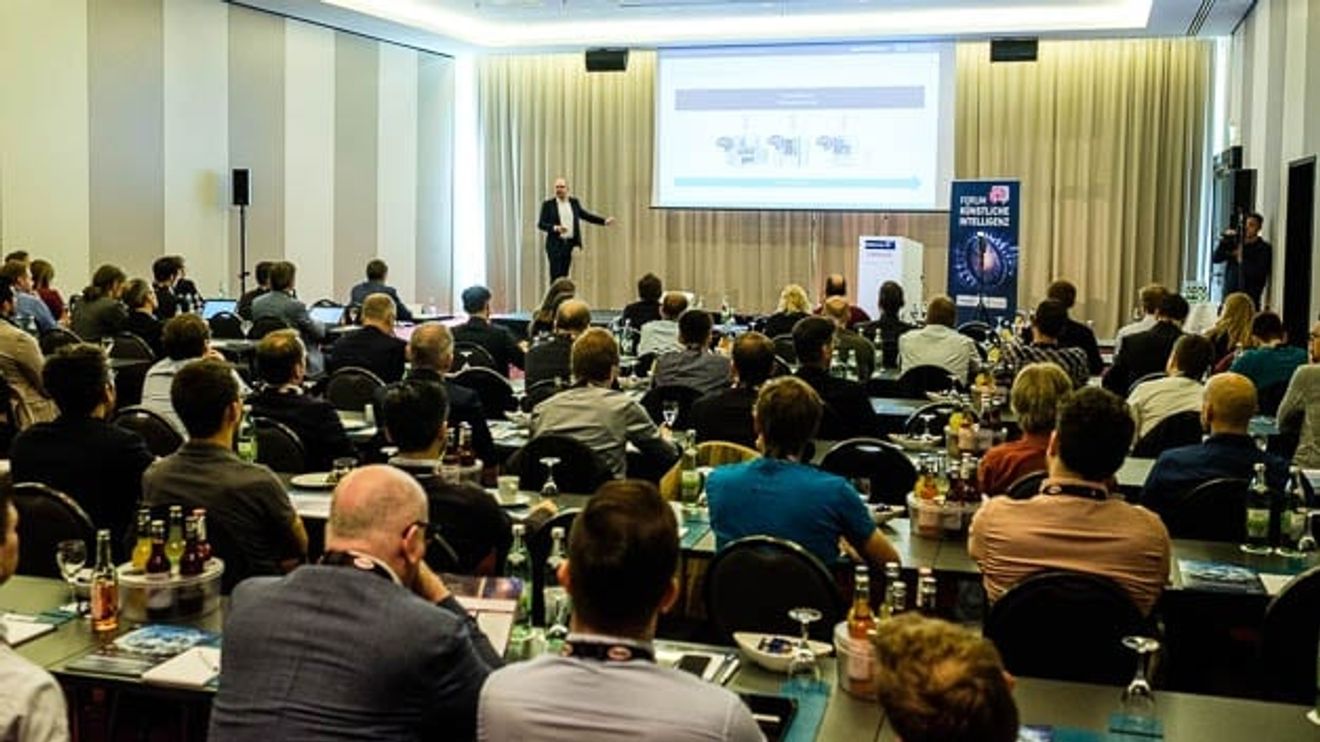
The term 'artificial intelligence' (AI) suggests that machines could take on human-like abilities. Of course, this is not the case, but it does raise expectations. In many presentations at the 'Artificial Intelligence Forum', organized by Elektronik, Elektronik automotive and Computer&Automation on 14 May 2019, it emerged that these expectations are inevitably disappointed and that AI requires a lot of intelligent preparatory work if it is to relieve humans in a meaningful way.
In the very first keynote speech, Prof. Martin Ruskowski from DFKI took a critical look at the capabilities, but also the shortcomings of AI. Industry is characterized by ever-increasing automation. The aim of Industry 4.0 is to manufacture individualized products, preferably in real time. "But no one asks the question about the costs of such a high degree of automation," Ruskowski stated and showed that humans are a very universal and intelligent "machine" in the production process.
Compared to mechanical machines, it lacks only one "feature" in addition to speed: the Ethernet connection. This is where artificial intelligence can play to its strengths by combining data from production and the corporate level or by taking over mindless tasks that tire humans, e.g. in the form of image recognition in quality assurance. The more specialized the tasks are, the more artificial intelligence can help. AI has no consciousness, no will and no goal orientation. "Neural networks are dumb as a post and can never replace 3.5 billion years of evolution," said Ruskowski. That is why the rules according to which the systems work and make decisions must always come from humans. His conclusion: people will continue to be at the heart of production in the future, not machines.
Industry 4.0 needs AI
In his keynote speech "Industry 4.0 - Testbed for AI", Prof. Jörg Wollert pointed out that a lot of artificial intelligence has already been developed for use in the last ten years, e.g. character and speech recognition. As soon as the technology becomes a natural part of products, it is no longer perceived as "AI". This is particularly true of speech recognition, which works unobtrusively in smartphones, car navigation systems and machines. Otherwise, however, he took the same line as Prof. Ruskowski and emphasized that AI is necessary for Industry 4.0 in order to generate valuable information from the data obtained - for example for predicting energy requirements, avoiding bottlenecks, ubiquitous predictive maintenance or in processes that run in real time.
He cited the dynamic motion control of robots or the behavior of autonomous vehicles as examples. Wollert's Institute for Automation and Mechatronics focuses on smart agriculture. This field is far less controversial than road traffic, but is nevertheless challenging in terms of orientation, environment recognition and dynamic behavior. The autonomous agricultural machines recognize the crops and can distinguish them from weeds. The weeds are destroyed with high voltage, which greatly reduces the use of pesticides. Interestingly, the training for plant recognition was not carried out using real photos, but simulated 3D models. "This allowed us to train all weather and lighting situations. This significantly increased our detection rate," said Prof. Wollert.
AI does not yet understand the world
During the technical presentations, Dr. Wieland Brendel from Layer7.ai brought up an interesting phenomenon: neural networks, which are used in image processing, recognize objects primarily based on their texture, not their shape. He showed a detailed image of an elephant's skin, which is recognized as such with 82% probability. The silhouette, on the other hand, is only recognized with a probability of 7% and is more likely to be a black swan. Consequently, neural networks can still recognize an image that has been broken down into puzzle pieces because they can still assign texture fragments such as eyes, skin areas or branches and leaves to a person, an animal or a plant.
Classification is therefore based on the recognition of local characteristics, not an overall view. As a result, changes to such textures that are inconspicuous to humans can lead to a complete failure of the recognition process, for example when the meaning of traffic signs can be reversed by small stickers. Layer7 therefore uses distorted images for training, which confuse the neural network and force it to focus more strongly on the shape. This makes recognition more robust.
Brendel's conclusion: machines can achieve amazing feats, but have no understanding of objects and the larger context. He concluded his presentation with: "Much more is possible as soon as machines understand our world."
Tools for the application of AI
Raphael Zingg is a research assistant at the Institute for Embedded Systems at the Zurich University of Applied Sciences (zhaw) and has been working on the application of neural networks to microcontrollers. Training these software structures requires a great deal of computing power and a lot of training data. This is why the training is carried out on high-performance computers, usually in the cloud. Microcontrollers are also sufficient for the application, known as inferencing . However, the neural network must be transferred to the computing architecture or instruction set of the microcontroller.
The manufacturers offer tools for this and Raphael Zingg has compared two of them: CMSIS-NN from Arm and X-Cube-AI from ST Microelectronics. X-Cube-AI is the more convenient of the two tools: It validates and translates the AI frameworks or libraries Keras (TensorFlow), Lasagne, Caffe and ConvNetJs. The tool can also compress the networks and then generates a target system-specific library with AI functions and firmware. CMSIS-NN contains functions for executing neural networks on microcontrollers, but does not offer a conversion function. This means that the parameters of the networks must always be adapted manually in the source code each time a new training process is carried out. However, Zingg has written the k2arm tool for the Keras library, which performs this conversion from Python to C. The user can select the fixed-point format (8 bit or 16 bit) supported by the CMSIS-NN. K2arm is to be published on Github as open source.
A series of tests using MNIST data (sample data for recognizing handwritten digits) showed that X-Cube-AI delivers exactly the same classification accuracy as a native Keras. With K2arm, the accuracy was slightly lower, especially with 8-bit calculation. For practical applications, however, the deviation in the sub-percent range is irrelevant. However, the performance on an STM32F4 discovery board with Cortex-M4 was 10 times faster with k2arm than with X-Cube-AI.
Conclusion by Raphael Zingg: Even "larger" neural networks can be executed efficiently on common microcontrollers such as the Cortex-M4 thanks to optimized frameworks.
Liability has to do with imprisonment
The forum was concluded by lawyer Susanne Meiners from Newtec. She introduced the technical audience to the world of case law, clarified terms such as civil law, criminal law and public law and assigned them to contract law, product liability, torts, EU regulations and standardization. Jurisprudence cannot keep pace with rapid technological developments. In a dilemma situation, when a driver has to decide within a fraction of a second whether to run over the senior citizen or the child, the "emergency in a hopeless situation" relieves him. This does not apply to an autonomously controlled vehicle, as case law does not recognize optimization in the sense of minimizing damage. It would therefore not be legal, for example, to shoot down passenger planes that are being misused for a terrorist attack, as in the case of the World Trade Center. Until now, the courts have always had to make lengthy individual decisions in such cases.
Meiners informed the audience about an important trend in the area of liability: in the event of damage, the party responsible has always (only) been liable. In many cyber security incidents, however, the perpetrator cannot be identified or even determined. It has recently become clear that even those who did not prevent the damage (such as the IT manager) may be partly responsible. Incidentally, the liability of the person who caused the damage, which is not limited by this, also means that the person who programs a backdoor, for example, is also held liable. "It's not the company that is liable, but the person who manipulated it," warned Meiners. Everyone was immediately reminded of the diesel crisis.


You might also be interested in
Artificial Intelligence Forum - Submit your presentation now
Artificial intelligence promises more productivity and more efficient processes in the factory, in embedded systems and in vehicle technology. Take the opportunity to present yourself as a competent partner at our 'Artificial Intelligence Forum'!
 read more...
System optimization / machine learning
Avoid machine downtimes with the analysis tool
Researchers at Fraunhofer IPA have developed an analysis tool that uses self-learning algorithms to find defects in high-speed production systems and perform machine benchmarking. Now they are using this technology to make themselves independent.
read more...Importance of machine learning for mechanical engineering
In spring 2019, the VDMA conducted a survey on machine learning in mechanical and plant engineering for the first time. The focus was on the importance and use of machine learning in company processes as well as in products and services.
read more...Best practice of AI in research & development
The Laboratory for Machine Tools and Production Engineering (WZL) at RWTH Aachen University has conducted a benchmark study on 'AI in Research & Development (R&D)' with an industry consortium and the Complexity Management Academy. On May 23,...
read more...A test catalog for the certification of AI
Fraunhofer IAIS and the Federal Office for Information Security (BSI) want to develop a test catalog for the responsible use of artificial intelligence (AI) applications as part of the KI.NRW competence platform.
read more...National winner of 'Jugend forscht 2019' chosen
Germany's best young researchers in the 54th national 'Jugend forscht' competition have been chosen. Artificial intelligence (AI) is playing an increasingly important role in the young talents' projects. The winners from the specialist areas and the...
read more...Light-based chip works in a similar way to the brain
Hardware that mimics the behavior of neurons and synapses - researchers from the Universities of Münster, Oxford and Exeter have succeeded in developing such a system. The system works with light - not electrons - and can therefore process data many...
read more...Founders are increasingly driving the use of AI
More and more German start-ups are using artificial intelligence (AI) and/or developing products or services based on AI. This figure is 62% higher than in 2018, according to a recent survey by the appliedAI initiative.
read more...How does Germany compare?
Artificial intelligence was the topic at the Hannover Messe 2019. But what is the mood and, above all, what is Germany's competitive position when it comes to AI? The VDE investigated these questions with a member survey.
read more...