
Artificial intelligence
How does Germany compare?
Artificial intelligence was the topic at the Hannover Messe 2019. But what is the mood and, above all, what is Germany's competitive position when it comes to AI? The VDE investigated these questions with a member survey.

Ansgar Hinz, CEO of the VDE, warns: "The 'Made in Germany' brand is fading!"
© Computers&AUTOMATION"We are obviously doing too well in Germany at the moment to realize that the swan song for Germany as an industrial location has already begun." Ansgar Hinz, CEO of the VDE, opens the press conference at the trade fair with these rousing words and continues: "Especially when it comes to future technologies, methods and cross-sectional skills such as AI, we are at best mediocre compared to the rest of the world!" Hinz draws the justification for this industry pessimism from the latest survey of 1,350 VDE member companies and universities. According to the survey, Germany is lagging behind the leading AI nations - above all China and the USA. Only 10% of companies and 7% of universities are convinced that our universities can keep up with the USA and China in AI research. Hinz: "There is a lack of investment, infrastructure and, above all, experts!"
USA, China and Japan lead the way in AI
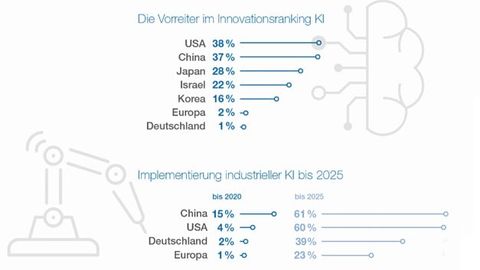
Currently, the USA, closely followed by China and Japan, are ahead in the field of AI. Israel and Korea are also ahead of Germany, which brings up the rear with Europe. As evidence, Hinz presents the number of patent applications for AI: 60% of all patent applications on AI worldwide come from the USA - led by the usual suspects: Microsoft, Alphabet, Intel, Apple, Amazon - closely followed by China and South Korea. According to Hinz, only Siemens manages to rank 16th among German companies.
Six out of ten respondents expect industrial AI to be implemented in China and the USA by 2025, while the majority in Germany expect it to be implemented later. For 71% of companies, the number one factor holding back Germany as a business location is the lack of knowledge about AI, followed by a shortage of skilled workers and legal hurdles (just under 50%). Universities are also plagued by a lack of specialists (67%), a lack of expertise and a lack of budget (53% each). 59% of companies and one in two universities are convinced that Germany and Europe, compared to the USA and China, do not provide sufficient resources for the implementation of revolutionary technical changes.
Industry 4.0 - Germany is weakening
But Hinz goes even further: Asian competitors - China, Japan and South Korea - are also well ahead in the Industry 4.0 innovation ranking. "Germany is only in the middle of the field, with Europe bringing up the rear," concludes the CEO, before going on to explain: "The basic problem is that German industry has long rested on its status quo and has therefore simply missed the boat in many areas compared to the USA and China, which are driving digitalization at all levels," says Ansgar Hinz, explaining the negative mood among those surveyed. 60% of universities and 50% of companies are convinced of this. They also believe that the industry is struggling to develop revolutionary business models with the help of digitalization. "To put it in a nutshell: We have to get out of our comfort zone," demands the VDE boss. To achieve this, various adjustments need to be made, above all in terms of innovation excellence, industry convergence and our willingness to take risks.


You might also be interested in
Computing power for AI
According to many experts, the potential of artificial intelligence in the manufacturing environment is enormous. Preconfigured or AI-adapted computer solutions make it easier to get started with the new technology.
 read more...
The potential in the manufacturing industry
A study commissioned by the German Federal Ministry for Economic Affairs and Energy demonstrates the high value creation potential of AI in the manufacturing industry. The authors of the study, Dr. Inessa Seifert and Dr. Leo Wangler, provide...
read more...AI in the industry
How widespread is artificial intelligence in industry today? The ARC Advisory Group is currently getting to the bottom of this question with a study. Ebele Maduekwe explains the upcoming results in advance.
read more...The Hannover Messe 2019 in pictures
At Hannover Messe 2019, exhibitors demonstrated what the networked production processes of the future will look like. In addition to AI, digitalization, 5G and I4.0, the Computer&AUTOMATION team has put together a selection of other things to...
read more...Edge AI HPCs for Vision AI and GenAI
Advantech has announced the 'AIR-410' and 'AIR-420', next-generation compact Edge AI high performance computers (HPCs). Combining AMD Ryzen 7000/8000/9000 series processors, scalable GPU support and Advantech's 'Edge AI SDK' software, the systems...
read more...Siemens presents technologies to accelerate industrial AI
At CES, Siemens presented technologies to accelerate industrial AI: new digital twins, AI co-pilots, an Industrial AI Operating System and applications in manufacturing, energy and life sciences.
read more...Hitachi takes over Synvert
Hitachi Group has signed an agreement to acquire Synvert, a Germany-based company, as a wholly owned subsidiary of its US subsidiary GlobalLogic from Maxburg, a private equity fund focused on founder-led technology companies in the German-speaking...
read more...Proalpha takes over Insiders Technologies
The Proalpha Group, provider of business applications for SMEs, acquires Insiders Technologies and significantly expands its 'Industrial AI Platform' with AI applications and services for digital document processing.
read more...Industrial AI at SPS | Endress+Hauser
"AI will become a natural functional component"
Industrial AI is also becoming increasingly relevant in process automation: although field devices themselves still make little use of it, it is already proving helpful in evaluation and peripheral devices as well as control systems. Christian...
read more...