

Research project
The big data machine
With 'The Machine', Hewlett Packard Enterprise (HPE) has redeveloped computer architecture from the ground up. Computer & AUTOMATION spoke to Andreas Hausmann, Chief Technologist at HPE, about the background and possible applications of 'Memory-Driven Computing'.

Mr. Hausmann, what is 'The Machine' and why did you start this project?
Hausmann: 'The Machine' is a research project in which we have developed the computer architecture, which has remained unchanged for 70 years, from scratch. Why did we do this? Because computers with the current architecture will simply not be able to process the volumes of data that we generate in the Internet of Things. Today, sensors are digitizing the real, analogue world on a grand scale. They measure temperature, humidity, speed, vibration, inclination, they capture images and sounds. This creates a volume of data that exceeds all previous standards. For example, modern jet engines have thousands of sensors. The engines of a single manufacturer alone can generate zettabytes of data - for comparison: one zettabyte was the total amount of data on Earth in 2010.
And this development is happening just as we are approaching the end of Moore's Law - since 2015, we have been observing that the increase in performance per surface area of processors is slowly leveling off. Current memory technologies are also approaching the end of their performance increase. We are convinced of this: Only if we make a radical new start will we be able to overcome the limitations of today's computers. That is why we have developed a new computer architecture that we call 'Memory-Driven Computing'.
Why is memory-driven computing so revolutionary?
Hausmann: We are turning the current computer architecture on its head. The core of today's architecture is the processor - and its performance will soon no longer be able to be increased as before. Today's computers also use 90% of their power to move data between different memory levels - for example, between RAM and disk storage. We are fundamentally changing both. The core of memory-driven computing is no longer the processor, but a new type of working memory of practically unlimited size that combines several memory levels. This allows computer performance to be increased many thousands of times and opens up completely new possibilities in fields such as medical research, production, networked mobility and securities trading.
How does the new technology work?
Hausmann: In the current computer architecture, the processor is the bottleneck. Processors are linked to individual, dedicated memory resources over which they have sole decision-making authority. This means that the computer cannot scale beyond its physical limits, which is why the main memory is a constantly scarce resource in the computing process.
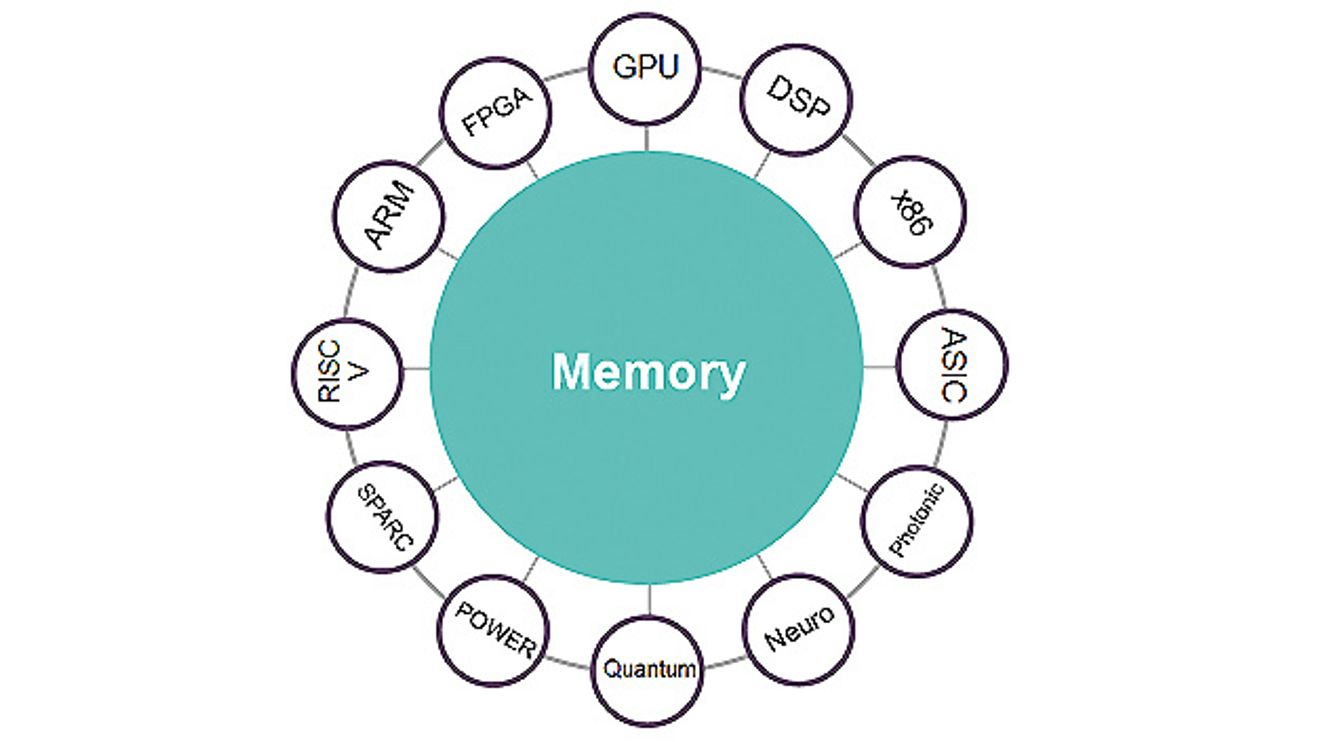
Memory-driven computing, on the other hand, focuses on the data. Here, memory becomes a massive pool of resources to which the appropriate processors can be assigned depending on the task. This fundamental change in architectural paradigms allows us to look at many problems from a completely new perspective: Memory-Driven Computing is not just a new hardware, but a fundamentally new system for which we have also developed completely new software.
What technology is being used to implement the project?
Hausmann: One of the most exciting things is the new system bus architecture based on Gen-Z, with which we are opening up the physical boundaries of the computer. Until now, the processor of a server could only access the memory located on the same motherboard. Gen-Z makes it possible for the processor of computer A to access the memory of computer B. As we are thus overcoming the physical limits of conventional hardware, we no longer use copper connections, for example, but photonics to connect the individual components. This creates a major advantage, namely spatial design freedom. With photonics, we can also communicate between the components of the memory pool over long distances without loss and at low cost.
For the memory pool itself, our current prototype uses a total of 160 terabytes of memory, distributed across a total of 40 physical computing nodes. Within the architecture, we can easily scale the manageable memory to exabyte size and theoretically up to 4096 yottabytes.

Andreas Hausmann: "With 'The Machine', we have created a computer that is ideally suited to the age of big data."
© Hewlett Packard EnterpriseWhat role does the processor still play in such a memory-centric architecture?
Hausmann: The role of processors changes fundamentally in memory-driven computing. Thanks to the independent memory pool, we have the option of assigning the most suitable processor to the individual tasks with the data located there on an ad hoc basis. In the past, the processor had to be a generalist that could handle various workloads well. Memory-driven computing offers much more scope for selecting the right processor for the task in hand. To solve a problem, we can use a single processor or many processors in parallel. Or we can use more specialized processors such as GPUs, depending on the requirements profile. If you like, we free the memory from the dictatorship of the processor.
What will the software of such an architecture look like?
Hausmann: Conventional operating systems are not capable of dealing with such a radically new architecture. We are currently using a
operating system developed in-house - for us, the future of memory-driven computing is clearly open source. The application software also has to be adapted so that it can exploit the possibilities of the new architecture. One new aspect, for example, is that I/O instructions are no longer required. This has to be taught to the application software. The fact alone
The fact that almost infinite resources are now available in the area of working memory alone requires a fundamental rethink of the question of which data needs to be calculated and when - and which data has already been precalculated and can then be retrieved later.
can be precalculated and then retrieved later.
What are the advantages of this fundamentally changed architecture?
Hausmann: Heterogeneous computing, i.e. the shared use of the same memory pool by several parallel processes - without having to move data back and forth at great expense - is revolutionizing entire sectors of software development. In addition, these new architectures allow us to speed up applications extremely, even if they are only modified. But if we give the architecture complete freedom, set assumptions from 70 years of software development to zero and fundamentally rethink an application, the results are breathtaking: Monte Carlo simulations, for example, such as those used in the financial world for risk analysis, can be accelerated by up to 8000 times. This turns simulations into real-time information.
So is memory-driven computing primarily designed for large computing center applications?
Hausmann: No, we want to make this architecture ubiquitous. It should run in miniature size in sensors or cars as well as in supercomputers the size of a shipping container. It is just as at home in the Internet of Things as it is in data centers.
Where can it play to its strengths, especially in manufacturing and production?
Hausmann: Memory-driven computing will make the cycle of sensors, analytics and actuators much more powerful, but also more flexible. Users will be able to access an almost unlimited amount of data extremely quickly, for example the complete sensor data history of not just one production machine, but many similar production machines. This means that a huge amount of correlation analyses can be carried out in fractions of a second, for example to fish out patterns from the current data stream that indicate imminent machine damage.
Memory-driven computing will also play an important role in the implementation of the changeable factory. This is because the system can react extremely quickly to a practically unlimited variety of product variants and unforeseen events. Memory-driven computing can also accelerate the training of robots with the help of deep learning.
Where else can it be used?
Hausmann: One example is medical research. We are cooperating with the German Center for Neurodegenerative Diseases, for example, which wants to use memory-driven computing to speed up its research processes and increase its precision by analyzing larger volumes of data. The DZNE scientists hope that this will lead to completely new insights into the causes of Alzheimer's and other dementias. The financial sector is another example. As already mentioned, we can speed up Monte Carlo simulations by a factor of 8000 with memory-driven computing. In the world of real-time financial transactions, this can make the difference between profit and loss for a company.
What is the timetable for 'The Machine' project?
Hausmann: Our timetable is organized on three parallel tracks. The first, most important step has already been completed: With our working prototype, we can work with partners and customers to further refine the technology for memory-driven computing and optimize applications to fully exploit the architecture's potential. To this end, we have also launched 'The Machine User Group' and made open source development tools available. Secondly, we are developing a reference architecture for an exascale supercomputer based on memory-driven technologies over the next five years - in other words, a computer that can perform at least one trillion computing operations per second. Thirdly, in the coming months and years, we will integrate technologies from The Machine research project into our current product lines, such as non-volatile memory technologies and photonics. Many customers will therefore benefit from the results of our research project in the very near future. We will therefore automatically take them on a journey into the new computer architecture.
Discover 'The Machine
In 'The Machine User Group', developers, technologists and industry experts can network to discover the possibilities of memory-driven computing together. HPE also provides developers with a free toolkit that allows them to take full advantage of memory-driven computing.


You might also be interested in
DLR Institute launched to analyze huge amounts of data
A new DLR institute was opened in Jena at the end of August 2017. It will focus on the analysis and handling of large amounts of data generated in the course of digitalization.
 read more...
The knowledge hub of the embedded community
The embedded systems industry will meet from March 11 to 13. In seven exhibition halls, exhibitors in Nuremberg will provide information on hardware, software, services and tools. Two accompanying conferences, expert panels and exhibitor forums will...
read more...Customized Single Board Computer
Helbling has developed a flexible embedded vision platform based on an ARM processor that can be used as a reference design for the development of customized single board computers (SBC).
read more...Secure embedded PC for industrial applications
According to the manufacturer, the 'ReliaCOR 54-13' embedded PC from Inonet is one of the first embedded computers made in Germany to be certified for AI applications in accordance with IEC 62443-4-2. It therefore meets the requirements of...
read more...Operation via touch, glove, pen or digitizer
Getac launches the next generation of 'F110' and 'K120' tablets: The new F110 is suitable for use in a variety of harsh outdoor and indoor scenarios.
read more...IPC for IIoT gateway
The compact and energy-efficient industrial PC 'DA-1200' from Cincoze is suitable for IIoT gateways in modern industrial applications.
read more...Two new surface-mounted keyboards
Wöhr is expanding its 'Surta' industrial keyboards with versions 15 and 16, which have been specially developed for environments such as medical and dental areas, the pharmaceutical, clean room and food industries, as well as general industry and...
read more...New threat to industrial control systems
FrostyGoop is the name of a new malware variant that specializes in industrial control systems (ICS). It poses a threat to critical infrastructures worldwide. OT cyber security expert Dragos has identified FrostyGoop.
read more...Edge rack server in robust
The trend towards hyper-convergent infrastructures is not stopping at the manufacturing and automation industry. Siemens has now launched the first edge rack server in robust industrial PC quality. How is the inner workings of the server designed?
read more...