
nLighten
Edge as a growth driver
The digital infrastructure is on the brink of change: central data centers are reaching their limits - powerful systems directly at the edge of the network are in demand. Edge data centers are becoming a decisive factor in complementing central infrastructures in a meaningful way. nLighten identifies five key drivers for this development.
Today's digital society is largely based on the infrastructure of global hyperscalers - from international giants such as AWS and Microsoft Azure to regional providers such as Akamai or OVHcloud. These players ensure that digital services are provided smoothly worldwide.
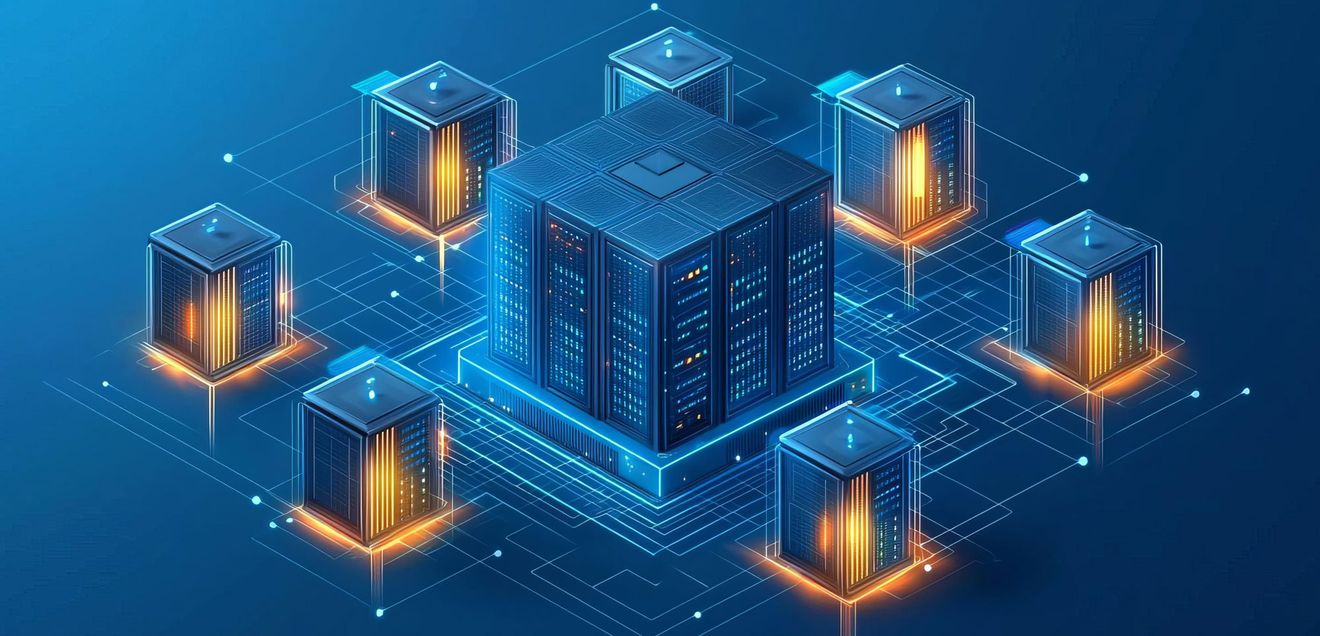
Traditionally, this is done via large, centralized data centers in metropolitan regions such as Frankfurt, Amsterdam or Paris. However, this model is increasingly reaching its limits - the requirements for speed, data processing and availability are changing rapidly. A change is noticeable: edge data centers, i.e. decentralized facilities in close proximity to users, are becoming increasingly important. They are a useful addition to central infrastructures - especially in the context of real-time analysis, AI applications at the edge of the network and digital services with high performance requirements.

Hans Nipshagen, Vice President Channel Sales at nLighten, identifies five key drivers for the increasing importance of edge data centers:
1. lower latency and improved user experience: By processing data in close proximity to the source, edge data centers minimize latency and enable real-time interactions - essential for applications such as augmented reality, virtual reality, gaming, autonomous vehicles and IoT solutions. This local approach noticeably improves the user experience through immediate responsiveness and supports new application scenarios such as real-time analytics, edge AI and machine learning.
2. optimized bandwidth usage and greater cost efficiency: local processing reduces the load on networks and makes operations more efficient because less data has to be transported over long distances. By filtering and analysing information directly at the edge of the network, only relevant data is forwarded to central cloud data centers - this optimizes bandwidth usage and speeds up decision-making processes. This leads to greater efficiency and faster insights, especially for data-intensive applications such as video analysis or predictive maintenance.
3. opening up new markets: Edge data centers help hyperscalers to provide their services even in previously underserved regions with a weak network infrastructure. The local presence of edge data centers ensures that users can access consistent, fast and reliable cloud services everywhere. In many parts of the world where centralized cloud infrastructures have so far been insufficient, edge technology opens up new opportunities for digital participation and growth.
4. support for 5G and next-generation applications: With the global expansion of 5G networks, edge data centers are taking on a key role for applications that rely on real-time and big data. With the help of edge infrastructures, hyperscalers can seamlessly integrate their cloud services into 5G networks and thus support future-oriented solutions for smart cities, autonomous vehicles and Industry 4.0. This strategic positioning gives them a head start in digital innovation and opens up new revenue potential in the growing 5G ecosystem.
5. increased reliability and improved disaster recovery: By distributing across multiple locations, hyperscalers ensure high availability and reduce the risk of downtime. The decentralized model improves emergency preparedness and ensures that important applications continue to run reliably even in an emergency.
By combining centralized and decentralized IT infrastructure, hyperscalers ensure global reach and local performance. This change is particularly relevant for the automation and manufacturing industry - it creates the basis for networked, flexible and future-proof production systems.


You might also be interested in
New Generation of Industrial Routers
Insys icom isexpanding its product portfolio with Moros.neo,a new generation of routers designed for use in critical infrastructure and industrial environments.
 read more...
Connecting Wireless Sensors and Analog Control Systems
Hottinger Brüel & Kjær (HBK) has reintroduced the "WSDA-101" wireless gateway to the market. The wireless gateway is particularly well-suited for applications that require predictable analog signals with low latency.
read more...Market Analysis: Industrial Networks
Industrial Ethernet Reaches 79%
A market analysis by HMS Networks shows that Industrial Ethernet accounts for 79% of all newly installed network nodes. Fieldbus technologies continue to lose ground.
read more...Benoît Thooris takes over as president
Benoît Thooris is taking over as head of UniversalAutomation.Org. The organization is also adding two new members to its Board of Directors.
read more...Flexible analog mix module
The analog mix module 'AM 821' from Sigmatek's S-DIAS series has eight analog differential inputs with 16-bit resolution and two analog outputs.
read more...New test laboratory in Neu-Isenburg
UL Solutions builds EMC and radio laboratory
UL Solutions has started construction of a new laboratory for electromagnetic compatibility and wireless communication in Neu-Isenburg. The facility is set to expand testing capacities for industrial systems, medical technology, consumer goods and...
read more...Networking identification systems at field level
'IdentChain' is a platform from Leuze with which identification systems can be networked at field level.
read more...AI-supported maintenance for industrial plants
Teamviewer has introduced key enhancements to its industry solutions 'Agentless Access' and 'Assist AR'. The company is thus strengthening its AI-supported offering at the interface between operational technology (OT) and IT.
read more...Portal for data exchange in mechanical...
VDMA and Innovalia develop data rooms
VDMA and Innovalia are jointly developing a data room portal for mechanical and plant engineering. It is intended to facilitate the secure exchange of data and accelerate the use of data-based applications in industry.
read more...