
Market Analysis: Industrial Networks
Industrial Ethernet Reaches 79%
Industrial Ethernet continues to grow in the field of factory automation. According to the latest market analysis by HMS Networks, Ethernet-based technologies now account for 79% of all newly installed network nodes worldwide. Fieldbus systems, on the other hand, continue to lose ground.

Industrial Ethernet has increased its share of newly installed network nodes in factory automation worldwide to 79%. This is according to the annual market analysis by HMS Networks, which has examined the distribution of new network nodes for the twelfth time. Last year, the share stood at 76%; in 2015, it was 34%.
Following a market slowdown in 2024, the automation market stabilized again in 2025. According to HMS Networks, supply chains have normalized and inventory levels have largely been reduced. Despite the ongoing weakness in the European automotive sector, investment in new automation projects has resumed in most regions. For the next five years, the company expects an average annual growth rate of approximately 7.7% in newly installed nodes.
Profinet over EtherNet/IP and EtherCAT
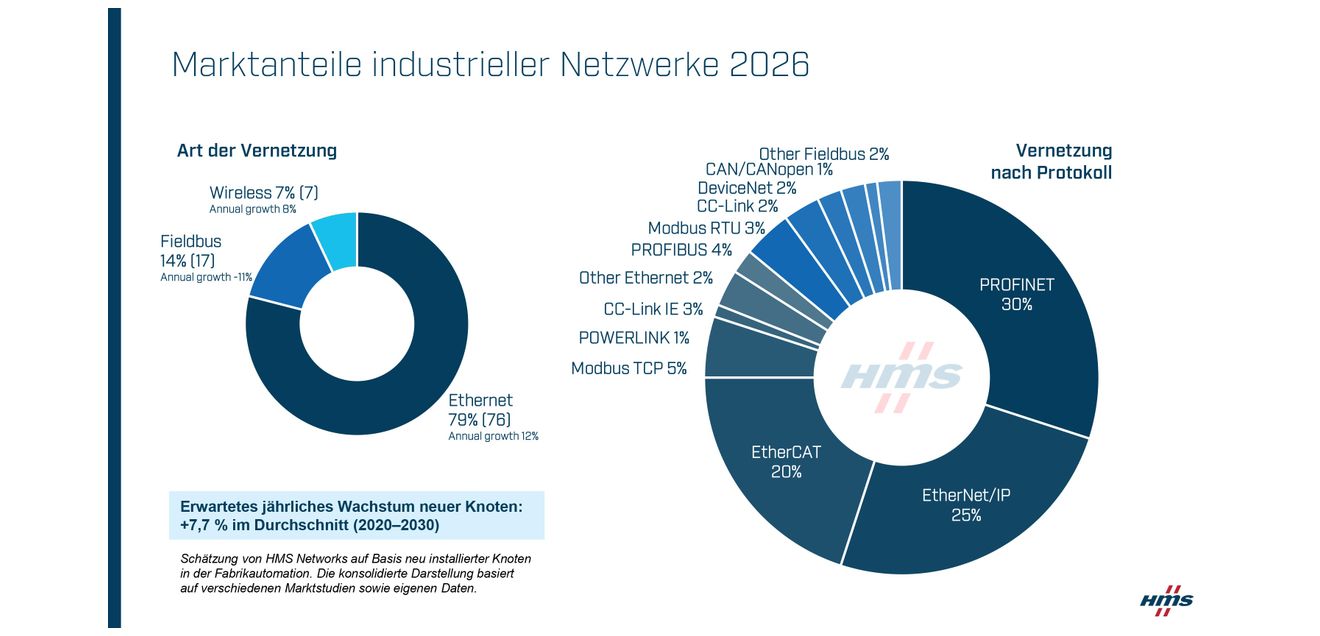
Within the Industrial Ethernet segment, Profinet remains the most widely used protocol, with a market share of 30%. Last year, that share stood at 27%. EtherNet/IP follows with 25%, up from 23% in 2025, while EtherCAT has grown from 17% to 20%.
Modbus TCP accounts for 5%, while CC-Link IE remains at 3%. Powerlink, on the other hand, has declined significantly, falling from 3% to 1%. Other Ethernet protocols account for a combined 2%.
Fieldbus technologies continue to lose ground
The share of traditional fieldbus systems fell from 17% to 14% within a year. Although Profibus remains the largest fieldbus standard at 4%, it continues to lose market share compared to the previous year's figure of 5%.
According to PI (Profibus & Profinet International), the number of newly installed Profibus nodes declined from 1.1 million in 2024 to 1.0 million in 2025. Modbus RTU holds a 3% share, while CC-Link, DeviceNet, and CAN/CANopen each account for between 1% and 2%. Other fieldbus protocols account for only 2%.
Wireless remains steady
Wireless network technologies account for 7% of new installations. They are primarily used in mobile applications such as automated guided vehicles (AGVs), autonomous mobile robots (AMRs), machine retrofits, and IIoT sensors.
According to the study, however, the rollout of 5G is proceeding more slowly than many had expected. The complexity of private 5G infrastructure is considered a major hurdle. The first industrial applications are emerging primarily in Asia.
Regional Differences
Profinet and EtherCAT continue to dominate the European market. At the same time, technologies such as Advanced Physical Layer (APL) and Single Pair Ethernet (SPE) are gaining ground. The decline of Profibus is particularly pronounced here.
In North America, EtherNet/IP remains the leading protocol, particularly in the automotive industry and discrete manufacturing. In addition, interest in IO-Link, APL, and SPE is growing, in part due to operational technology (OT) cybersecurity requirements.
Profinet and EtherCAT continue to grow in the Chinese market. CC-Link IE maintains its strong market position there.
The focus is shifting to higher levels
“Twelve years of market analysis tell a remarkably consistent story. The transition from fieldbus to Industrial Ethernet is now in its final stages. The exciting question today is what happens next. Once nearly everything is based on Ethernet, the discussion shifts from ‘Which protocol?’ to ‘What builds on top of it?’. For example, functional safety, cybersecurity, TSN, OPC UA, Single Pair Ethernet, or IT/OT convergence. That is precisely where both complexity and differentiation will lie in the future,” says Magnus Jansson, Director of Product Marketing at HMS Networks.
In addition to its market analysis, HMS Networks also publishes the “State of Industrial Networking” report, which examines, among other things, developments in cybersecurity, industrial communications, and regional market trends.


You might also be interested in
Benoît Thooris takes over as president
Benoît Thooris is taking over as head of UniversalAutomation.Org. The organization is also adding two new members to its Board of Directors.
 read more...
Flexible analog mix module
The analog mix module 'AM 821' from Sigmatek's S-DIAS series has eight analog differential inputs with 16-bit resolution and two analog outputs.
read more...New test laboratory in Neu-Isenburg
UL Solutions builds EMC and radio laboratory
UL Solutions has started construction of a new laboratory for electromagnetic compatibility and wireless communication in Neu-Isenburg. The facility is set to expand testing capacities for industrial systems, medical technology, consumer goods and...
read more...Networking identification systems at field level
'IdentChain' is a platform from Leuze with which identification systems can be networked at field level.
read more...AI-supported maintenance for industrial plants
Teamviewer has introduced key enhancements to its industry solutions 'Agentless Access' and 'Assist AR'. The company is thus strengthening its AI-supported offering at the interface between operational technology (OT) and IT.
read more...Portal for data exchange in mechanical...
VDMA and Innovalia develop data rooms
VDMA and Innovalia are jointly developing a data room portal for mechanical and plant engineering. It is intended to facilitate the secure exchange of data and accelerate the use of data-based applications in industry.
read more...Profinet enables CRA conformity
The EU Cyber Resilience Act (CRA) will require all manufacturers of products with digital elements to implement comprehensive security measures from December 2027. After a thorough review of its technologies, Profibus & Profinet International...
read more...Profibus & Profinet International
MTP Specification 2.0 published
Profibus & Profinet International (PI) announces the official release of the Module Type Package (MTP) Specification 2.0. The MTP 2.0 standard creates the basis for true cross-industry interoperability as well as more flexibility and efficiency...
read more...Kevin Kennedy becomes global head of the partner ecosystem
Red Hat is continuously strengthening its dynamic, networked partner ecosystem. Now Kevin Kennedy has been appointed as the new Vice President of the Global Partner Ecosystem.
read more...