

KIT
New building block for the quantum internet
Together with European partners, researchers at the Karlsruhe Institute of Technology (KIT) have networked superconducting quantum computers with a spin-based quantum memory. In doing so, they are taking quantum technology a decisive step forward. The European Innovation Council is funding the project as part of the Pathfinder program.
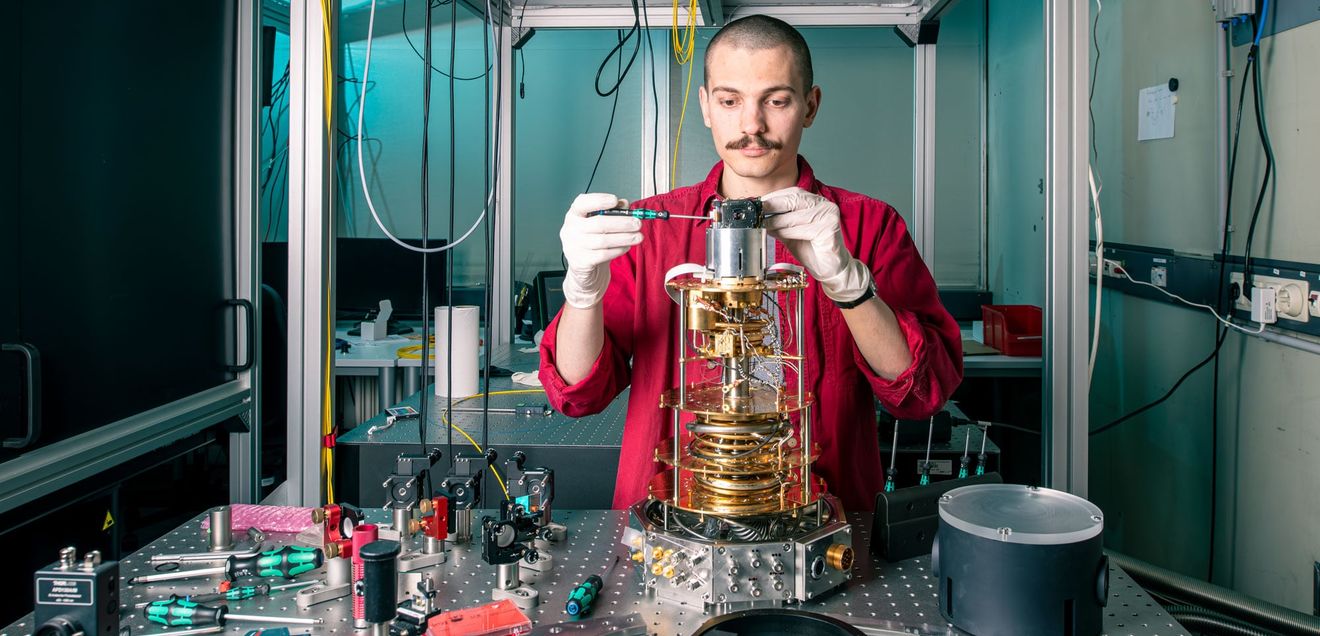
The development of quantum technologies is progressing, with quantum computers in particular promising breakthroughs in medicine, materials science and cryptography. However, they only develop their full potential when they are networked. "At the moment, many quantum systems work independently of each other," explains Professor David Hunger from the KIT Institute of Physics. "In the Superspin project, we are developing a technology with which a quantum computer and a quantum memory can be reliably coupled. In this way, we are also creating the basis for linking quantum computers in the future, realizing distributed quantum computing and building a quantum internet."
To connect the systems, qubits are converted into photons, known as "flying qubits", which travel almost loss-free over fiber optic cables. With the help of quantum entanglement, quantum states can be reliably transferred from one system to another.
The coupling of different systems is particularly technically challenging: superconducting qubits work in the microwave range, while diamond-based quantum memories use light in the visible wavelength range. Special quantum transducers convert the states and adapt the photons for transport via fiber optic cables. At KIT, a quantum memory made of diamond defects is being developed that combines light and spin properties and can store the photons. "Our project goal is to connect the physically completely different systems and create an entanglement between a superconducting qubit and a spin-based quantum memory," says Hunger.
The Superspin project is part of the Pathfinder program of the European Innovation Council (EIC) and is one of 44 projects that will receive a total of over 140 million euros. The partners are Aalto University in Finland, Palacký University in Olomouc in the Czech Republic and the Dutch start-up QphoX.


You might also be interested in
New Generation of Industrial Routers
Insys icom isexpanding its product portfolio with Moros.neo,a new generation of routers designed for use in critical infrastructure and industrial environments.
 read more...
Connecting Wireless Sensors and Analog Control Systems
Hottinger Brüel & Kjær (HBK) has reintroduced the "WSDA-101" wireless gateway to the market. The wireless gateway is particularly well-suited for applications that require predictable analog signals with low latency.
read more...Market Analysis: Industrial Networks
Industrial Ethernet Reaches 79%
A market analysis by HMS Networks shows that Industrial Ethernet accounts for 79% of all newly installed network nodes. Fieldbus technologies continue to lose ground.
read more...Benoît Thooris takes over as president
Benoît Thooris is taking over as head of UniversalAutomation.Org. The organization is also adding two new members to its Board of Directors.
read more...Flexible analog mix module
The analog mix module 'AM 821' from Sigmatek's S-DIAS series has eight analog differential inputs with 16-bit resolution and two analog outputs.
read more...New test laboratory in Neu-Isenburg
UL Solutions builds EMC and radio laboratory
UL Solutions has started construction of a new laboratory for electromagnetic compatibility and wireless communication in Neu-Isenburg. The facility is set to expand testing capacities for industrial systems, medical technology, consumer goods and...
read more...Networking identification systems at field level
'IdentChain' is a platform from Leuze with which identification systems can be networked at field level.
read more...AI-supported maintenance for industrial plants
Teamviewer has introduced key enhancements to its industry solutions 'Agentless Access' and 'Assist AR'. The company is thus strengthening its AI-supported offering at the interface between operational technology (OT) and IT.
read more...Portal for data exchange in mechanical...
VDMA and Innovalia develop data rooms
VDMA and Innovalia are jointly developing a data room portal for mechanical and plant engineering. It is intended to facilitate the secure exchange of data and accelerate the use of data-based applications in industry.
read more...