

Sensor-actuator communication
IO-Link - Companion Specification for OPC UA in progress
The IO-Link community has set up a technical working group to specify the integration of IO-Link in OPC UA based on existing use cases. A final proposal for a corresponding Companion Specification (draft for voting) should be available in 2018.
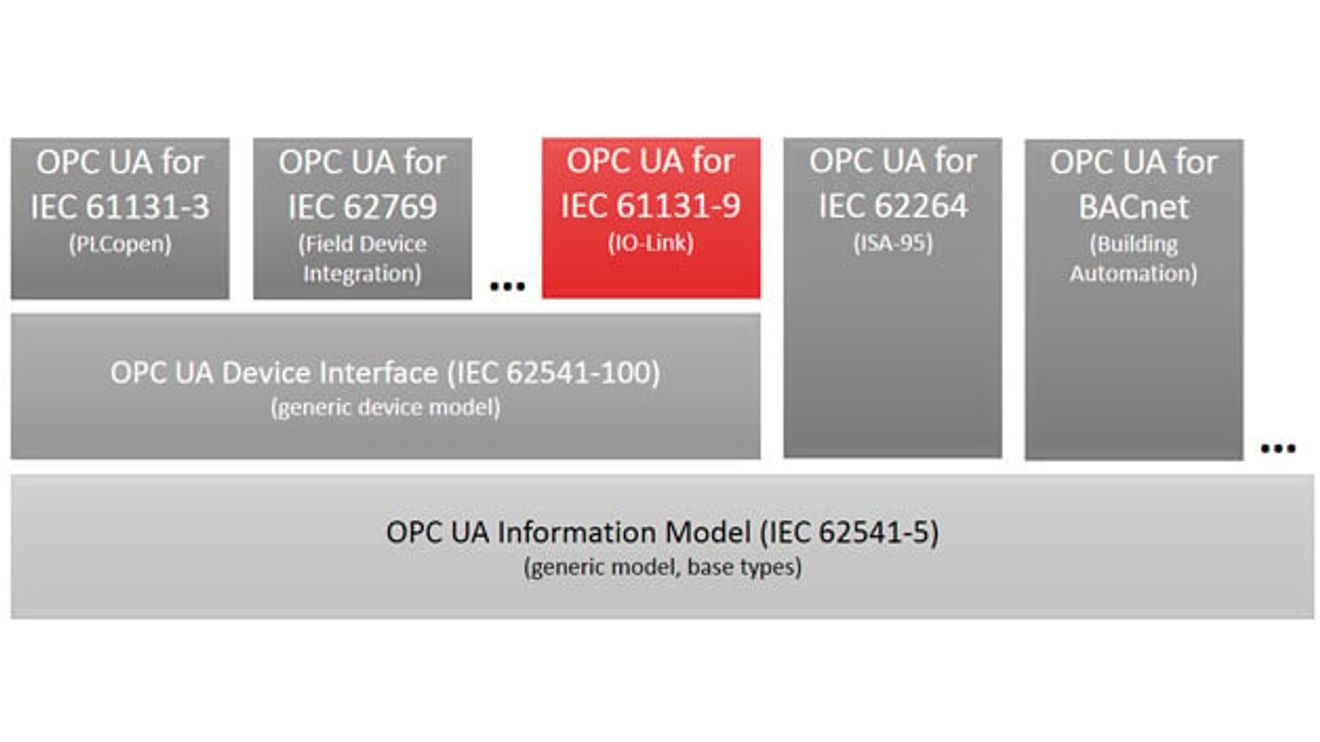
The Industry 4.0 platform sees OPC UA (from the OPC Foundation) as a suitable architecture model for implementing end-to-end integration from IT to field level. For this reason, a corresponding standard for a data and function model is now being developed within the IO-Link community in order to be able to represent IO-Link devices and IO-Link masters accordingly in OPC UA in the future. The approach follows the general recommendation of developing OPC UA Companion Standards.
IO-Link as a point-to-point protocol for sensors and actuators has become increasingly established over the last few years. By using appropriate so-called "IO-Link masters", IO-Link sensors and actuators can be connected to the various fieldbus systems without further adaptation. Today, such masters can even be integrated into simple devices at low cost. IO-Link thus offers the possibility of accessing a very wide range of sensors and actuators in a standardized and fieldbus-independent manner.
As part of Industry 4.0 efforts, there is also a need to semantically integrate IO-Link devices into systems that lie above the fieldbus in order to be able to evaluate sensor data. This functionality is often referred to as "sensor to cloud" to express that the sensor data is analyzed by IT systems that are outside the automation. In this way, sensor data can also be seamlessly connected to MES and ERP systems.
The new IO-Link / OPC UA working group (C4/PG51) is headed by Michael Tiegelkamp from TE Connectivity.


You might also be interested in
VDMA Companion Specs for OPC UA
In the factory of the future, machines will have to speak the same language - this requires standardized communication interfaces. The VDMA's OPC UA image processing and robotics working groups have now published their first specifications.
 read more...
A switch especially for automation
Indu-Sol Managing Director Karl-Heinz Richter is convinced that switches from the IT world do not always meet the requirements of automation technology. The network specialist from Schmölln is therefore now coming up with its own solution.
read more...Profibus User Organization (PNO)
New Profidrive profile tester available
The PNO has announced that a new version 5 of the Profidrive profile tester is now available. The Profinet-based tool can be used to test drives for compliance with the Profidrive profile.
read more...IEC adopts Mini-IO from TE as standard
The International Electrotechnical Commission (IEC) has recognized the Mini-IO connector from TE Connectivity (TE), a provider of connectivity and sensor solutions, as an international standard (IEC 61076-3-122).
read more...Data hub for OPC UA
In June 2017, Industrie Informatik presented the latest release of the MES solution Cronetwork. The focus was on the newly integrated OPC UA server. Thomas Krainz, member of the management team and responsible for product management, explains what...
read more...Parallel to SPS IPC Drives 2017
The 'Automation 4.0 Summit'
TSN, sensor technology, open source and embedded vision: all these trend topics from the Industry 4.0 environment will be addressed at the 'Automation 4.0 Summit', which runs parallel to SPS IPC Drives 2017.
read more...Via OPC UA into the Internet of Things
With the current firmware version V3, the Simatic RF600 RFID system supports the open OPC UA interface. This allows the device to be connected via the industrial IoT gateway 'Ruggedcom RX1400' with MindConnect or the MindConnect Nano cloud gateway,...
read more...TE Connectivity buys Hirschmann
Hirschmann Car Communication becomes part of TE Connectivity. This was announced by the specialist for transmission and reception systems and subsidiary of VOXX International.
read more...OPC UA is set!
OPC UA is regarded as the established standard for Industry 4.0, so you couldn't miss it at Hannover Messe 2017 - as demonstrated by three short videos.
read more...