
175 years of Siemens
From pointer telegraph to digitizer
What began with an improved pointer telegraph is now digitizing industry. Siemens has shed its skin more than once since it was founded.
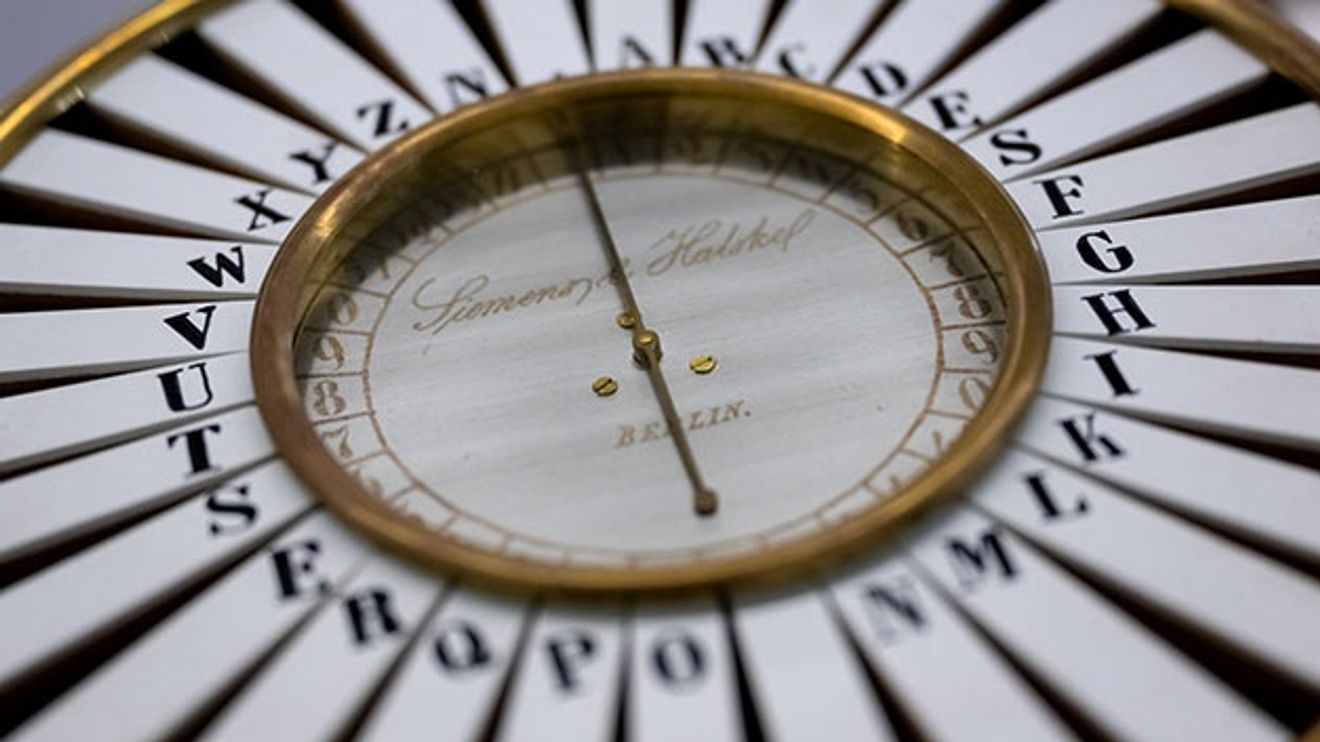
The replica of a pointer telegraph (1847) from Siemens can be seen in Siemens' historical depot. The company is 175 years old this year.
© Sven Hoppe/dpaFour German DAX companies could actually celebrate their 175th birthday on October 1. This is the anniversary of the shareholders' agreement that marked the beginning of Siemens. What began as a backyard workshop for the construction of improved pointer telegraphs is now helping companies worldwide with the fourth industrial revolution, building intelligent infrastructure and a marketplace for digital services. Along the way, the company has transformed itself time and again, helping three other DAX-listed companies into the world.
It has become difficult to explain Siemens clearly, as digitalization and software for industry and infrastructure are playing an increasingly important role in the Group. And many things that were once associated with Siemens, such as cell phones, telephones, refrigerators and power plant turbines, are no longer produced by the Munich-based company.
Cash cow digital industries
The smallest of the three core divisions, Mobility: trains and rail infrastructure, is still the easiest. They are perhaps the most prominent direct point of contact with the average consumer - although the customers here are cities, corporations or entire countries. And here, too, things are becoming increasingly digital, from predictive maintenance thanks to artificial intelligence (AI) to the networking of train inventory management, reservations and ticket sales.

However, Siemens has recently earned most of its money in its Digital Industries division, far away from the consumer. This is about factories and production lines and their simulation, about detecting problems and fixing them before they occur, about continuous monitoring and optimization of production - also in terms of resource consumption and energy consumption. Artificial intelligence, digital images of reality and cloud solutions are the tools here. "We can connect the digital and real worlds like no other company," emphasizes Group CEO Roland Busch. Siemens has been involved in the rapid construction of plants for coronavirus vaccines, for example, and is working with Daimler to realize the car factory of the future.
Industrial metaverse planned
And the next goals have already been set: together with graphics card manufacturer and artificial intelligence chip specialist Nvidia, Siemens wants to develop a kind of industrial metaverse and combine its digital models with more realistic visualization and real-time AI from Nvidia. This will "literally open up another dimension of digitalization", enthuses CEO Busch. "Experts from all over the world will be able to work together virtually as if they were in the same room and achieve more much faster and more sustainably. "
At the same time, the Group is building an ecosystem under the name Xcelerator, in which not only its own services but also those of third-party providers are to be offered and networked. And those who want to do so no longer even have to buy the hardware and software, but can obtain it as a complete package as a service.
In the meantime, the move towards digital has almost gone too far for some. "Siemens will never become a pure software company," emphasized Jürgen Kerner, General Treasurer of IG Metall and member of the Siemens Supervisory Board, in August, urging the company to also invest in production in Germany. One of Siemens' key strengths is that it is represented in both worlds. Thanks to its hardware, the company is already in the engine room of industry - where its software-only competitors have yet to reach.
"Our aim is to constantly reinvent ourselves, anticipate new technologies and trends, remain agile and not rest on our laurels," says Busch. "We want to continue to play a leading role worldwide for the next 175 years."
From Siemens & Halske to Siemens
In recent years, this reinvention has not only been reflected in frequent digital advances and an emphasis on topics such as climate protection and resource conservation, but also in a radical transformation. While other companies were struggling with the coronavirus crisis, which Siemens overcame with astonishing stability, the company completed its project to focus.
After a rather unpleasant start to the new millennium with a bribery scandal and a weak phase in business, Siemens wanted to move away from its image as a general store that produced everything from cell phones to gas turbines. This is also the reason for two of the other DAX companies already mentioned. With Siemens Healthineers and Siemens Energy, the Munich-based company with Berlin roots has floated its healthcare technology and energy technology on the stock market in recent years. Both are large enough to be listed on the Dax. And neither would exist if a company had not been founded on October 1, 1847, which was initially - for legal reasons - not even called Siemens, but after the business partner Halske.
The fourth Dax company is still missing. It is the only one not to bear the name of the company founder, but it was also created as a spin-off: Infineon is rooted in the former semiconductor division of Siemens. And all four companies have another special feature in common: their financial year does not begin on January 1, as is the case with most German corporations, but on October 1 - just like the history of Siemens 175 years ago.


You might also be interested in
Mediator between OT and IT
Robur Automation used AI and edge computing to implement a parking solution without barriers and was one of the pilot users of an edge solution with an S7-1500 design. A field report.
 read more...
Cooperation with Microsoft
With the "MO360 Data Platform", Mercedes-Benz is networking its passenger car plants with the Microsoft Cloud. The aim is to improve transparency and predictability along the digital production and supply chain processes.
read more...Curious standards from tea to clay
Tea is quickly made in everyday life. But not when it comes to ISO standard 3103. Here, the process is explained in great detail over six pages. You can read these and other strange guidelines here.
read more...Strategic cooperation with Eplan
Siemens Smart Infrastructure and Eplan enter into a strategic partnership for the industrial and infrastructure market segments to intensify cooperation in the area of software solutions.
read more...Development of production lines
Siemens cooperates with Nissan
Together with Nissan, Siemens is developing production lines for the new all-electric Nissan Ariya in Tochigi, Japan.
read more...Siemens threatens first quarterly loss since 2010
Business at Siemens is actually solid, but due to a billion-euro write-down on the minority stake in the former energy technology division Siemens Energy, the first quarterly loss since the financial crisis is looming.
read more...Siemens and Nvidia expand partnership
Siemens and Nvida are intensifying their partnership. The aim is to create an industrial metaverse and further advance the use of digital twin technology powered by artificial intelligence.
read more...First control cabinet made of green steel
The Siemens subsidiary Alpha Verteilertechnik claims to offer the first control cabinet for industry made entirely of green steel.
read more...Siemens quarterly figures Q3-2024
Siemens confirms forecast with a "but"
Siemens is struggling with a weakening automation market in the third quarter. The software business, on the other hand, is developing strongly. It remains to be seen whether this will continue after the switch to a SaaS model.
read more...