
Copilots
From assistance to autonomy
In Germany, around 20% of companies use AI solutions, an increase of eight percentage points compared to the previous year. Microsoft is driving this development forward with 'copilot agents'. Initially assistive technologies are evolving into autonomous systems that can make decisions and control processes independently.

In contrast to traditional AI assistants, which usually work reactively and wait for predefined commands, co-pilot agents act proactively: they independently analyse company data, identify optimization potential and make operational decisions. This is made possible by the use of modern language models, cloud infrastructures and comprehensive process automation.
Intelligent assistance redefined
The idea of an assistant that takes over, organizes and supports tasks is firmly anchored in the modern working world. Microsoft is transferring this principle to digital assistants with its Copilot agents. They go beyond traditional AI assistants by not only responding to commands, but also proactively analyzing and optimizing tasks. They integrate seamlessly into business processes and make intelligent decisions based on contextual data.
Microsoft officially describes Copilot as an AI-based assistance function that is embedded in various Microsoft products: Microsoft 365, for example, supports Copilot in text creation, presentations and logging. GitHub Copilot automates code completion and increases developer productivity. Microsoft distinguishes between two variants: 'Copilot in' is integrated directly into an application such as CRM and provides targeted support there, for example as Copilot in Sales, while 'Copilot for' combines data from several Microsoft 365 apps and generates emails from Excel and SharePoint information, for example, like Copilot for Sales.
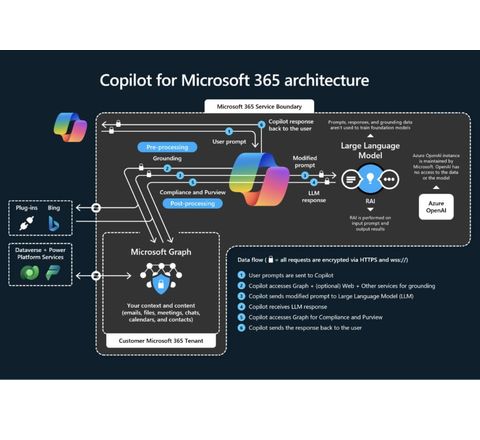
Technically, Copilot is based on GPT-3.5 and GPT-4 via the Azure OpenAI Service. Processing takes place in six steps:
- Input of a request by the user.
- Content check for problematic data.
- Enrichment with company information via Microsoft Graph.
- Processing by the language model to generate a suitable response.
- Security check before output to the user.
- Output to the user
Customized AI agents
With Copilot Studio, the further development of Power
Virtual Agents, companies can create individual AI agents for specific business processes. The low-code platform makes it possible to develop AI-supported chatbots and assistants without in-depth programming knowledge. In the long term, Microsoft is aiming for 'agentic AI', i.e. AI that independently prioritizes tasks, optimizes processes and makes decisions autonomously. Copilot Studio enables companies to develop customized AI agents with a combination of low-code design and pro-code functionalities.
The functions of Copilot Studio include
- Visual modeling of dialogues and topic-related interactions.
- Generative AI to automatically create conversational sequences from natural language descriptions.
- Data integration with SharePoint, FAQs, manuals and Dataverse for company-specific responses.
- Workflow automation via Microsoft Power Automate and connection to external systems (e.g. Salesforce, SAP).
- Multi-channel compatibility, including for web,
Microsoft Teams and Azure Bot Service.
The first companies are already using Copilot Studio successfully: Thomson Reuters, for example, uses the platform for automated contract analyses, while major banks use it to create compliance bots for checking regulatory documents.
At the same time, the flexibility of Copilot Studio also brings new challenges. Companies need to develop clear strategies to define data access rights, automation rules and escalation mechanisms. Because the more autonomous the agents become, the more important the question becomes: how do companies retain control over their AI processes?
Safety and compliance for co-pilot agents
Microsoft Copilot agents integrate existing Microsoft 365 security mechanisms to reliably protect company data. The central security measures include:
- Access control: Role-based authorizations (RBAC) ensure that users only access approved data.
- Data isolation: Information remains within the Microsoft 365 tenant, is not used for AI training and is end-to-end encrypted (TLS, BitLocker).
- Compliance & auditing: Microsoft Purview enables
audit-proof logging and compliance with legal requirements (GDPR, HIPAA). - Attack prevention: Security filters protect against misuse and 'prompt injection' attacks.
Copilot meets common data protection and compliance standards, but compliance remains a shared responsibility between the company and Microsoft. A structured approach ensures secure and compliant use. From an IT security perspective, Copilot is not fundamentally different from other enterprise applications, but requires additional data protection and access controls due to the use of generative AI.
Future analysis: Where is the journey going?

While the first AI integrations, such as in Microsoft 365, primarily provided support functions, the technology is increasingly developing in the direction of automated business processes and autonomous decision support. Copilots are used for proactive process control: Copilot agents perform routine tasks such as accounting reconciliations, contract reviews or the creation of reports independently. They also orchestrate company-specific data flows and optimize processes via Microsoft Graph and Power Automate. And they analyze business figures, generate forecasts and provide automated recommendations for action for various specialist departments. This trend indicates that AI assistants will no longer just be tools in the future, but strategic players in corporate digitalization. A decisive factor for the future of digital assistants is market development. While OpenAI's ChatGPT dominates with a 59% market share, Microsoft Copilot is becoming increasingly important with 14.4% due to its close connection with Microsoft tools. Google Gemini (13.6%) offers an alternative approach with multimodality and web connectivity, while specialized players such as Anthropic Claude or open source models such as Llama 2 play a role primarily in data protection and research environments.
The key differences between these systems lie in their integration and specialization. Microsoft Copilot scores with its seamless integration into company processes by automatically providing relevant content in Word, Excel and Teams. OpenAI's ChatGPT, on the other hand, impresses with its high linguistic competence and versatile expandability, but remains a general assistant without specific adaptations. Google Gemini relies on web integration and multimodal processing, which is particularly advantageous for research and media analysis.
|
An autonomy to be controlled Microsoft's Copilot agents are changing the way companies use AI by transforming them from pure assistance systems into strategic automation solutions. Their deep integration into existing software increases efficiency, but requires clear governance structures and targeted authorization management. While Microsoft relies on enterprise software, OpenAI and Google score points with knowledge processing and multimodality. The choice of the right system depends on the respective requirements. |


You might also be interested in
Early Access Program for AI Features
PTC has launched an early-access program with Onshape Labs for AI features on the Onshape cloud-based CAD platform. Users will receive early access to new tools for product development.
 read more...
Humanoid Robotics at BMW in Spartanburg
"Physical AI" combines digital AI with real machines and robots. This allows intelligent systems, such as humanoid robots, to be integrated into real-world production processes. Following the successful deployment of the Figure 02 humanoid robot at...
read more...Cybus Brings in Siemens Executive Stefan Schwab to Lead the Company
The Hamburg-based software provider Cybus will have a dual leadership structure going forward: Stefan Schwab will join co-founder Peter Sorowka as co-CEO.
read more...SensoPart and Cambrian Robotics
Partnership for 3D-Guided Robotics
Cambrian Robotics and SensoPart are jointly developing an AI-powered solution for 3D-guided robotic applications. The combination of vision sensors and AI is designed to simplify gripping and positioning processes.
read more...Why AI Agents in the SOC Don't Learn Over Time
AI agents support security operations centers, but so far they lack a permanent memory. A technical article explains the challenges facing autonomous security automation.
read more...Industrial AI and Manufacturing
Siemens and IFS Bridge the Gap Between Planning and Operations
Siemens and IFS are collaborating to use industrial AI to enable a closed-loop digital twin across the entire plant lifecycle. The goal is to more closely link design data with real-world operational information and optimize industrial processes.
read more...Four Steps Toward Greater AI Sovereignty
Following the failure of “Claude Fable 5,” the AI consulting firm Neurawork recommends a robust AI strategy focused on data sovereignty, reliability, and governance.
read more...Alibaba Expands 'Qwen' for Robotics
Alibaba is expanding its Qwen model family with a robotics suite for Physical AI. The three models support manipulation, navigation, and simulation for autonomous robotic systems
read more...Qualcomm Acquires AI Specialist Modular
Qualcomm is acquiring the AI software company Modular. The goal is to expand an open software platform for generative and agent-based AI in edge, cloud, and data center environments.
read more...