

AI benchmarking
Best practice of AI in research & development
The Laboratory for Machine Tools and Production Engineering WZL at RWTH Aachen University has conducted a benchmark study on 'AI in Research & Development (R&D)' with an industry consortium and the Complexity Management Academy. On May 23, they selected the top performers from the industry.
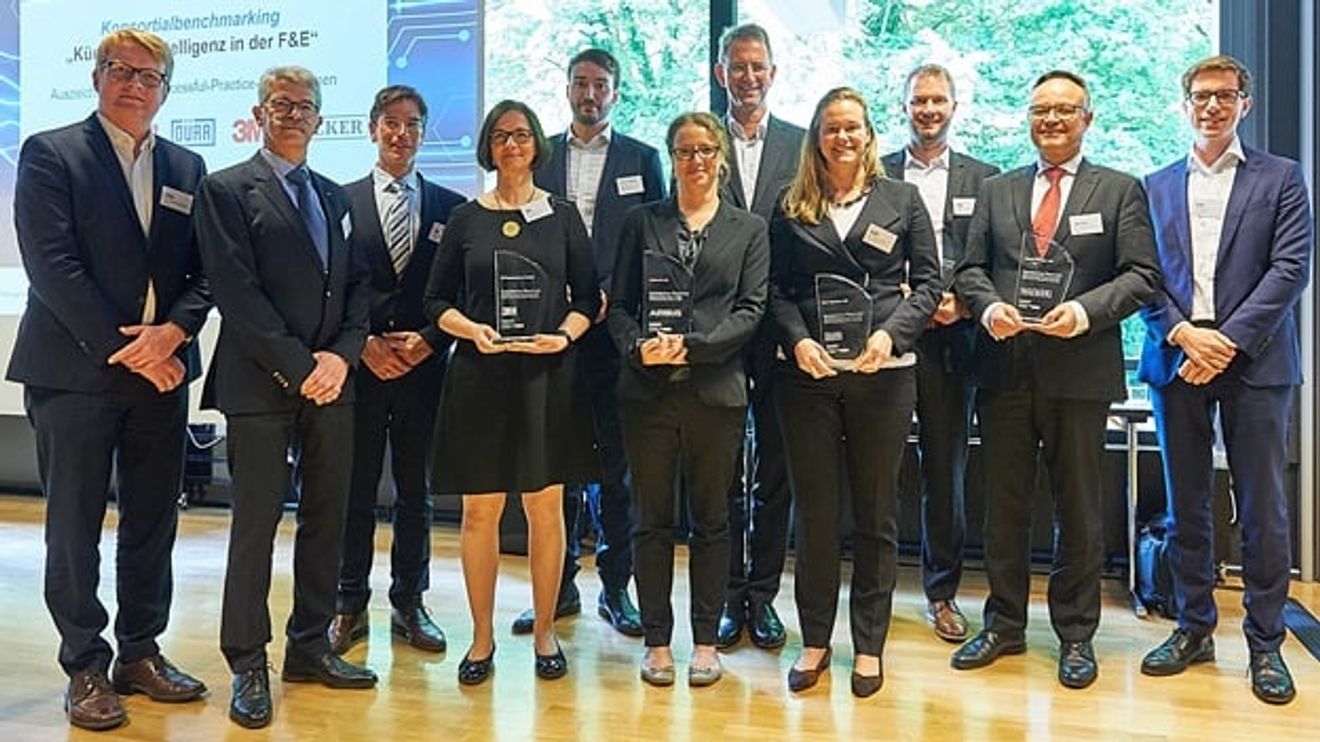
Award winners and consortium of the benchmarking 'AI in R&D 2019' (from left to right): Dr. Jan-Henning Fabian (ABB), Klaus Bohle and Dr. Christian Michels and Dr. Andrea Stricker (3M Germany), Jan Koch (WZL, RWTH Aachen University), Audrey Galametz (Airbus), Prof. Dr. Günther Schuh (WZL, RWTH Aacen), Dr. Annabel Jondral (Dürr Systems), Dr. Martin Hoffmann (ABB), Dr. Thomas Renner (Wacker Chemie), Dr. Simon Alt (Dürr Systems).
© CMA, Kurt BeyerThe study investigated how AI is used in companies' research and development work and where it is already being incorporated into new products. Using detailed written questionnaires, over 200 companies provided answers on four key areas of AI in R&D. In addition to the identification of new service offerings through the "application of AI in the product portfolio", possible applications for the "optimization of internal R&D processes" were queried. The companies also provided information on "organizational requirements" and "technological requirements" for the successful integration of artificial intelligence in R&D. The responses on the use of AI were first evaluated and 30 top performers were identified. From this group, the WZL at RWTH Aachen University and the Complexity Management Academy identified the five leading companies - the 'Successful Practices 2019' include 3M Germany, ABB, Airbus, Dürr Systems and Wacker Chemie.
A winning example: AI at Dürr Systems
Dürr Systems, for example, scored highly in the "Applications in the portfolio" evaluation criterion: Its 'DXQplant.analytics' software uses AI to systematically identify quality deviations in the car painting process, uncover the causes and derive optimization suggestions. This is achieved through self-learning data models that search for recurring patterns in the measured quality data and link these to special features in the painting process. Another argument in Dürr's favor was the 'Adamos' platform for the Industrial Internet of Things, which was founded together with partner companies.
Community with manufacturing companies in development
A key finding of the consortium study is that the successful practice companies in particular are developing use cases in networks. The aim of the following activities: The competencies of the university environment at RWTH Aachen University are to be linked more closely with manufacturing companies. A community with manufacturing companies will be established on the university campus in order to promote collaboration in the field of digital solutions in R&D. Demonstrators are to be set up and use cases implemented.
Basis for data collection
The "Successful Practices" were determined in collaboration with a jury of experts from international companies, who also formed the consortium for the project. The members of the consortium were 24 leading industrial companies from the manufacturing industry in a wide range of sectors. Prof. Günther Schuh, Director of the WZL at RWTH Aachen University, led the project. At the start of the project in July 2018, the partners worked out the current industrial challenges in the field of 'Integration of AI in R&D'. These challenges formed the basis for the questionnaire. A large proportion of the companies that responded came from Germany. The remaining companies are based in other European countries, the USA or Asia.


You might also be interested in
A test catalog for the certification of AI
Fraunhofer IAIS and the Federal Office for Information Security (BSI) want to develop a test catalog for the responsible use of artificial intelligence (AI) applications as part of the KI.NRW competence platform.
 read more...
Image processing in transition
What opportunities do embedded vision and machine learning offer users? The VDMA and five industry representatives addressed this question during a panel discussion at embedded world 2019. A summary.
read more...Beckhoff implements AI in Twincat
Beckhoff has announced a solution for machine learning that is seamlessly integrated into the Twincat 3 controller and is therefore also suitable for the demanding motion sector.
read more...'Artificial Intelligence Forum 2019'
"Neural networks are dumb as a post"
Artificial intelligence is very hesitant to find its way into industrial applications. Expectations of the technology are high. They are rarely fulfilled. However, those who approach the topic with the right premises can reap many benefits.
read more...National winner of 'Jugend forscht 2019' chosen
Germany's best young researchers in the 54th national 'Jugend forscht' competition have been chosen. Artificial intelligence (AI) is playing an increasingly important role in the young talents' projects. The winners from the specialist areas and the...
read more...Light-based chip works in a similar way to the brain
Hardware that mimics the behavior of neurons and synapses - researchers from the Universities of Münster, Oxford and Exeter have succeeded in developing such a system. The system works with light - not electrons - and can therefore process data many...
read more...Edge AI HPCs for Vision AI and GenAI
Advantech has announced the 'AIR-410' and 'AIR-420', next-generation compact Edge AI high performance computers (HPCs). Combining AMD Ryzen 7000/8000/9000 series processors, scalable GPU support and Advantech's 'Edge AI SDK' software, the systems...
read more...Siemens presents technologies to accelerate industrial AI
At CES, Siemens presented technologies to accelerate industrial AI: new digital twins, AI co-pilots, an Industrial AI Operating System and applications in manufacturing, energy and life sciences.
read more...Hitachi takes over Synvert
Hitachi Group has signed an agreement to acquire Synvert, a Germany-based company, as a wholly owned subsidiary of its US subsidiary GlobalLogic from Maxburg, a private equity fund focused on founder-led technology companies in the German-speaking...
read more...