
Embedded Vision
Image processing in transition
What opportunities do embedded vision and machine learning offer users? The VDMA and five industry representatives addressed this question during a panel discussion at embedded world 2019. A summary.
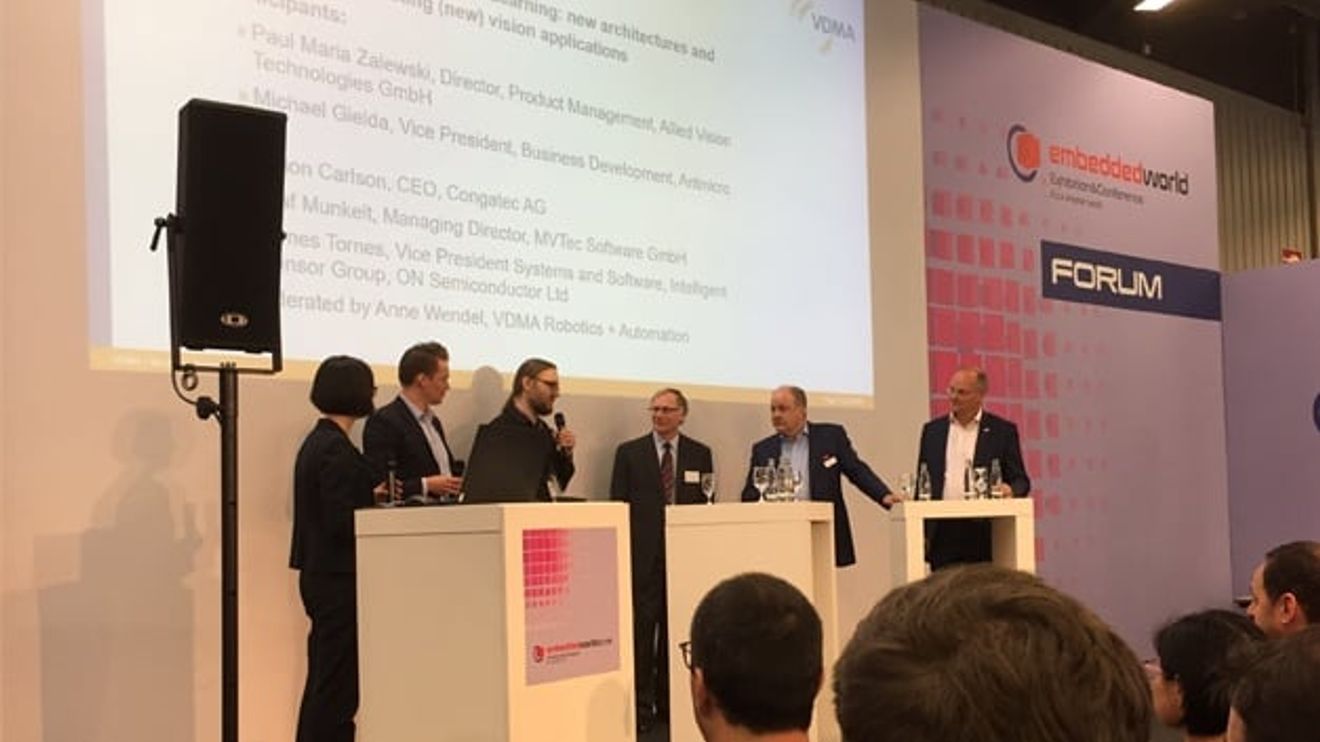
The technical basis of embedded vision systems includes compact, powerful computer platforms that consume little energy and can process more and more image data in real time thanks to standardized interfaces to image sensors. James Tornes, Vice President Systems and Software of the Intelligent Sensor Group at ON Semiconductor, attributes the positive development of embedded vision to the fact that the available sensors and cameras are becoming smaller and smaller and enable increasingly noise-free images. As a result, the processing power required to solve the desired tasks is also decreasing. "One important aspect is the fact that the performance of processors for battery-powered applications - such as hand-held scanners, doorbell cameras or intelligent IP cameras, etc. - is increasing significantly. Some of the processors used there can also be used in suitable embedded applications." Tornes describes this fact as an important enabler for the entire embedded vision market.
According to Paul Maria Zalewski, Director Product Management at Allied Vision Technologies, the biggest current challenge in applying efficient image processing functions to embedded vision systems is the cameras and all the integration efforts they require. "New camera modules and technologies will help embedded engineers to significantly reduce one-off development costs. At the same time, users benefit from more image processing functions directly in the camera module, which improves resource allocation on the host side."
Jason Carlson, CEO of Congatec, attributes the fact that the performance of such camera modules has increased significantly in the recent past primarily to the performance explosion in processor technology: "Today, different cores of a processor can take on different tasks. For example, one core is responsible for gateway tasks, another serves as a motion controller, and other cores of the same chip can perform vision-related tasks such as recognizing faces." The fact that all of these areas can be combined and processed in a single system has a corresponding impact on the prices of the solutions based on them, which are thus becoming increasingly economical.
The software side
The software side for embedded vision is also developing rapidly: methods from the field of artificial intelligence such as machine and deep learning are making a significant contribution to the simplified teaching of image processing systems - with a positive impact on the cost-effectiveness of new developments in the embedded vision world.
Dr. Olaf Munkelt, Managing Director of MVTec Software, explains: "Deep learning on embedded platforms is becoming increasingly important in order to create embedded vision solutions efficiently and thus shorten time-to-market. We see deep learning as an ideal complementary technology to realize specific vision applications, for example to classify defects. By combining deep learning with existing approaches, complex image processing tasks, including pre- and post-processing, can be solved efficiently."
However, there are also critical voices regarding the use of AI-based algorithms. Michael Gielda, Vice President Business Development at Antmicro, says: "Artificial intelligence offers great opportunities and solves many problems. However, one difficulty is that it is not known exactly how an AI-based algorithm works and how it arrives at its decisions." To illustrate this, Gielda cites an example from the field of security: "Algorithms decide in a way that is not completely comprehensible whether a person in an image should be examined for terrorist activities or not. Artificial intelligence is a black box technology, and this is a problem that naturally affects not only the image processing industry, but all areas in which it is used."
Develop ecosystem
In recent years, there has been great progress in all components required for the construction of embedded vision systems, be it sensors for image acquisition, processors, embedded boards, cameras, image processing software or interfaces for data transmission. Nevertheless, there is still some uncertainty among potential users as to which of the numerous components available on the market they should select to solve their particular task, how they can be combined and which combination of components is most suitable.
Dr. Olaf Munkelt misses a kind of template to help users make the right decision. His observation: "If possible, customers want to obtain all components for an embedded vision system from a single source. This is the only way to build embedded vision solutions easily." Jason Carlson agrees: "We are only in the early stages of this young technology, so there are no proven standards here as there are in other, more mature markets." According to all participants, it would therefore be important to create a kind of ecosystem in the near future in which all the necessary components, from the sensor boards and cameras to the software, work together in a simple way.
However, according to Michael Gielda, the variety of possible platforms is likely to increase in the future: "As this is a young technology, companies and users are currently still testing out many options and trying to find the best solutions. The resulting variety can confuse and unsettle users." As far as software is concerned, Gielda advises: "Open source helps to use existing knowledge and accelerate developments."
PC-based image processing remains
Despite all the euphoria about the possibilities of embedded vision, the experts are certain that this technology will not completely replace PC-based image processing. The question is not "either - or"; the area of PC-based vision will also continue to grow. For image processing as a whole, so much growth is still foreseeable that there is enough room for both architectures to develop positively.
Author:
Peter Stiefenhöfer is the owner of PS Marcom Services in Olching.


You might also be interested in
Edge AI HPCs for Vision AI and GenAI
Advantech has announced the 'AIR-410' and 'AIR-420', next-generation compact Edge AI high performance computers (HPCs). Combining AMD Ryzen 7000/8000/9000 series processors, scalable GPU support and Advantech's 'Edge AI SDK' software, the systems...
 read more...
Siemens presents technologies to accelerate industrial AI
At CES, Siemens presented technologies to accelerate industrial AI: new digital twins, AI co-pilots, an Industrial AI Operating System and applications in manufacturing, energy and life sciences.
read more...Hitachi takes over Synvert
Hitachi Group has signed an agreement to acquire Synvert, a Germany-based company, as a wholly owned subsidiary of its US subsidiary GlobalLogic from Maxburg, a private equity fund focused on founder-led technology companies in the German-speaking...
read more...Proalpha takes over Insiders Technologies
The Proalpha Group, provider of business applications for SMEs, acquires Insiders Technologies and significantly expands its 'Industrial AI Platform' with AI applications and services for digital document processing.
read more...Industrial AI at SPS | Endress+Hauser
"AI will become a natural functional component"
Industrial AI is also becoming increasingly relevant in process automation: although field devices themselves still make little use of it, it is already proving helpful in evaluation and peripheral devices as well as control systems. Christian...
read more..."People always remain at the center"
Sick now considers artificial intelligence to be a central component of industrial applications. Phil Krumbein, Market Product Manager Logistic Solutions at Sick in Düsseldorf, reveals exactly where the company relies on AI.
read more...How AI and the cloud are challenging sustainability
The rapid rise of artificial intelligence is driving up the energy consumption of data centers and jeopardizing global sustainability goals. Schneider Electric presents six practical solutions to meet the new requirements.
read more...Critical Manufacturing takes over Convanit
Critical Manufacturing, a provider of Manufacturing Execution Systems (MES) solutions, has announced the acquisition of Convanit - an artificial intelligence company specializing in image-based analytics in high-tech manufacturing.
read more...Technical University of Munich
AI chip developed for decentralized use without the cloud
A new type of AI chip developed at the Technical University of Munich (TUM) works without the otherwise necessary connection to the internet or cloud servers. The 'AI Pro' chip is modeled on the human brain. Its neuromorphic architecture helps it to...
read more...