
Peakboard
Intelligent data visualization
If you can visualize your process data in real time, you can use it effectively. But how can intelligent data visualization be implemented for digital production processes?

Process transparency in practice.
© PeakboardThe age of digitalized production means that a wide variety of machines, sensors and other data sources provide a wealth of process information. As a result, there is - at least in theory - a very extensive information base for process optimization that continues to grow as the digitalization and networking of systems progresses. Three points in particular pose a challenge:
- The individual accessibility of the information for different employees,
- the meaningful consolidation and preparation of the data
- and the effective evaluation and interpretation of the data.
As a rule, a provision cycle of raw data from the various subsystems is only run through once a day - in the simplest case with visualization tools such as Excel or software from manufacturers such as Tableau, QlikView or similar applications. However, this means that the question of where an error occurred can often only be answered at the end of a day or an evaluation cycle - and only retrospectively, often only in a vague manner and only by a few individuals. With such retrospective information, no one who wants to control and optimize their process directly can achieve flexible regulation of finely interlinked work steps. Yet it is precisely this kind of flexible process optimization that is necessary to ensure effectiveness and process reliability in the face of increasingly individualized production orders and just-in-time production.
Acute error prevention
In order to avoid errors, all employees in a company should have a permanent insight into ongoing processes. This requires information systems that collect the relevant information for everyone involved in real time, link it together in a meaningful way and make it clearly visible. Employees can react appropriately if they recognize problems in the process at an early stage - for example with the help of a missing parts monitor, which not only shows which materials are available and which are missing, but also indicates which next work steps are possible and sensible. This allows new priorities to be set at an early stage before employees start work steps that, in the worst case, cannot be completed at all and would disrupt the overall process.
Such information serves as a basis for acute error prevention during the production process itself and empowers manual workers to take more responsibility. Other process information is useful for shift supervisors, planners and managers who need such individually compiled data as a basis for optimizing processes and developing a common logic and site-specific artificial intelligence (AI) for the various production elements.
Criteria for optimal visualization
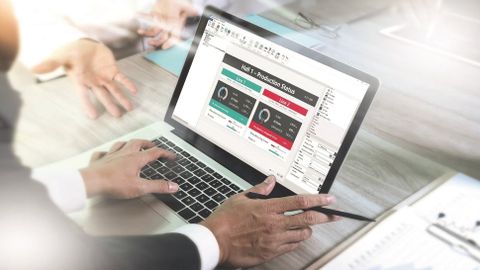
A modern tool for real-time visualization of process data has a data connection to all upstream systems and data sources and provides simple input options for employees if necessary.
© PeakboardAn optimal visualization solution should therefore not only be structured differently for each location, but also provide information adapted to different hierarchy levels. To ensure this, decision-makers who want to bring data visualization in their companies up to date must take a few criteria into account:
- An essential prerequisite is that there is a data connection to as many upstream systems and data sources as possible - from supplier to machine to customer data. At the same time, the application must be fault-tolerant so that visualization performance is guaranteed even if an individual system section fails. This requirement can be met if data is exchanged decentrally, i.e. directly between the system that generates the data (e.g. SAP) and the tool that visualizes this data. This means moving away from classic business intelligence (BI) structures towards independent information procurement through each individual visualization interface.
- Another point is speed: data processing and visualization are most useful when they take place in real time or with minimal loss of time. Direct and decentralized data exchange also plays an important role here. While the structures of a classic BI system have various processing layers, which generally generate a large time lag, a decentralized approach enables real-time visualization.
- In addition, the presentation of the data must follow an information logic that does not require interpretation in order to enable employees to work better and more efficiently. For example, a mechanic should not be expected to assess raw data that depicts the overall process.
- In many cases, it can make sense for employees to enter direct feedback on their work steps into an information system via simple touchscreens. This applies above all to individualized, one-off production, in which short feedback cycles help employees to coordinate their own work with that of their colleagues.
- When it comes to complex process information, it is often not enough to simply supply raw data. Consequently, it is the task of the developers and managers of the information system to define how to deal with which data. Each piece of information should therefore be able to be followed by a process instruction.
- Individual process information and instructions are relevant for every employee and every department. A future-oriented visualization tool provides a selection service that is flexible and can be manually adapted for each work area.
- Last but not least, a good information system can be adapted for every change and expansion during operation. Accordingly, the option for a long-term and continuous improvement process should already be considered in the architecture in order to be able to successively develop and expand the existing information system. In this way, digitization can be implemented in small and simple steps on the company's own initiative, without the need for excessive costs for consulting, system restructuring or IT expertise that has to be constantly consulted.
Process transparency in practice

Example of a dashboard that combines data from different data sources such as SAP, Oracle, Excel and Sharepoint and displays it in a small space.
© PeakboardThe following example of series production shows how a modern visualization solution can be structured:
A monitor hangs on each of several production lines at a site, providing employees with an overview of the overall situation. The upper screen area (Current Production Order) displays the current production order for the respective line, which is generated according to a simple logic with data from the SAP system.
A Manufacturing Execution System (MES) provides the actual quantity and stores the number of parts produced in an Oracle database. Information about machine events, for example 'production start', 'set-up' or 'malfunction', flows into the same MES database. These events form the data basis for the timeline (production history) of the production process. This timeline graphically displays the relevant statuses of the production line over the last twelve hours.
Relevant news is listed in the middle section of the dashboard (Current Information). Those responsible, such as shift supervisors, maintain these in an Excel spreadsheet on a shared network drive and use them to communicate with the workforce. The lower area with colored squares (Lines of the Department) is used to provide quick information about all other production lines that are not visible from the current position of the monitor. As with the timeline, the color symbolizes the current status.

Finally, on the right-hand side (Responsible Staff), the person responsible for the line appears with a picture. The responsibilities and images are taken from a SharePoint document library and maintained there.
The example of this dashboard shows how a single visualization tool can bring together information from very different data sources, from SAP and Oracle (MES) to Excel and Sharepoint, and display it in a small space. Every employee can thus gain an overview of the respective line in a matter of seconds. They are also able to classify the situation on the other lines and view general information without having to read any figures or interpret complicated data records.


You might also be interested in
Wiring software flexibly maps workflows
The wiring expert Eplan is presenting version 2.9 of Eplan Smart Wiring with a new user interface that flexibly maps different workflows.
 read more...
AI follows its own rules
At the end of last year, Google put the icing on the cake of the advancing development of artificial intelligence with its quantum supremacy test. America and China are engaged in an AI race. What role does Germany and Industry 4.0 play in this?
read more...Scan floor plans with tablet
WSCAD is presenting numerous product innovations relating to the E-CAD solution. These include the first functions of the next version, Suite X Plus, with a completely newly developed editor and improvements in terms of overall performance, app...
read more...Smart services and cloud technology bundled
On January 1, 2020, the Phoenix Contact Group bundled its digital service portfolio in the subsidiary Phoenix Contact Smart Business in Berlin. This includes all activities relating to cloud technology and data analytics as well as software services.
read more...Measuring technology function range extended
The 'Dasylab PLC Edition' software package from SL-automation enables industrial companies to access their programmable logic controllers via 'Dasylab' software. Now a further developed 'PLC Edition' with an extended range of functions is being...
read more...Focus on cloud and edge computing
The Eclipse Foundation, currently the largest open source organization in Europe, wants to promote global industry collaboration on open source projects in strategic technologies. Mike Milinkovich, Executive Director of the Eclipse Foundation,...
read more...Three questions for... Emsisoft
"Security must not be an annoying add-on"
To ensure data security in companies, there are measures that could be implemented without effort, but often fall by the wayside for reasons of convenience. This includes the selection of passwords. Christian Mairoll on human error.
read more..."Value creation networks need a security standard"
The higher a company's level of networking, the greater the demands on IT security. Similarly, the risk of a cyberattack increases, against which manufacturing companies can protect themselves using specific tools. Alexander Heckl explains the...
read more...Complete testing tasks fully automatically
The modular QBIC systems with integrated IOTA from Cretec are a new generation of mobile, fully automated work platforms based on cobots, which according to the provider are easy to operate, very fast and can be used individually.
read more...