
Bosch Connected Industry
Rethinking the value stream
Until now, flexibility and efficiency have been opposing process parameters in industrial value streams: The use of modern IoT technologies offers new opportunities to resolve this old contradiction in a 'smart' way.

Modern IoT technologies for flexibility and efficiency in the value stream.
© BoschThere is a world of difference between very large and very small batch sizes in industrial production: Highly automated diesel pump lines, for example, produce similar product variants in a matter of seconds in three-shift operation. The process steps are firmly coordinated with each other and manual work is reduced to a minimum. The counterpart to the so-called high-runner lines can be found in prototyping, for example, where products in batch size 1 are created very flexibly with a lot of manual production effort and individual know-how. Lines on which many different product variants are manufactured in small quantities - so-called exotic lines - are also highly flexible: specialized employees carry out the majority of the production and assembly steps in order to meet individual customer requirements.
So how can high efficiency and high flexibility in terms of variant diversity be combined? The first step is to rethink the value stream in terms of value stream design. A rigid interlinking of production steps is replaced by innovative value stream concepts - for example, by modular production cells arranged in a matrix. This provides greater flexibility with regard to batch size 1. Different orders have an individual production cell sequence and dwell time in the cells. This means that losses due to unbalanced cycle utilization (cycle sequence losses) and downtime losses on rigid lines are a thing of the past. In this scenario, products wait for production capacity - in contrast to conventional line production, where workers wait for products. In addition to the flexibility gained, this means better capacity utilization and increases productivity while at the same time reducing work in progress in production. Transportation from station to station is carried out by autonomous transport systems (AGVs), which in turn are controlled by an intralogistics control and production system. Self-learning algorithms make these systems more intelligent every day. Thanks to edge computing and artificial intelligence, the mobile elements of the intralogistics system are being organized in an increasingly decentralized manner, right up to an organization in the sense of swarm intelligence. In a nutshell, autonomous and automated transport systems are highly efficient and operate very flexibly from the perspective of the overall system.
The digital twin of the information flow
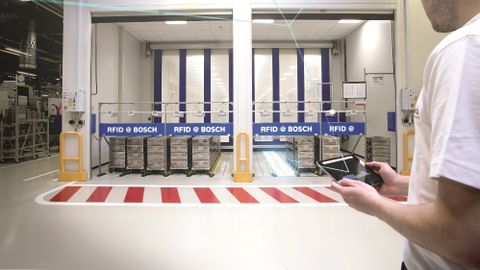
Another prerequisite for the combination of efficiency and flexibility is real-time data of the physical process from the source to the sink. This is the only way to achieve flexible and efficient control. What good is modular cell production if the material for the different variants is not available in the cell at the right moment? The value stream extends across various IT and system boundaries that need to be networked. For example, IoT sensor technology now offers the possibility of mapping and reliably tracking the entire material flow - from the supplier to incoming goods, goods receipt and storage stages, across production stages through to shipping and distribution to the end customer - in real time as a digital twin.
Together with order data from the document flow, internal material movements can be automated and synchronized using autonomous transport vehicles, picking processes with robotic solutions and intelligent supermarkets. Real-time transparency stabilizes the new flexibility. For example, deviation management allows disruptions to be detected in advance and alternative courses of action to be proposed. People can use these tools to make data-based decisions and have an ever more up-to-date overview of materials, machines, capacities and conditions for informed interventions.
Pragmatic steps
Of course, it is not a question of spending years tinkering with the ideal of flexible automation in the sense of a complete solution. Rather, small but recognizable steps in this direction are necessary. The conversion of lines in line with the production cell system, the use of AGVs in specific applications and control via software modules require one thing above all: quickly recognizable added value that promotes user acceptance and offers management the desired cost-effectiveness. Pragmatic and agile solution development creates the basis for this by focusing on alleviating the immediate 'pain' of users. This requires understanding, a willingness to change, courage - and the opportunity to test and continuously develop solutions in an industrial environment. Bosch Connected Industry uses this opportunity in numerous project implementations, not only in its own Bosch plants.
Together with users, for example, prototypes are developed in user experience workshops and then tested in practice. By providing regular feedback, convinced users are directly involved in the further development of 'their' solution: Requirements become features, each software release brings greater added value for users. In addition to user experience, an understanding of the industrial environment is of central importance: only those who are familiar with production and logistics can perfect IoT solutions so that they can also create robust and stable added value in the previously less automated industrial material provision process. The pragmatic and participatory approach also triggers a multi-layered group dynamic: Project participants grow together to form a 'community' that proactively drives the further dissemination of the solution.
Digital organization of the material flow

Let's take the example of a production plant that manufactures various components for the automotive industry. Starting with prefabrication, through assembly and testing of the finished parts, to packaging and shipping, the various stations are automatically approached by autonomous transport systems and supplied with the required components and semi-finished products. The AGVs travel the routes independently and bring different parts to gripper robots, which in turn remove them from the boxes and place them in the production line or testing station with a precise fit.
Where previously media disruptions and high manual effort were the order of the day, variant production is now automated and flexible: if a parameter changes, for example due to manual intervention in the area supermarket, transport routes, material deliveries and production steps are simply adapted digitally. In addition to the necessary hardware, this is made possible above all by the software operating in the background. It ensures that all data from the material flow is utilized and optimized for the benefit of the overall system. However, a key challenge often initially lies in the digitization of process data, such as deliveries, transport orders, status information and material flow data, without which no software can optimize.
In our example, the transport orders are organized digitally. The software plans and optimizes the entire internal transport in real time: all vehicles are stored with regard to their restrictions such as loading capacity, envelope curves and speeds. Live data is processed or calculated. When optimizing internal transport routes, algorithms use this information to select the most suitable means of transport for the goods. In doing so, the system acts intelligently in terms of the overall system: Even a vehicle that is further away may be suitable for the task given the traffic situation or the loading status.
The software optimizes the material flow and knows the respective status of the material, for example from the intelligent supermarket. There, all material movements are automatically recorded and booked using RFID, barcodes or sensors. The software not only automates booking in and out. A put-to-light signal also indicates where the incoming material should be stored. The added value of such assistance systems is particularly evident in the mixed operation of autonomous and manual processes: if there is an incorrect putaway, the employees receive a signal - and can correct the error immediately. This saves them time for bookings and the time-consuming search for the correct lane or incorrectly stored goods. Using 3D visualizations, they can also see at any time where and in what quantity which material is currently located.
The real 'treasure' for structural improvements lies in the historical real-time data of the material flow. The software uses data analysis to evaluate fleet movements, for example: How efficiently did the individual transportation systems run? How high was the capacity utilization? Are there structural bottlenecks in the value stream design that can be eliminated? By recording position and speed, the routes can be displayed graphically in the form of drive maps, heat maps and efficiency diagrams. This allows logistics specialists to quickly identify where, for example, there are danger zones due to the intersection of frequent routes with pedestrian areas and take countermeasures such as speed reduction.
Real-time data for the analyses
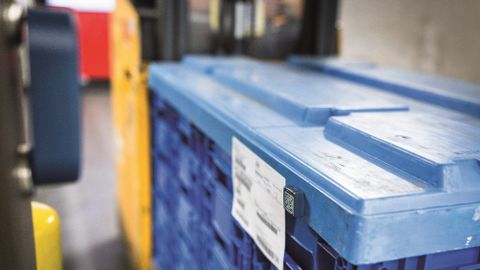
In a similar way, the vehicles and their freight can be tracked in the extralogistics supply chain to the incoming goods department. Using track-and-trace applications, the freight regularly informs the software where it is currently located. In this way, previously very manual scheduling processes can be automated using relevant real-time data and buffer stocks, which serve as a safeguard against unplanned incidents, can be reduced.
The capacity for goods receipt processes can be planned more efficiently thanks to the exact arrival times of the goods. Historical tracking data serves as the basis for calculating the time of arrival, with machine learning algorithms taking into account the idle times that are important for logistics applications. The data also provides an important basis for traceability in terms of product tracking and for analyzing process errors.
In summary, it can be said that There is still a lot of potential in efficient and flexible value streams. It is worth starting with the concepts and digitalization of parts in smaller, pragmatic and iterative steps. This can start with a few supplier connections or with specific intralogistics issues at an individual plant. The direct feedback from users shows: The pragmatic approach brings the material flow back to the center of attention. After all, it is not enough to implement exciting and complex technologies. They must also quickly translate into concrete added value for everyone involved.
Author
Matthias Hülsmann is Vice President Connected Logistics at Bosch Connected Industry.


You might also be interested in
Grid operators under pressure to act
The high investment costs for the expansion of the 5G network are causing problems for network operators. The technology consultancy BearingPoint assumes that network operators therefore need to reposition themselves - now!
 read more...
IIoT platform solutions: Your path to the smart factory
The future has begun - industry is mastering new challenges every day. Cyber-physical systems - connections between IT and software components - are being developed to produce goods and merchandise by means of the overarching networking of all...
read more...Implementation of IoT projects
TÜV Süd names data protection and IT security as the biggest obstacles
The Internet of Things is bringing more and more benefits to companies. However, there are still problems with implementation: companies have major concerns about data protection and IT security. And then there's the money...
read more...Four remote maintenance tasks in one device
With the RMG/941, SSV has developed an IoT gateway that combines four industrial remote maintenance tasks in a compact DIN rail housing.
read more...Bosch plans 'AI Campus' in Tübingen
Bosch is planning to strengthen its activities in the field of future-oriented AI technology: In 'Cyber Valley', the technology company plans to invest around 35 million euros in the construction of the 'Bosch AI Campus' in Tübingen.
read more...Bosch wants to convert all products to AI
The technology group Bosch wants to equip its entire product range with artificial intelligence (AI) or use AI in production by 2025.
read more...Know your own needs
Bosch Connected Industry has set itself the goal of bringing the software into the field. One tool for this is the 'Nexeed Industrial Application System'. Matthias Fontius explains the differences to existing solutions and why digitalization cannot...
read more...SPS Connect 24.11. - 16:45 - 17:05
The digital understanding twin
Digital twins transform raw data into understandable and accessible information for domain experts and software developers.
read more...Trumpf collaborates with the IPAI AI Network
Trumpf is a new partner of the IPAI AI network in Heilbronn. Together, the two parties plan to develop and test artificial intelligence applications for industry.
read more...