
GAIA-X
A European data ecosystem
In June, the French and German economy ministers presented the GAIA-X data initiative. What is behind the GAIA-X concept? What are the plans and tasks of the associated foundation? - The European data initiative from the perspective of an automation specialist.

The concept for GAIA-X arose from the idea of thinking about a data ecosystem from the point of view of a data owner and user. The aim is to implement a European data ecosystem with a layer that can be used by and between all these infrastructure providers and users in a domain and across domain boundaries and that can inspire data exchange.
The GAIA-X initiative also aims to further support today's individual and domain-specific standards in order to achieve rapid user adoption. The overarching, compelling goal is to convey European values in the spirit of an honorable merchant rather than seeing the customer as a product - the magic word is trust, complemented by federated management of identity and access as well as clearly regulated principles for storing, sharing and exploiting data under the control of the data owner. At the same time, a solid basis is to be created to promote strong innovation on the basis of this digital sovereignty and to drive digitization on value principles that truly represent Europe. This initiative was launched by politics, administration and industry alike in the context of the Industry 4.0 movement and was very well received.
Over time, participation in the GAIA-X meetings increased to a considerable number of participants - an ongoing development. This resulted in an intensive exchange of ideas, initially as a Franco-German initiative, but aimed at Europe, its citizens, companies and regions. This path is now being pursued together with other European partners and in coordination with the European Commission. The aim is to establish an initial framework for handling use cases by the end of 2020.
In the case of Beckhoff, the motivation to participate in the GAIA-X initiative was and has grown through encounters with customers and other interest groups in the manufacturing industry as well as with many other user groups, including automation. A clear need has emerged here to actually participate in the design of a jointly usable data ecosystem.
Motivation for automation engineers
For Beckhoff as an automation provider and for many automation users, such an ecosystem can be much more than just a data space. This is because it is a European and cross-user domain initiative that integrates its future users into the process at an early stage through use cases. This means that the architecture is shaped at an early stage in a requirements engineering process with the precise target group in mind.
For market players in the capital goods industries that use automation technology as an enabler for their products, the use of cloud technologies is highly desirable under the principles mentioned above. After all, many of these users' concerns apply specifically to so-called hyperscaler clouds. In addition, some users of cloud technology also become cloud service providers for their customers. In this respect, participation in the requirements analysis and definition with regard to data sharing principles as well as monetization models, data localization and legislation is highly desirable.
Activities of GAIA-X requirements engineering
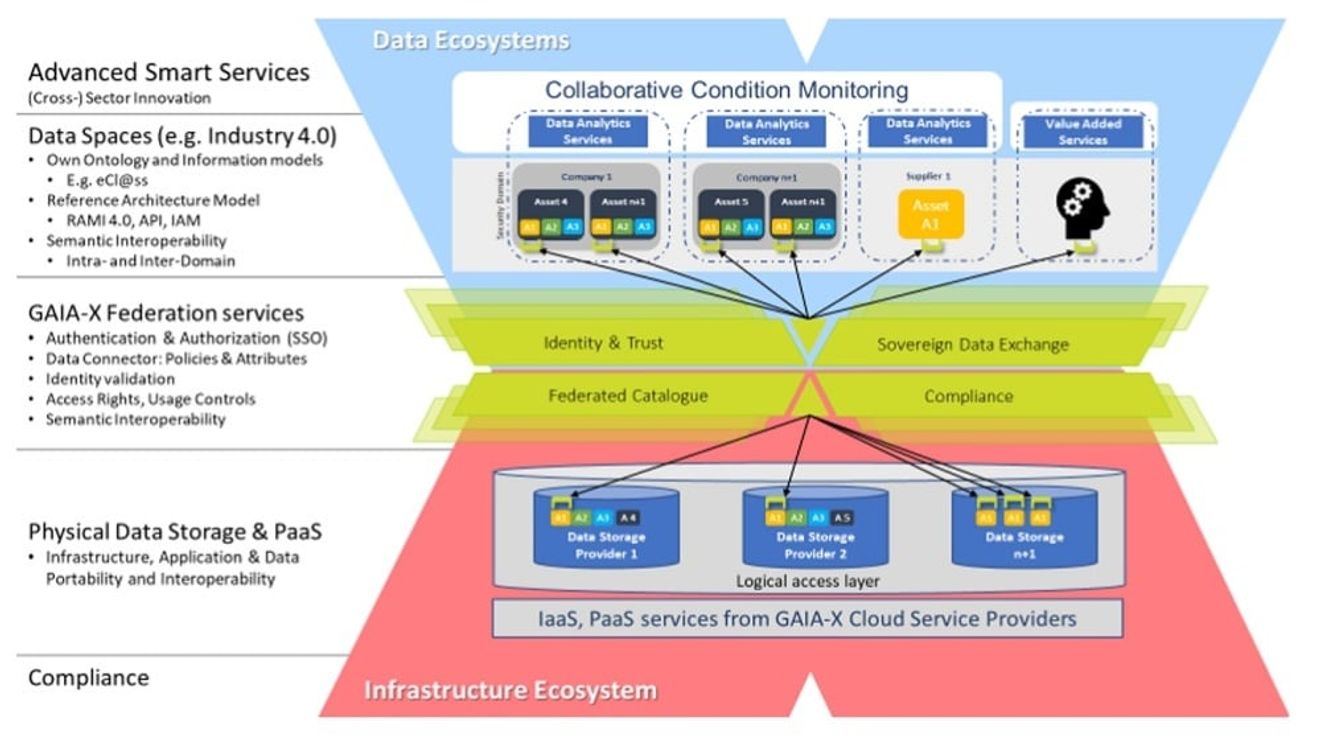
The key elements of a data ecosystem according to GAIA-X: Frameworks and application of the basic communication fractal.
© GAIA-X FoundationIn joint meetings of over 170 participants from eight European countries, a phase of veritable Babylonian linguistic confusion initially developed regarding the necessities and needs of the most diverse kinds. This was - and still is - certainly due to the diversity of participants from a wide range of domains, such as energy, health, mobility, public administration, smart living, finance, Industry 4.0 and SMEs. The agricultural sector was added later. In total, over 40 use cases had already been compiled by mid-2020.
On June 4, 2020, the GAIA-X initiative was officially announced at an international media event led by the French and German Ministers of Economic Affairs. With the establishment of a foundation, the working groups of users and infrastructure providers are now to be given a home. In principle, the participants are pushing for the establishment of an open, neutral and non-profit-oriented interest group, which has fortunately already been implemented by the founding companies with the GAIA-X Foundation. In addition, there are to be national hubs in which members and users organize themselves: Currently, providers can be enabled to bring compliant products or services to the market in accordance with the GAIA-X standard via membership. Users can, but do not have to, become members of the Foundation.

The work of the GAIA-X Foundation is not profit-oriented. Consequently, the work must be financed through minimal membership fees, graduated according to a company's revenue. The idea of non-discriminatory and SME/SME-supporting access to GAIA-X also plays an important role here. With this financial leeway, it may not be possible to build 'castles', but a small, solid and effective team can be established. Work is also being planned on various technical, regulatory and organizational topics with the help of further working groups with pro bono participation of interest groups and members from a wide range of domains.
The main task of the GAIA-X Core is to provide a small number of services that make it possible to implement the GAIA-X basic principles (see next page) for data exchange. In addition, administration is to be carried out on this basis.
Elements of the GAIA-X core functionalities
For this reason, the following areas of work were defined, in which a common framework is to be developed as the basis for very different standards in the user domains:
- IAM Framework
- Federated Catalog
- Data Broker/Data Connector
- Data Exchange Interoperability
- User Interface
- Accreditation, Registration, Self-Description Validation
- Conceptualizing Certification Process
- Continuous Monitoring
- Self Description
- Interconnection and Network
It is particularly exciting that no new and large uniform standard - which would then be unwieldy and unattractive - is planned. Instead, there is an agreement that the respective common standards of a domain should be built on top of a simple core layer. From the automation engineer's point of view, these are the standards commonly used in the manufacturing environment, all of which are accessible to automation technology.
The five basic principles of the GAIA-X Data Space
The GAIA-X Foundation does not want to generate a new uniform standard; instead, the respective common standards of a domain are to be based on a simple core layer. This GAIA-X core should only provide a few services that essentially guarantee the following five GAIA-X basic principles for data exchange.
1. openness and non-discrimination for the adaptation of all market participants:
- An open ecosystem across domains and value-added services in the form of a data- and service-exchanging network in which value-adding actions can be carried out.
- Organized centrally, decentrally and also heterogeneously in terms of geography, legislation and technology.
- Access from a local device, an edge computer, on local 'on-premise' clouds or central cloud systems.
- Exchange, enrichment, linking, analysis and evaluation of data across different security and application domains.
2. simple and unique identification and establishment of trust for participants in a federated structure:
- One click to participate using federated trust and identity management.
- Clear and comprehensible rules for participation and collaboration according to standardized and selectable roles.
3. data custodianship, i.e. the free choice of legislation and geography for data and services:
- Data owners decide for themselves which data is shared with which users with which access rights and for what purpose it is processed.
- A role-based authorization concept
should meet regulatory requirements, data order processing and GDPR compliance should be legally compliant.
4. identical protection classes for data and services:
- For data exchange and the use of services, standardized and higher-level organized semantics.
- Additional domain-specific standards.
- Semantics including semantics enablement layer for operating the ecosystem and user domains.
- Storage and use of algorithms and data with certain basic metadata to identify protection classes and confidentiality rules for a datum (data set).
5. ecosystem for algorithms and methods of data monetization:
- Synergies in existing and new value networks of actors.
- Data monetization marketplace with incentives for digital value creation.


You might also be interested in
Reliable measured values in harsh environments
Two devices expand the 80 GHz radar transmitter series 'Sitrans LR100' from Siemens. The Sitrans LR140 high-frequency transmitter with 4 to 20 mA is configured via Bluetooth and the 'Sitrans-mobile-IQ' app.
 read more...
GAIA-X and Open Industry 4.0 Alliance
Is a European data space coming?
The aim of the GAIA-X Foundation is to establish a European data infrastructure for secure digitalization and networking. The Open Industry 4.0 Alliance is pursuing a similar goal. Gerd Hoppe and Nils Herzberg explain the background to these...
read more...SPS Connect 24.11. - 15:10 - 15:30
Continuously optimizing with the Digital Enterprise
As a result of advancing industrial digitalization, machine and plant manufacturers need flexibility in order to reliably meet requirements. A consistently digitalized value chain makes this possible: the digital company with the digital twin.
read more...SPS Connect 26.11. - 16:50 - 17:10
Revolution in transportation systems?
With Acopostrak, XTS and XPLanar, B&R and Beckhoff have introduced completely new transport systems in recent years. But what is so special about linear transport systems? What rationalization potential do the new technologies offer?
read more...SPS Connect 24.11. - 14:10 - 14:30
Flexible I/O components as a basic building block
Find out more about flexible I/O components as the basic building blocks of reliable sensor technology and communication for edge computing and automation in this presentation by Michael Jost.
read more...SPS Connect 25.11. - 11:00 - 11:20 a.m.
Realization of intell. Operating concepts in the Industry 4.0 environment
Terms such as gateway and edge device, as well as greenfield and brownfield scenarios, are frequently used in the context of Industry 4.0. Cloud-based analytics and different methods of cloud communication are also discussed.
read more...SPS Connect 25.11. - 12:00 - 12:20 p.m.
Industrial Artificial Intelligence - Future of Automation
Artificial intelligence helps us in every area of our lives, whether we're trying to read our emails, get directions, get music or movie recommendations. The bottom line: it makes our lives easier.
read more...The supplier overview in the cloud
What is the ideal way to start digitizing a company? How can administrative control processes such as the creation and management of supplier documentation be accomplished at high speed while minimizing risk?
read more...SPS Connect 11/24 - 1:35 - 1:55 pm
GAIA-X - the data space of digital Industry 4.0?
In June, the French and German economy ministers presented the GAIA-X data initiative. What is behind the GAIA-X concept? Gerd Hoppe from Beckhoff provides some insights during SPS Connect.
read more...