
Phoenix Contact
M12 with push-pull locking
Phoenix Contact is expanding its portfolio of M12 connectors with push-pull quick locking and is making the A-, D- and L-coded device connectors with pin contacts available with the matching push-pull housing screw connections for SMD and THR processes.
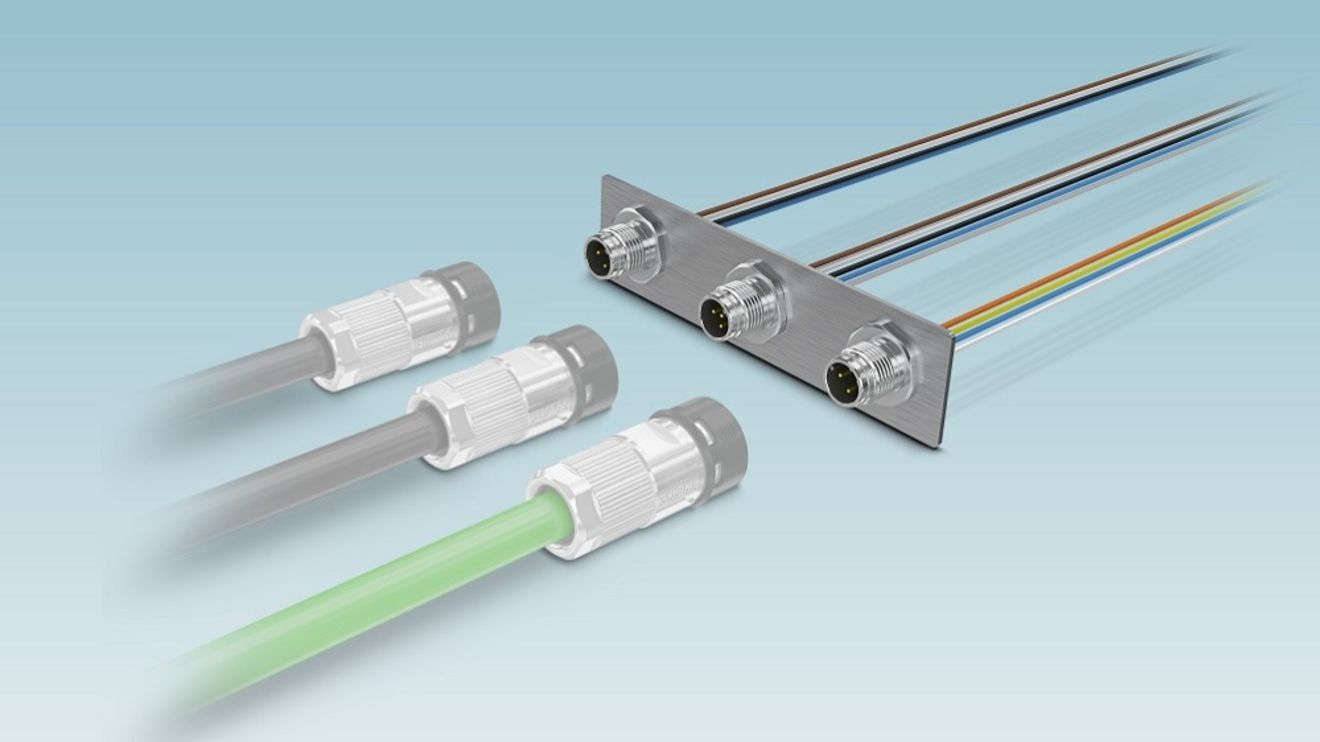
Alternatively, there are variants for wave soldering. The push-pull device connectors with pre-assembled strands are suitable for longer distances inside the device. The matching field cable connectors for signal transmission (A-coded) and data transmission in accordance with CAT5 (D-coded) have crimp connections for conductor cross-sections of up to 0.34 mm² or 1 mm².
Quick locking is achieved without tools by simply plugging them in. The user receives clear feedback on the secure connection: if the connectors are not correctly locked, the mechanism springs back into place.
Would you like a little more?

First-hand news every week - that's what the Computer&AUTOMATION newsletter offers you.
© WEKA Trade MediaSubscribe to our weekly newsletter and keep your finger on the pulse of automation time. Once a week, on Tuesdays, we provide you with the latest news, exciting interviews, guest commentaries, application-oriented technical reports and new products. Stay up to date with us.
Our newsletters are of course free of charge and can be canceled at any time!


You might also be interested in
Real-time data transmission in smart grids
Phoenix Contact launches robust multi-fiber data connectors on the market. The M17 MPO (multi fiber push-on) series fiber optic connectors are particularly suitable for real-time data transmission in intelligent power networks.
 read more...
Extended to include fiber optic variants
Phoenix Contact is expanding the FL Switch 1000 series with fibre optic variants that are housed in a slimline enclosure and, according to the supplier, offer a higher port density and prioritization of data traffic for automation protocols.
read more...Phoenix Contact at SPS Connect
Can also be operated with thick gloves
With its all-in-one solutions (AIO), Phoenix Contact offers industrial PCs with a fully enclosed die-cast aluminum housing (IP65) that can be expanded modularly and integrate Profisafe functions.
read more...SPS Connect 26.11. - 16:15 - 16:35
Safety meets security
Manufacturing and IT are becoming increasingly interconnected as part of Industry 4.0. This also requires the networking of functions that were previously considered separately: Safety and security.
read more...SPS Connect 24.11. - 14:00 - 14:20
The future of switch cabinet construction
In this presentation, three experts from Rittal, Eplan and Phoenix Contact will explain how digitalization is changing engineering and manufacturing processes.
read more...RJ45 replaced
With the 'XTS' transport system, Beckhoff enables flexible machine concepts with highly individualized product transport. In the current generation, an Ethernet interface from Harting replaces the RJ45 interfaces of the computer cards. What are the...
read more...Three questions for... Phoenix Contact
"The threat situation has worsened significantly"
Taking the necessary measures to protect against cyberattacks is given varying degrees of priority in companies. However, any negligence gives attackers a technological advantage. Dr. Lutz Jänicke reveals how damage can be reduced and avoided.
read more...Yaskawa and Phoenix Contact announce partnership
Yaskawa and Phoenix Contact have agreed a partnership to utilize Phoenix Contact's 'PLCnext Technology' in the development of next generation machine control platforms.
read more...System availability ensured
Even if only one component fails, the entire machine or system can - in the worst case - come to a standstill, as their functions are usually closely interlinked. To prevent this worst-case scenario, every fault must be safely shut down.
read more...