
Analog Devices
Vibration sensors for condition monitoring
When developing sensors for condition-based monitoring, single-pair Ethernet or 10BASE-T1L offers advantages such as smaller sensor dimensions, less complexity and cost-effective cabling. But what needs to be considered in the design?

The physical layer standards developed by the IEEE for Single-Pair Ethernet (SPE) and 10BASE-T1L create new connectivity options for the transmission of system status information in condition-based monitoring (CbM) applications. SPE is an architecture that can be used for both power supply and broadband data transmission - in addition to the supply voltage, data can also be transmitted at up to 10 Mbit/s over distances of more than 1000 m via a two-wire cable. With the ADIN1110, an SPE transceiver with built-in MAC, Analog Devices has developed what it claims to be the industry's first MAC-PHY for 10BASE-T1L. It communicates with an embedded microcontroller via a simple SPI bus, which reduces both power consumption and firmware development time for the sensor.
Low noise power supply
Conducted condition monitoring sensors have strict requirements for noise immunity. In CbM applications in the fields of railroad technology, automation and heavy industry (e.g. pulp and paper processing), vibration sensor solutions must have a noise level of less than 1 mV so that no false vibrations are signaled to the data acquisition or control unit. This means that the power supply used must introduce very little noise (in the form of output voltage ripple) into the measurement circuit (i.e. the MEMS signal chain). The power supply design for the MEMS sensor must also be immune to noise coupled into the cable used for power and data. In other words, the power supply must have a high PSRR value (Power Supply Rejection Ratio).

A particularly low-noise power supply is essential for a MEMS sensor to be able to detect even very low vibrations. The output of the 'ADXL1002' MEMS accelerometer from Analog Devices is specified for a noise voltage density of 25 µV/√Hz. This specification must be met or exceeded by the power supply of the MEMS sensor during normal operation so that the performance of the sensor is not impaired.
Since wired CbM sensors are typically supplied with 24 to 30 V(DC), a step-down converter with a wide input voltage range and high efficiency is required to minimize power dissipation and improve the long-term reliability of the sensor.
The right housing
A steel or aluminum housing accommodates the MEMS vibration sensor, protects it against the ingress of dust or water in accordance with IP67 and provides a stable attachment to the system to be monitored. The resonant frequency of the housing for vibration sensors must be greater than the frequencies of the vibrations to be measured.
Sensor prototypes are tested using modal shakers that provide a controlled environment for adjusting the vibration level and running through the intended frequency range. The determined sensor frequency response should correlate as well as possible with the corresponding data sheet specification. Modal analysis is often used to gain an understanding of the vibration characteristics of housings. It provides information about the natural frequencies and natural modes (relative deformation) of a construction.
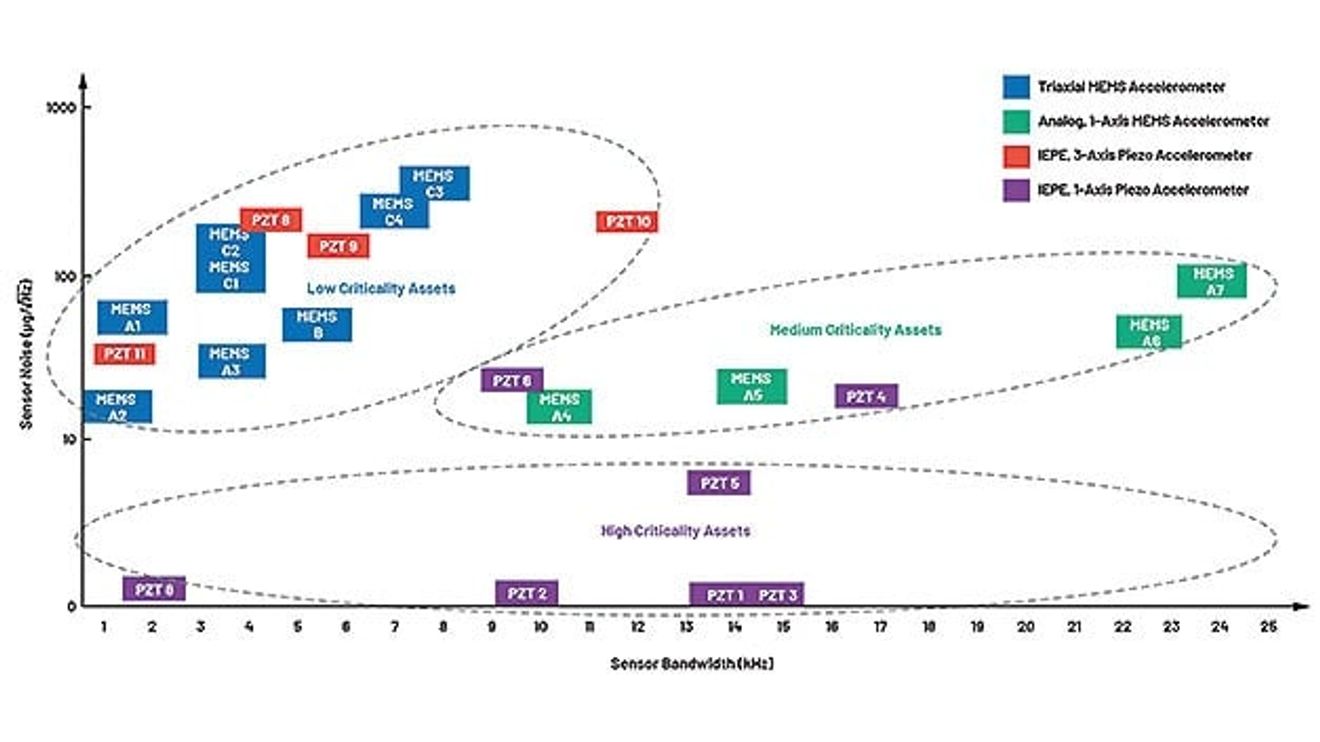
Comparison of different vibration sensors, divided into triaxial and uniaxial MEMS and IEPE sensors. It can be clearly seen that the different types of MEMS sensors form specific clusters that can be assigned to different applications.
© Analog DevicesFinite element method (FEM) analysis using ANSYS or similar programs can be used to simulate the modal response of structures to help optimize the design and reduce prototype iterations. Equation 1, which represents the modal analysis of a system with one degree of freedom in a simplified form, can be used to easily evaluate a design. The natural frequency is related to the mass matrix and the stiffness matrix of the housing. If the height of the housing is reduced, the stiffness increases, while the mass decreases, so that the natural frequency increases accordingly. The opposite is true if the height of the housing is increased: The stiffness decreases, while the mass increases, and the natural frequency decreases.
Choice of MEMS vibration sensor
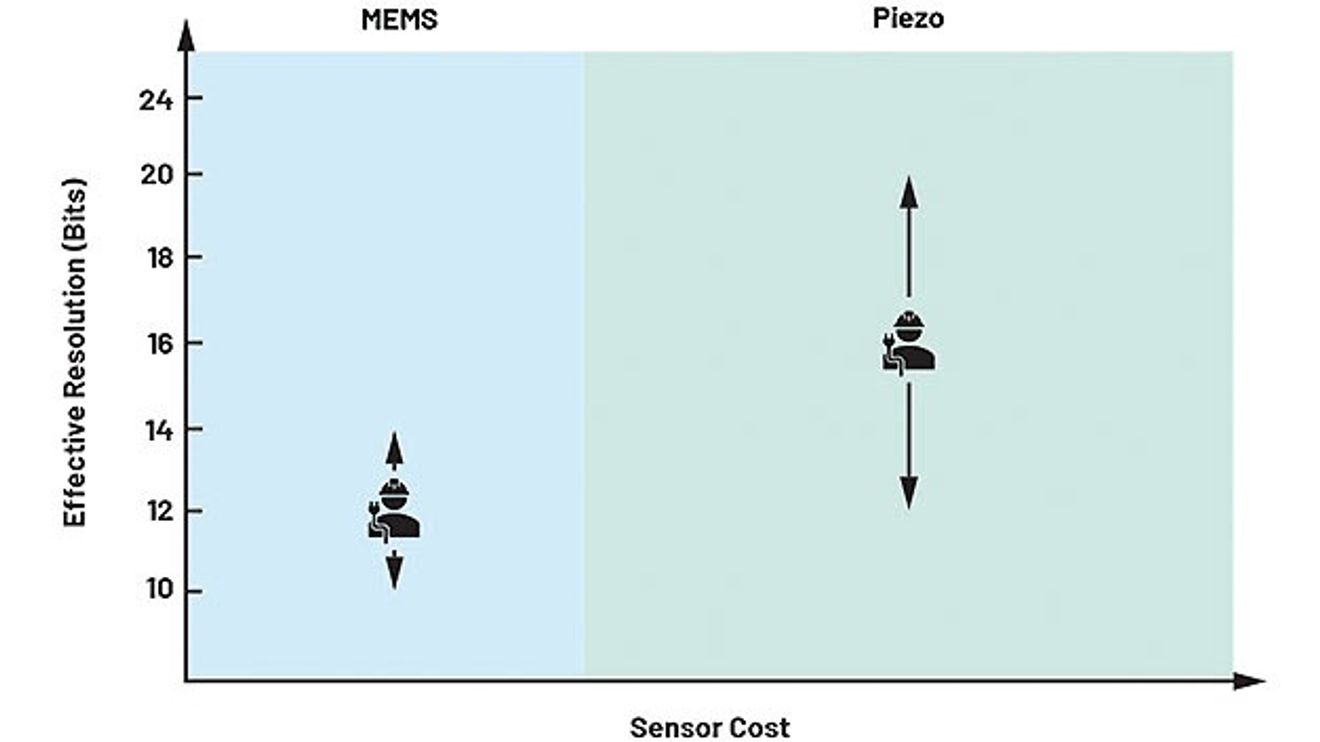
Even if there is no official standard for classifying vibration sensors, it is possible to classify them on the basis of their effective resolution. Compared to piezo sensors, MEMS acceleration sensors only cover a small range. They were developed for application-specific tasks such as airbag activation or rollover detection in motor vehicles, the positioning of robot arms, platform stabilization or precise inclination measurement. It was only a few years ago that MEMS manufacturers developed sensors that can compete with IEPE vibration sensors in terms of performance. This technology is therefore still in its infancy, but more and more MEMS suppliers are investing in vibration sensor solutions for condition monitoring.
3-axis MEMS versus IEPE vibration sensors
Tests have been conducted to determine how well 3-axis MEMS accelerometers can identify faults that single or dual axis IEPE vibration sensors could not detect. Faults such as a bent shaft, an eccentric rotor, bearing problems or a twisted rotor could not be detected with absolute certainty with a single-axis vibration sensor unless certain precautions are taken to understand specific anomalies before assembly. If only a single-axis vibration sensor is available, additional CbM sensors (for motor current or magnetic field) are required to identify faults with greater reliability.
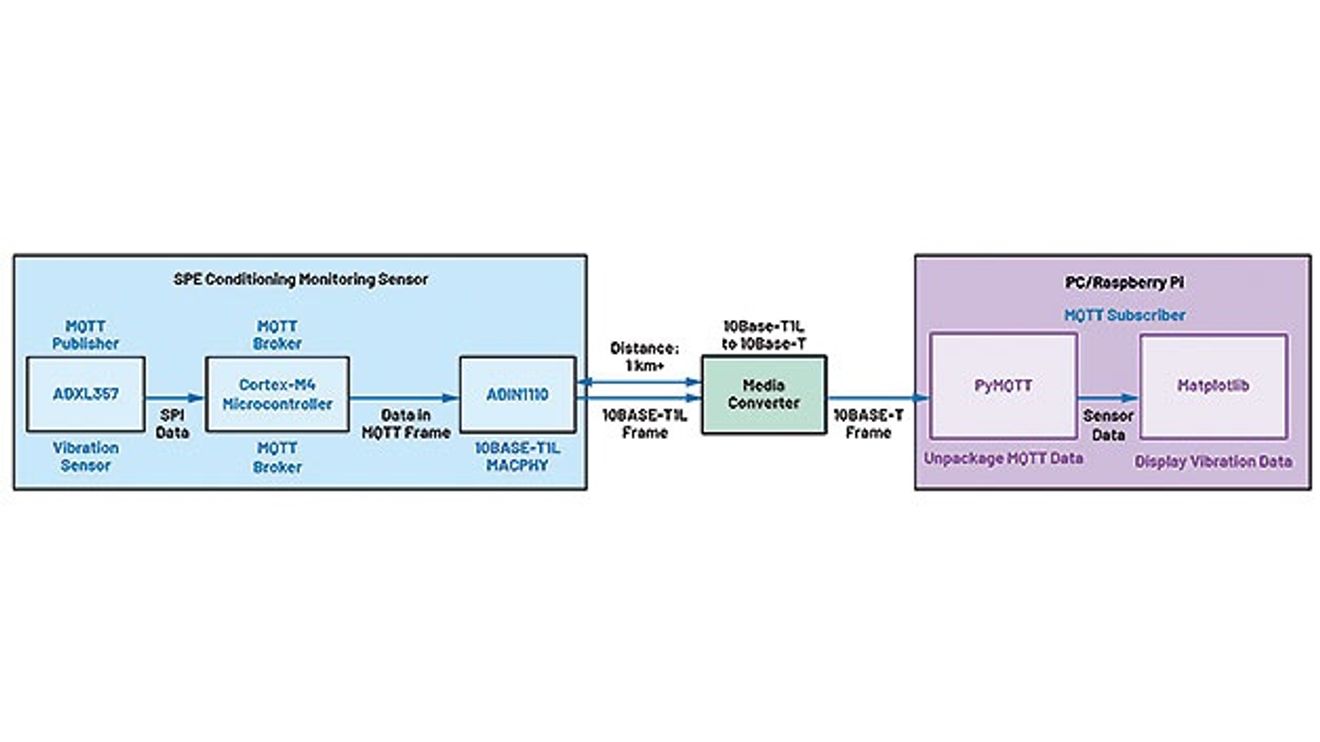
Block diagram of the practical condition monitoring sensor with single-pair Ethernet interface.
© Analog Devices
Therefore, a single-axis sensor with better noise and bandwidth properties needs to be weighed up against a 3-axis sensor, especially as the additional axes can alleviate problems relating to the installation position. With three sensing axes, not only can all vibrations be detected in the horizontal, vertical and axial directions, but more in-depth insight into the operation of the system can be gained.
Analog Devices has designed a condition monitoring sensor with a single-pair Ethernet interface and built-in vibration sensor. The system architecture is suitable for different sensor types (e.g. for temperature, pressure, sound or position) with digital or analog output without requiring major changes to the microcontroller firmware. The vibration sensor had to be small, have a digital output (SPI or I2C) and a high level of integration (amplifier, ADCs) to meet the requirements. The choice fell on a 3-axis MEMS accelerometer with a digital output.
As it is possible to obtain more reliable diagnostic information with three axes than with just one axis and mounting is more problematic with single-axis sensors, a low-noise 3-axis sensor was chosen instead of a single-axis MEMS sensor with less noise and greater bandwidth. Another important aspect was power consumption. The ADXL357 generates less heat in an IP6x module than other sensors because it does not require an additional ADC or operational amplifier.
Microcontroller and software architecture
MQTT (Message Queue Telemetry Transport) is a messaging protocol for the Internet of Things that enables network clients to transmit telemetry data in low-bandwidth environments. Message transmission based on the publish-and-subscribe principle is particularly suitable for connecting remote devices with a minimum code footprint and network bandwidth. Publishers send messages, subscribers receive the messages relevant to them. So-called brokers are responsible for forwarding the messages from the publishers to the subscribers. Some MQTT brokers manage millions of simultaneously connected MQTT clients. This means that several sensors can be connected to one SPE device and a sensor data pipeline is created. Both publishers and subscribers are MQTT clients that can only communicate with the MQTT broker. The MQTT clients can be any devices (e.g. Arduino, Raspberry Pi or ESP32, but also applications such as Node-Red or MQTTfx).
The diagram above shows the block diagram of the status monitoring sensor with single-pair Ethernet interface, connected to a PC or a Raspberry Pi. The first four blocks in the picture are a sensor, a microcontroller, a MAC-PHY and a media converter. The sensor used is the ADXL357 3-axis MEMS sensor, which can detect vibrations. Any standard low-power microcontroller with an SPI interface can be used to read data from the ADXL357.
The measured vibration data is placed in an MQTT topic in order to be transferred to the MAC-PHY - again via SPI. The Cortex-M4 microcontroller is suitable for read and write operations via SPI to the MAC-PHY ADIN-1110 to enable different operating modes and configurations such as PoDL ON or OFF, T1L Special, Master or Slave and 1V or 2.4V. The ADIN1110 converts the MQTT data topics into the 10BASE-T1L format and transmits over IP67 cables up to 300 m long. The Media Converter then converts the data from 10BASE-T1L to 10BASE-T format so that the data can be interpreted, processed and displayed by a PC or Raspberry Pi.
The 10BASE-T1L MAC-PHY
The ADIN1110 is a robust, low-power, single-port MAC-PHY transceiver designed for 10BASE-T1L Ethernet for industrial applications. With its integrated MAC interface, it can be connected directly to various host controllers via SPI. Thanks to the SPI communication channel, it is possible to use low-power processors without an integrated MAC, which greatly reduces the power consumption of the overall system. The ADIN1110 is designed for edge node sensors and field instruments (as used in building, factory and process automation), and is also suitable for intrinsically safe environments.

The 'Ethernet to the Field' and 'Ethernet to the Edge' concepts envisage connecting all sensors and actuators to a converged IT/OT network. Most Cortex M4 microcontrollers with sufficient memory are suitable for this application. The software architecture of the SPE condition monitoring sensor from Analog Devices consists of several elements. Its microcontroller is compatible with the operating system (FreeRTOS), the MQTT libraries and the IP stack or IwIP.
PyMQTT is a Python-based library extension for integrating an MQTT client into a web application. It is used to subscribe to the SPE sensor, extract the data and visualize this data in a GUI. In principle, it acts as a wrapper around the paho-mqtt package, which simplifies the integration of MQTT into a Python application.
The ADIN2111 2-port Ethernet switch uses 10BASE-T1L technology to provide all nodes in a factory or building with an Ethernet connection, thereby simplifying network management. It supports low-power edge node designs and connects to a variety of host controllers via SPI. The ADIN2111 is also ideal for daisy-chaining data between edge nodes with scarce resources in row or ring topologies. It can monitor the connection quality and detect errors. To this end, the module enables real-time error detection and error localization with an accuracy of 2% over a cable distance of 2 km. Sensors, actuators and controllers can be networked in a series or ring topology, whereby existing, individual twisted pair cables can be used.
Data acquisition and GUI
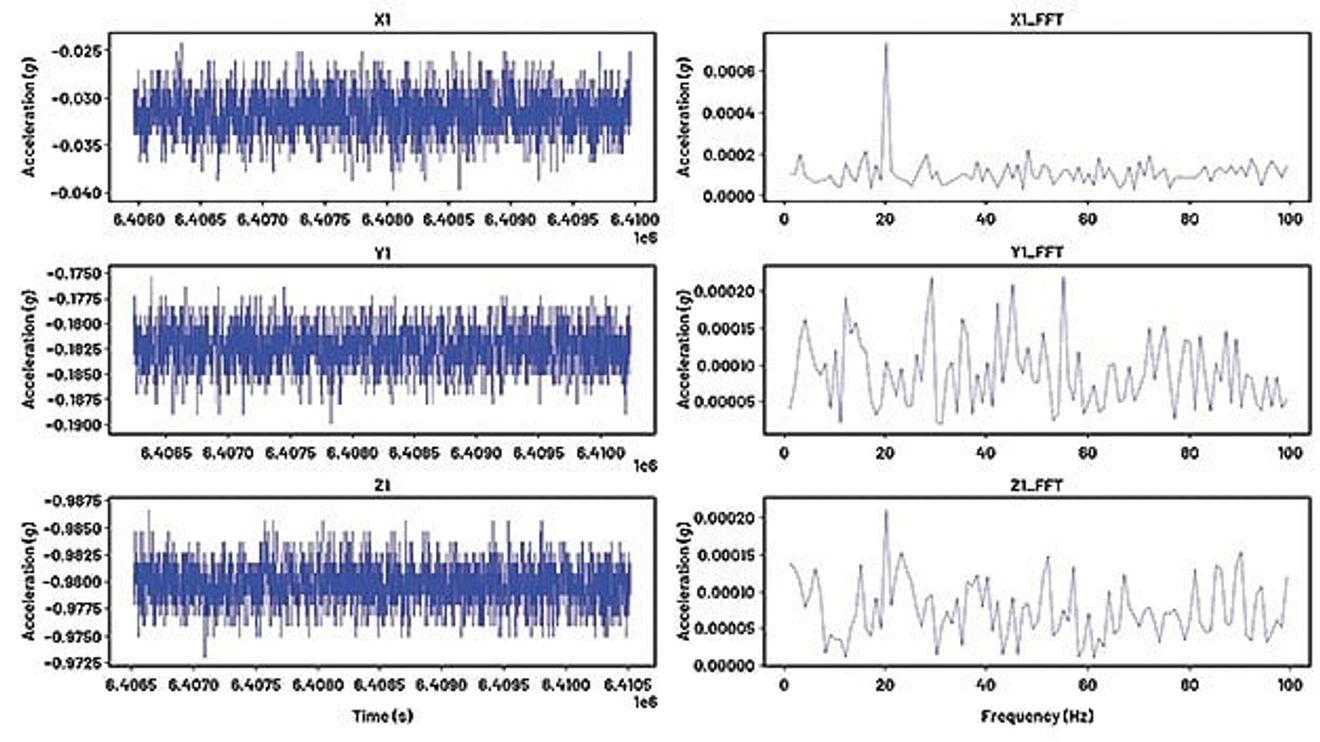
The recorded vibration data can be visualized in the time and frequency domain using the Python-based GUI. As the Python GUI is available as an executable, no code development is required as long as no modifications are desired. The performance of the SPE sensor system was verified in a series of tests. Unbalance tests are a reliable method for this purpose, as the signatures can be easily recognized in the time and frequency domain. The image above left shows the data on the left in the time domain and on the right in the frequency domain. The y and z axes show a clear sinusoidal signal corresponding to the vibrations caused by the unbalance at the motor speed (base frequency). The y- and z-axes were positioned so that they register the strongest vibrations in the event of a motor imbalance. The x-axis also measures some periodic data, but these are not sinusoidal and are an order of magnitude weaker in amplitude than on the y- and z-axes. In the frequency domain display, however, the x-axis shows a clear imbalance signature, as is also the case on the y- and z-axes. In order to investigate the noise characteristics of the system, a further test was carried out, for which a tone generator was mounted on a common base plate with the SPE sensor. The vibrations are not perceptible to a human hand, but the ADXL357 can reliably detect the anomalies in conjunction with the 10BASE-T1L-based communication pipeline on all three axes.
| Spectral signatures | Detectable with one axis | Remarks | |||
|---|---|---|---|---|---|
| Error | Detectable with z-axis (vertical) | Detectable with y-axis (horizontal) | Detectable with x-axis (axial) | Reliable detection with one axis | |
| Unbalance | Fundamental vibration (1x) | Fundamental oscillation (1x) | 9x, 10x | Yes | Additional axes result in a more reliable measurement |
| Eccentric rotor | Fundamental oscillation (1x) | 3x | no | Axial signature clearly indicates an eccentric rotor. | |
| Twisted rotor | Fundamental oscillation (1x) | 3x, 4x, 5x, 6x, 7x, 8x, 9x, 10x | no | Axial signatures at higher harmonics clearly indicate a twisted rotor. | |
| Bent shaft | Fundamental vibration (1x) | Fundamental vibration (1x) | 3x | Possible | Axial signature clearly indicates a bent shaft. |
| BPFO | 3x (BPFO), 4x | 3x (BPFO), 4x | Yes | Not detectable by measuring only the x-axis | |
| BPFI | Fundamental oscillation (1x) | 5x (BPFI) | no | Cannot be determined by measuring only the x- or z-axis |


You might also be interested in
The interactive e-paper of the winners
The interactive e-paper Computer&Automation "Products of the Year 2022" offers twelve categories, 36 winners and video interviews with the award winners at a glance! Click right in and experience the industry's pacesetters up close.
 read more...
Computer&Automation Interactive
The new e-paper experience
Where print reaches its limits, our e-paper unfolds its full potential - true to the motto: pictures say more than 1000 words. Our e-papers now contain more information in the form of videos, GIFs, web links and picture galleries! See for yourself!
read more...The e-paper of issue 3/2022
Find out what the 3D twin can do in engineering, why the saying "data is the new oil" is not just a phrase and how TSN, OPC UA and 5G can accelerate digital business models. Also in this issue: a low-code approach for control systems.
read more...Sascha Niederhagen becomes part of the management team
On July 1, 2025, Sascha Niederhagen took over the position of Executive Vice President EMEAI in the Wika Group.
read more...Temperature transmitter with true drift detection
Just one year after its market launch, the digital temperature transmitter 'Type T38' from Wika already has all the important international approvals and is therefore available worldwide.
read more...Flow meter for conductive liquids
The 'Flowtrans MAG H20' from Jumo measures conductive media with high precision - even drop by drop - and can be used flexibly in a wide variety of processes.
read more...Award for sustainability management
Sick has received a platinum medal in the EcoVadis sustainability ranking. This puts the provider of sensor-based automation solutions in the top 1 percent of more than 130,000 companies worldwide that have been assessed over the past twelve months.
read more...Up to 12.5 m measuring range
Gefran has extended the measuring range of the 'GSH-A' series so that the latest draw-wire sensor in the range can realize a stroke of 10 to 12.5 m.
read more...Largest construction project in the company's history launched
The Endress+Hauser Group's oldest and largest production site in Maulburg is being extensively modernized and expanded. To this end, the provider of measurement technology and automation solutions is investing more than 100 million euros in the...
read more...