
Quality assurance
Tire thickness under the magnifying glass
As car tires are the only direct connection between the vehicle and the road, they have to meet high quality standards. However, ensuring this by measuring the thickness of the rubber layers directly in the calendering process is no trivial task.

Around 70% of the natural rubber produced worldwide is used in tire production. In total, the tire industry produces over one billion tires per year. For this purpose, textile or steel cord is coated with rubber on both sides using four-roll calenders in component production. The coating is applied by pressing the cord together with a layer of rubber on the top and bottom side in the roller gap. By adjusting the distance between the rollers, both the thickness of the resulting material and the crowning or wedge shape can be regulated.
In order to guarantee the high quality of the rubber sheets produced and thus the end product, car tires, it is necessary to constantly monitor the thickness of the material. To ensure that this goes hand in hand with the optimization of the raw materials used, the process is subject to fully automatic control.
The thickness in the calendering process determines the function of the component. However, measuring it during the process is a major challenge, as the black surface of the rubber sheet as well as the high temperatures and vapors of rubber production place high demands on the sensors.
One way of measuring thickness directly on the calender is the 'Thicknesscontrol TCP 8303.ET' measuring system from Micro-Epsilon. It combines two different sensor technologies in one measuring head: an inductive sensor based on eddy current determines the distance to the surface of the calender roll, while an optical laser triangulation sensor measures the distance to the surface of the rubber web. The thickness of the rubber web can be calculated from the difference between the two measured values.
Two principles combined
The eddy current sensor is therefore ideal for determining the distance from the measuring head to the roller, as it measures through the rubber, so to speak. This is possible because only metallic objects are used as the measurement object and rubber therefore has no influence on the measurement signal. The displacement sensors are actively temperature-compensated and therefore insensitive to temperature fluctuations. In addition, the sensor used in this sensor combination is modified in such a way that it generates a precise distance signal despite a very high basic distance in the area used.
The distance to the surface of the rubber sheet is determined by a laser triangulation sensor. Optical measuring methods usually provide very accurate results, but often reach their limits with matt and dark surfaces. The sensor used in the measuring system has what is known as A-RTSC (Advanced Real-Time Surface Compensation). This real-time surface compensation dynamically regulates the light intensity of the sensor during the measurement, ensuring precise measurement results even on difficult surfaces such as black rubber. The sensor offers an adjustable measuring rate of up to 49 kHz and can be individually adapted to the process speed.
In a water-cooled protective housing
In the 'Thicknesscontrol TCP 8303.ET' system, the eddy current sensor has a central hole through which the laser triangulation sensor measures. This enables precise, synchronous measurement. Both sensors are housed together in a water-cooled protective housing, which protects them against the high ambient temperature. Thanks to the water cooling, the sensor head works at ambient temperatures of up to +200 °C and is therefore robust enough for the environmental conditions in tire production. An additional compressed air purge prevents vapors or dust from covering the sensor's optics.
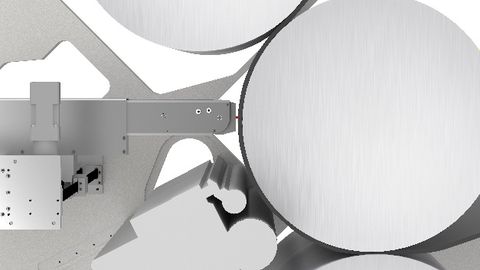
In tire production, textile or steel cord is coated with rubber on both sides using four-roll calenders.
© Micro-EpsilonThe sensor head is integrated into a mechanism that ensures a constant distance between the sensor head and the surface of the calender roll. On the other hand, it regulates the angle of attack depending on the process-relevant adjustment of the roll. In order to measure the thickness correctly, the sensor combination must always be positioned so that it points towards the center of the roll.
The measuring system determines the thickness over the entire width of the rubber sheet. For this reason, the system is equipped with a linear axis that enables transverse movement. Measuring widths of 1400 mm, 1800 mm or 2200 mm are available. To fully monitor the process in a four-roll calender, two 'Thicknesscontrol TCP 8303.ET' systems are used, each of which monitors the product thickness from the upper (rolls 1 and 2) and lower roll gap (rolls 3 and 4). The measuring system is supplemented by a downstream total thickness measurement.
Author:
Achim Sonntag is Head of Equipment/Systems at Micro-Epsilon Messtechnik in Ortenburg.


You might also be interested in
Confocal chromatic precision sensor
The confocal chromatic sensor 'IFS2407-1.5' expands Micro-Epsilon's 'confocalDT' sensor portfolio and is used for high-precision displacement and thickness measurement. The sensor has a measuring range of 1.5 mm with a base distance of 17 mm.
 read more...
Confocal sensors for series integration
The 'confocalDT IFD2410' and 'confocalDT IFD2415' confocal compact sensors represent a new generation of sensors from Micro-Epsilon.
read more...The e-paper special: looking for products of the year 2024
They've earned it: all 96 nominated products from 12 categories in their own e-paper. Browse through the individual areas and make your personal selection. You can also find out more about the companies and their solutions in the accompanying video...
read more...Geometry inspection of long products in the metal industry
The 'DimensionControl Metal Profile Gauge (MPG)' from Micro-Epsilon is used for automatic profile measurements of long products made of steel, aluminum and non-ferrous metal and can be easily integrated into the production line thanks to its...
read more...The e-paper for the special issue
Sensor & Vision 2023
Intelligent sensor technology always requires smooth interaction with software and surrounding systems. The examples in this e-paper demonstrate what this can look like in individual cases. This shows that team play counts - in sensor technology as...
read more...Real 3D from a single source
3D sensors alone are no guarantee for highly accurate 3D measurements - a coordinated interaction of hardware and software is essential.
read more...Complete 3D solution with standardized software
Micro-Epsilon's '3DInspect' software enables the parameterization and acquisition of measurement data from the new generations of the 3D product portfolio for precise geometry, form and surface inspection - Surfacecontrol, Reflectcontrol and...
read more...Measurement technology - The winners
Whether it's heat, pressure or flow, measurement technology allows the system operator to keep an eye on everything. The winning products in the 'Measurement technology' category show which measuring principles can help with this.
read more...Laser sensors for the battery industry
The optoNCDT 1900-6 and 1900-6LL laser sensors expand the Micro-Epsilon laser triangulation sensor portfolio.
read more...