
Color sensors
The metrological challenge
Color measurement always involves a comparison between the measured color and the color perceived by the human eye. How must modern color measurement technology be designed in order to detect even the smallest color deviations by machine?
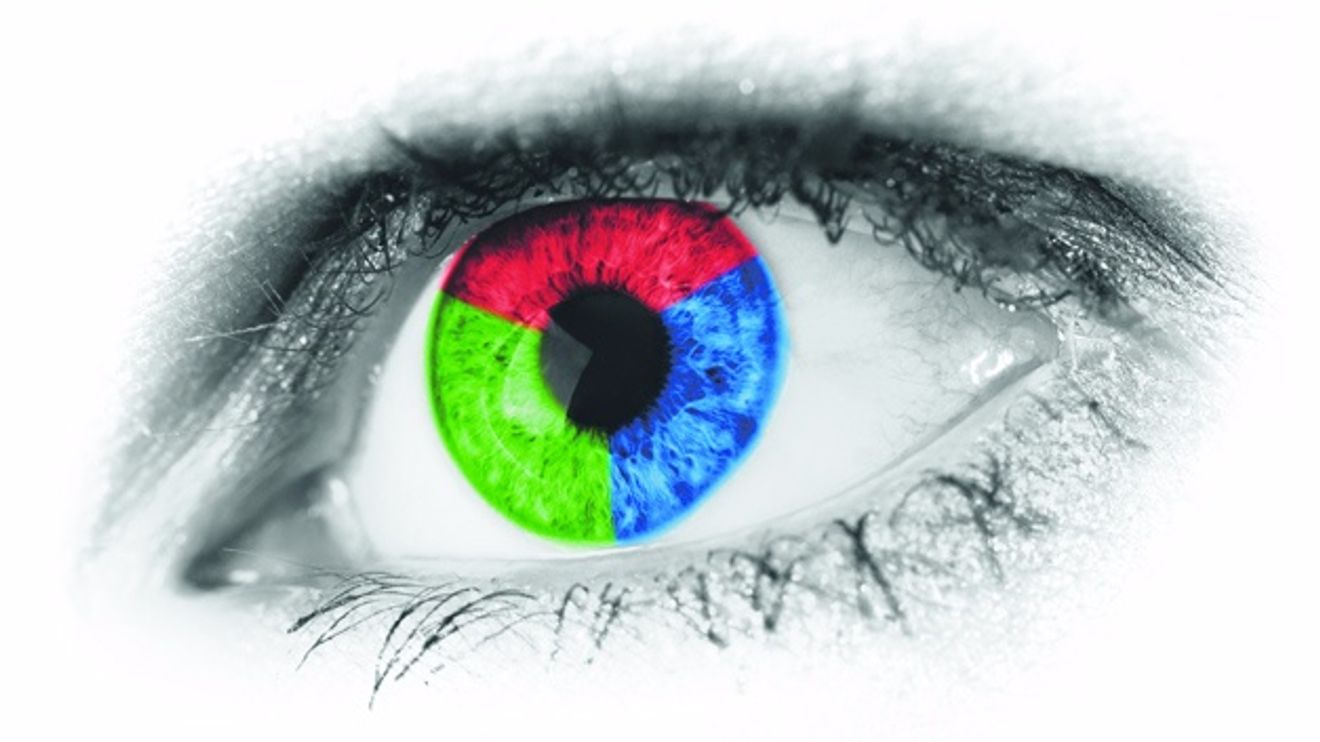
As an individual, visual sensory impression caused by light, color is a major challenge for industrial measurement technology. In most applications, it is crucial to detect even minimal color deviations, as the eye perceives these without any problems.
Human color perception
The sensors used for color control in industrial applications must function in such a way that they correspond to the color perception of the human eye. This is caused by light in the wavelength range from 380 nm to 780 nm. The human eye has different sensory cells: 120 million rods, which are responsible for light-dark vision, and six million cones, which are responsible for color perception. There are three different types of cones, which are sensitive in different wavelength ranges of the visible spectrum. As the rods have a significantly higher sensitivity than the cones, color vision is dependent on lighting.
Colors can be described differently on the basis of human color perception. Thanks to three different types of cones, the color space is three-dimensional.
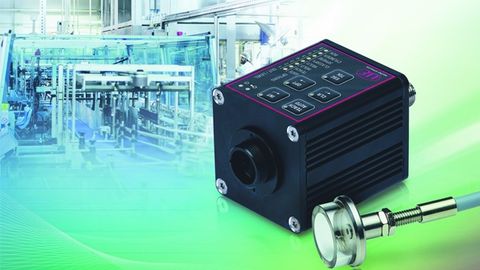
Painted parts on cars, printed products or façade panels are just a few examples of products whose color must be checked during production, as even minimal deviations are visible to the human eye.
© Micro-Epsilon■ Since 1931, the CIE 1931 standard color space defined by an international commission has ensured comparability in the description of colors. It is based on a study in which the color perception of test subjects was examined. Parameters such as observation conditions and lighting were defined at the same time to ensure comparability.
■ In technical applications, the CIELAB color space is more commonly used, which can be generated by transformation from the standard color space. The coordinates of this color space are L as a measure of brightness, a (green/red chromaticity) and b (blue/yellow chromaticity). The advantage of this color space is that each hue, which the human eye perceives as a separate color, occupies the same volume.
■ The HSV/HSI color space is less common.
■ As the RGB and CMYK colour spaces used on screens and in printing technology are significantly smaller than the CIE standard colour space, they cannot reproduce all the colors that the human eye can see. They are therefore unsuitable for precise industrial color measurement.
In addition to the color spaces, other definitions are also important: for example, the CIE Commission specifies requirements for lighting and the observation distance for color measurement. Another important parameter for industrial applications is the so-called Delta-E color distance - the distance between two colors in the color space. Depending on the color, the perception limit for humans is between 0.5 and 1. In the automotive industry, a Delta-E <0.1 is usually required.

Metrological challenge
If the observation geometry is fixed, the color is physically a reflected intensity spectrum in the visible wavelength range. In addition to the color of the object, this reflection spectrum depends on the illumination. Various light sources are defined for illumination, for example incandescent lamps, daylight, fluorescent lamps or cool white LEDs. A color sensor must be able to detect the reflected spectrum and should imitate the way the human eye works.
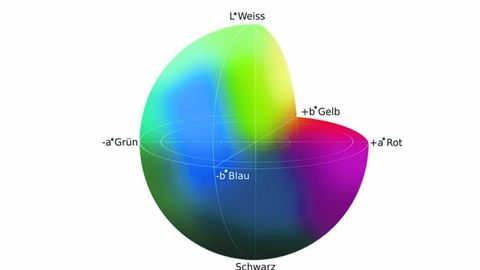
The L*a*b* color space, which has become established for color testing in the industry, includes all colors visible to the human eye.
© Micro-EpsilonFor the measurement, the reflected light is broken down into spectral components. The simplest method for this is to use filters that are only permeable to one part of the spectrum at a time. Most conventional CCD cameras, whose sensor is divided into green, red and blue pixels, are based on this method. Color sensors for industrial applications, such as the 'Colorsensor CFO' series from Micro-Epsilon Eltrotec, work on a more precise principle. Here, the sample is illuminated with a light source - usually white light LED illumination. The light reflected from the sample hits the sensor, where it passes through three different filters onto light-sensitive sensor elements. The absorption spectra of the filters used should be selected so that the areas overlap. The filters are responsible for splitting the light into long-wave (X), medium-wave (Y) and short-wave (Z) components.
The individual signals are then transformed into L*a*b* color values. As this results in measured values that allow the color to be classified according to the color perception of the human eye, they are also referred to as perceptive color sensors or true color sensors. They are particularly suitable for detecting color deviations. Using a teach-in function, users can teach in the desired color and also specify a maximum permitted color deviation. During operation, the sensor then compares the color of the products and can, for example, signal via a digital output whether the color of the sample is within the tolerance range.
Clear identification
Color measurement systems such as the 'Colorcontrol ACS7000' from Micro-Epsilon Eltrotec work on a different functional principle: this splits the spectrum of the incident light into 256 parts via refraction on a grating, which are imaged behind the grating onto a CCD sensor line. This allows the complete visible spectrum to be measured with a spectral resolution of 5 nm. In contrast to the color sensor, the color measurement system not only provides a comparison to reference colors, but can also clearly identify individual colors and output them as coordinates in the color space. Both the sensor system and the white light LED are housed in the system's casing, to which various measuring heads can be connected via fiber optic cables.
Exemplary applications
The automotive industry offers plenty of typical applications for color measurements, as bumpers, door handles and exterior mirrors are painted in body color on most cars today. In addition, there are distance sensors and headlight cleaning systems that are integrated into the bumpers. All parts are painted separately, but must still match the body color perfectly. The color match is therefore checked during assembly. And all the colors in the vehicle interior must also match exactly - with textured, curved and reflective surfaces posing additional challenges for the color measurement technology.
Another impressive example of the challenge of color measurement is the production of zinc façade panels, whose surface color can be changed by coating, for example. During production, the color must be constantly monitored in order to detect deviations at an early stage. Otherwise, façade panels with minimal deviations in color would be easy to identify in large-scale façades.
The smallest color deviations must also be detected during the production of tablets, as different color tones in transparent blister packs would have a negative impact on the perception of quality.
Author: Joachim Hueber is Product Manager Color Sensors at Micro-Epsilon Eltrotec in Uhingen.


You might also be interested in
Confocal chromatic precision sensor
The confocal chromatic sensor 'IFS2407-1.5' expands Micro-Epsilon's 'confocalDT' sensor portfolio and is used for high-precision displacement and thickness measurement. The sensor has a measuring range of 1.5 mm with a base distance of 17 mm.
 read more...
Confocal sensors for series integration
The 'confocalDT IFD2410' and 'confocalDT IFD2415' confocal compact sensors represent a new generation of sensors from Micro-Epsilon.
read more...The e-paper special: looking for products of the year 2024
They've earned it: all 96 nominated products from 12 categories in their own e-paper. Browse through the individual areas and make your personal selection. You can also find out more about the companies and their solutions in the accompanying video...
read more...Geometry inspection of long products in the metal industry
The 'DimensionControl Metal Profile Gauge (MPG)' from Micro-Epsilon is used for automatic profile measurements of long products made of steel, aluminum and non-ferrous metal and can be easily integrated into the production line thanks to its...
read more...The e-paper for the special issue
Sensor & Vision 2023
Intelligent sensor technology always requires smooth interaction with software and surrounding systems. The examples in this e-paper demonstrate what this can look like in individual cases. This shows that team play counts - in sensor technology as...
read more...Real 3D from a single source
3D sensors alone are no guarantee for highly accurate 3D measurements - a coordinated interaction of hardware and software is essential.
read more...Complete 3D solution with standardized software
Micro-Epsilon's '3DInspect' software enables the parameterization and acquisition of measurement data from the new generations of the 3D product portfolio for precise geometry, form and surface inspection - Surfacecontrol, Reflectcontrol and...
read more...Measurement technology - The winners
Whether it's heat, pressure or flow, measurement technology allows the system operator to keep an eye on everything. The winning products in the 'Measurement technology' category show which measuring principles can help with this.
read more...Laser sensors for the battery industry
The optoNCDT 1900-6 and 1900-6LL laser sensors expand the Micro-Epsilon laser triangulation sensor portfolio.
read more...