

Intuitive operation
The intelligent pneumatics
Early knowledge of the condition of a system is a prerequisite for reducing overall operating costs and at the same time increasing the availability and safety of systems. Intelligent pneumatics helps with this.

Reduced total cost of ownership and maximum productivity start with the planning and creation of networks at field level. As actuators of numerous other components, pneumatic valves influence various factors in production - for example plant availability, machine safety, energy efficiency, raw material consumption and often also the quality of the end product. There are therefore good economic reasons for ensuring that these valves operate at a high level. Thanks to intelligent valves, users can anticipate when individual components reach critical limit values and thus take action at an early stage.
One example of such an intelligent pneumatic valve is the combination of the valve systems from the 'AV' series with the 'Smart Pneumatics Monitor' from Aventics.
This module first records the respective operating states, analyzes the data and finally aims to provide condition-based maintenance by providing processed information. The data for the analysis is provided by the 'Advanced Valve' (AV) valve system, the 'Advanced Electronic System' (AES) valve electronics with integrated fieldbus connection as well as input, output and sensor modules.
Seamless flow of information
The valve electronics control up to 64 valves with a total of 128 coils and up to ten I/O modules in a decentralized manner. Process signals are recorded via these I/O modules. As the electronics support the common fieldbuses and Ethernet protocols, they can be integrated into various control environments without any additional effort and thus fulfill the basic requirements for seamless data flow from the machine controller to the pneumatic actuator and back.

In the case of shock absorbers and a number of other components, decreasing effectiveness can be seen over time. Oil loss occurs when monitoring this shock absorber and indicates wear.
© AventicsThe Smart Pneumatics Monitor provides the determined data and information about the status of the machine via an Ethernet connection in the standardized OPC-UA data format in parallel to the controller without affecting its function or the performance of the bus system.
In order to generate this meaningful information, which goes far beyond pure, abstract data records, a PLC programmer would have to represent these links, reprogram them for each project and have the corresponding pneumatics expertise in addition to knowledge of various PLC languages. Only in this way is it possible, for example, to recognize wear conditions at an early stage from all existing data in the sense of predictive maintenance. Theoretically feasible, but very time-consuming. The Smart Pneumatics Monitor provides a remedy.
In practice, with its Ethernet interface and standardized data protocols, it is the link between the valve system and company IT. All data from the valves and components connected to the I/O modules of the valve system are read into a microprocessor and processed using mathematical algorithms developed in-house. In addition to the existing program modules, users with programming skills can have further customer-specific modules developed by Aventics if required. All modules of the components to be evaluated are then combined and linked together in a graphical user interface using drag & drop. This linking in the form of parameterization is ultimately the only task that the user has to perform, as only the user knows which sensor is connected to which input.
Focus on wear and tear
Applications with high benefits for the machine operator include energy consumption and wear. If a user wants to find out more about the wear of a cylinder, they can determine this by analyzing the speed profile, for example. To do this, the 'Smart Pneumatics Monitor' uses the sensors already present in the control system. These are connected in the graphical user interface with a software module whose function is to determine the current status of the cylinder from the speed profile and other data accessible via the valve system.

Pneumatic valve in credit card size: Thanks to the diagonal inner workings, the 'AV' valves are very compact and lightweight, making them particularly suitable for decentralized installation.
© AventicsThis information is then transmitted externally via an Ethernet interface. This can be done, for example, via the OPC UA server integrated in the Smart Pneumatics Monitor. Any information that is recorded via the connected sensors can provide information about the entire application. For example, conclusions can also be drawn about the condition of components without their own sensors by analyzing pressures, flow rates or speeds during the ongoing process: In order to monitor the wear of a shock absorber, for example, the progression of damping over time is monitored. This curve provides information about changes in the shock absorber over the course of its operating time. This makes it possible to determine when the shock absorber will be defective and needs to be replaced. The limit values required for this are defined in the software. As a result, the user receives direct information - for example, that the shock absorber needs to be replaced with a new one in four weeks.
Whether energy or wear - the Smart Pneumatics Monitor differs from monitoring systems that only collect existing data and forward it unfiltered thanks to the clear information about the system status. It compiles all the data, evaluates it decentrally, analyzes it and generates easily understandable information from it, so that a specific need for action is shown at the end.
Alternatively, the user can analyze the data themselves and use it to monitor and optimize their process, for example. The data can be processed, evaluated and saved in the Smart Pneumatics Monitor or an ERP system. Alternatively, Aventics takes over the evaluation and then provides users with the finished information and recommendations for action.
Another function that the system can perform is to reduce the load on the control system. One example of this is the monitoring of energy consumption: the sensor signals are usually processed as part of the control system. Alternatively, a machine manufacturer can outsource standard recurring functions to the Smart Pneumatics Monitor, where they are processed and can then be fed into the controller as prepared information via the Ethernet interface. The control system benefits from this pre-processing through reduced cycle times.
Visualization via cloud, server & co.
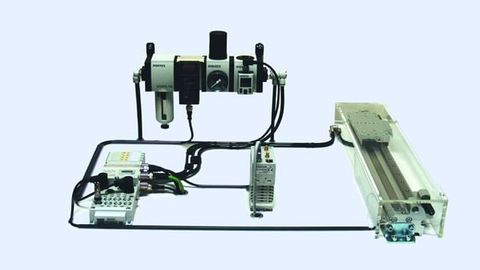
Data hub for I4.0 services: The 'AV' valve system together with 'AES' electronics supply data from connected components to the 'Smart Pneumatics Monitor', which generates insightful information from it.
© AventicsWhen defined limit values are reached, the electronics can automatically send messages to connected ERP and MES systems as well as to employees in maintenance, for example. The solution thus paves the way for Industry 4.0 and the Internet of Things in terms of pneumatics: all information belonging to the real application is already attached to it as a virtual twin and can be imported into a cloud, where it can then be used for further work.
Users can choose between different display and communication options. As standard, the system is equipped with both an integrated web server - so that users can connect to the box using an internet browser and use the internal browser for display - and an OPC UA server, which offers the relevant data for retrieval. In principle, however, interfaces can also be implemented, such as MQTT, simple e-mail or SMS transmission or interfaces to common database and cloud services.
Author: Dieter Michalkowski is Global Account Manager and Industry 4.0 expert at Aventics in Laatzen.


You might also be interested in
Aventics is sold to Emerson
Triton has announced its intention to sell Aventics to Emerson. An agreement has been reached with Emerson on the framework conditions and the regulatory approval process is underway.
 read more...
Andreas Ostermann von Roth strengthens management team
Andreas Ostermann von Roth joined the management of pneumatics specialist Aventics on January 1, 2018. He succeeds Dr. Thomas Brückner, who retired in mid-2017.
read more...New products at the industrial trade fair
"Integrated Industry - Creating Value" is the motto of the world's most important industrial trade fair, Hannover Messe 2017. Computer&AUTOMATION shows an excerpt of the products that can be seen in Hanover in a picture gallery.
read more...SensoPart and Cambrian Robotics
Partnership for 3D-Guided Robotics
Cambrian Robotics and SensoPart are jointly developing an AI-powered solution for 3D-guided robotic applications. The combination of vision sensors and AI is designed to simplify gripping and positioning processes.
read more...Expansion of the Sensor Portfolio
Infineon Completes Acquisition of ams Osram's Sensor Business
Infineon has completed the acquisition of ams Osram's non-optical analog/mixed-signal sensor portfolio. The business is expected to generate approximately 230 million euros in revenue in 2026.
read more...Technologies for precise data and analytics
From June 9 to 11, 2026, Sensor+Test once again brought together trade visitors from the fields of sensor technology, measurement, and testing in Nuremberg. With its focus on these core technologies and the wide range of application areas, the trade...
read more...Increased revenue and expanded production capacity
The Fraba Group, a manufacturer of sensors for industrial motion control, looks back on a successful 2025, during which both revenue and the number of employees increased.
read more...From sensor to intelligent system
Sensors, measurement technology and artificial intelligence are merging to form intelligent systems. From June 9 to 11, 2026, Sensor+Test in Nuremberg will showcase the most important trends in a changing industry.
read more...Technology and innovation center opened in Chengdu
Balluff has opened a technology and innovation center at its production site in Chengdu, China. The aim is to provide even more targeted support to local and international customers with solutions and expertise.
read more...