
Sensors 4.0
The cyber-physical production system
The requirements for tomorrow's sensors and measuring systems in the context of Industry 4.0 can be determined with the help of cyber-physical production systems. The Laboratory for Machine Tools and Production Engineering (WZL) at RWTH Aachen University is presenting one of these.
Developments in the context of Industry 4.0 generally aim to optimize production at various levels of the automation pyramid using information that is available in real time wherever possible. To this end, real-time capable statistical, physical or mathematical models are fed with real data in order to map and predict the behavior of processes, systems, supply chains and product properties. The increasing use of sensors and the resulting increase in information density enable the use of ever more complex and accurate models. Possible tasks for these models include determining the machine condition based on thermal loads for volumetric compensation of machine tool deformations.
In production, models are implemented in the form of so-called cyber-physical production systems (CPPS). These CPPS collect data via production-integrated sensors and measuring systems in real time, store and evaluate data for the purpose of modeling, actively interact with the physical, human and digital world through actuators and are connected to each other and to the Internet of Things (IoT) via digital communication devices.
Sensor technology in Industry 4.0

Basic structure of a cyber-physical production system (CPPS) for the self-optimizing assembly of aircraft structural components.
© RWTH AachenA basic prerequisite for the use of CPPS is the supply of real data to the models used. This results in requirements for the (further) development of sensors. These requirements - set out in the VDI Roadmap for Production Metrology 2020 - address the speed, accuracy, safety and flexibility of industrially used sensor technology.
CPPS require the integration of measurement technology directly into production processes and systems. The speed of the measurement process or the sampling rate is of great importance in order to avoid delaying the sequences of dynamic processes by waiting for the measurement process. In addition, the sensor system must be able to meet real-time requirements and provide the recorded information to any number of recipients simultaneously. Automated data pre-processing at the sensor is essential for this.
Zero-defect strategies in production and the reduction of component tolerances require greater accuracy. This can be achieved on the one hand by further developing the sensor hardware and on the other hand by reducing calibration uncertainties. Compensation strategies that take environmental conditions into account in order to reduce measurement uncertainties are also a possible approach.

Requirements for future sensor technology based on the VDI Roadmap for Production Metrology 2020.
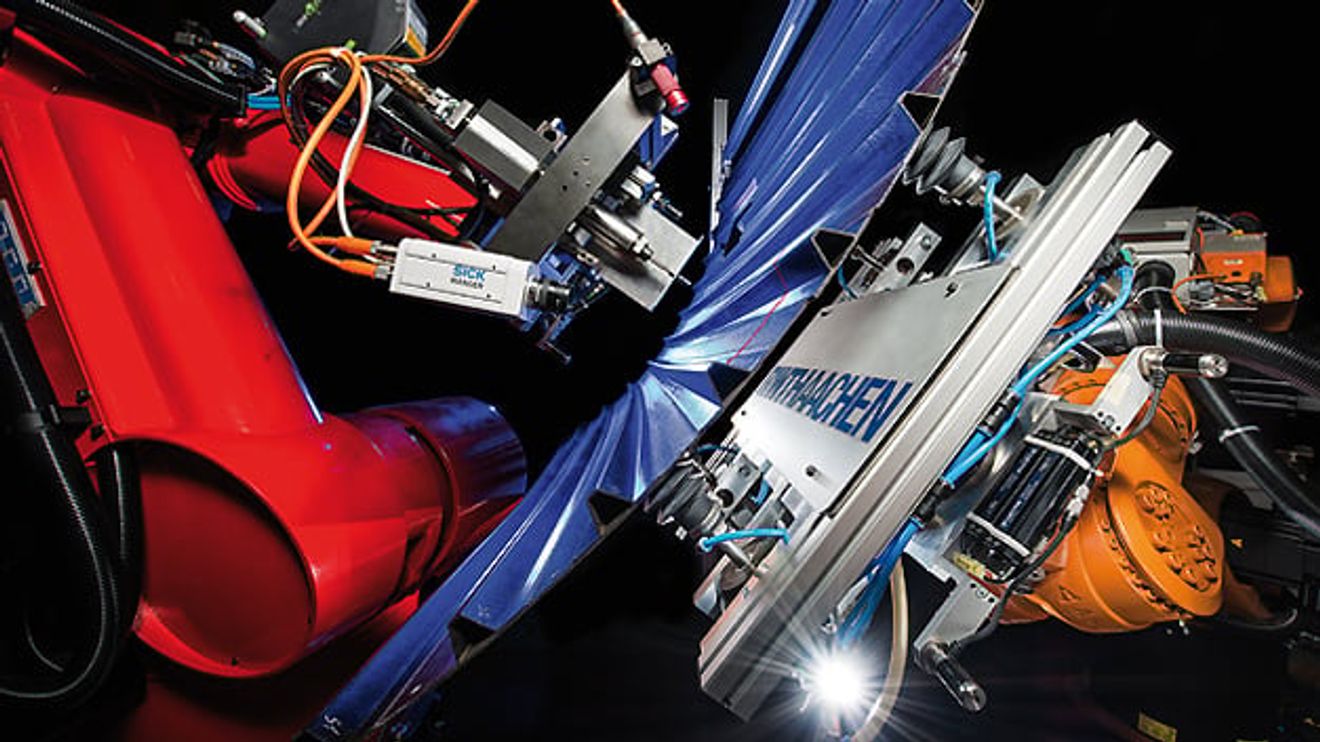
© RWTH AachenOne example of a process with high demands on speed and accuracy is the robot-based metrology-supported assembly of aircraft components. The required assembly tolerance of approx. 0.1 mm can only be achieved by metrological monitoring and control of the robot position before each assembly step, without the use of rigid devices. At present, only a few measuring systems meet this requirement, so that either several measuring systems have to be used in parallel or longer waiting times have to be accepted.
The use of sensor data for production control requires the data to be adequately validated; the measurement uncertainty must be determinable and verifiable. These requirements and the need for traceability have been further tightened by the revision of ISO 9001 (2015). In addition to the general proof of measurement uncertainty, current developments are also pursuing the goal of assigning an individual measurement uncertainty to individual measured values - for example by accessing environmental information such as temperature.
Flexible production with multi-sensor systems
The variety of information required for the operation of CPPS requires multi-sensor systems, whose information must in turn be merged by means of sensor data fusion. This leads to an increasing density of information, which allows users to use the data associated with a component for several applications and therefore more flexibly. At the same time, however, it becomes more difficult to identify the information relevant to an individual application. Pre-processing the data in the sensors makes things easier. Applications for this include damage diagnosis on fiber composite workpieces, where a single process cannot provide sufficient information about damage. For example, it is possible to first localize defects spatially at the macro level using lockin thermography and then classify them in more detail using ultrasound.
In addition to general requirements for improving the speed, accuracy, safety and flexibility of sensor technology, Industry 4.0 also calls for holistic and networked sensor technology. This requires standardization of the information technology connection of intelligent sensors. In addition to the standardization of input data for intelligent sensors (e.g. 'STEP' for product geometries), standardized service-based output information is required to communicate the sensor data. The increasing sensor density and the associated data volumes also require the further development of common communication structures for real-time capable transmission of high data rates.
Metrologically supported assembly in motion

Metrologically supported assembly using the example of windshield assembly in motion at the WZL of RWTH Aachen University.
© RWTH AachenThe example of windshield assembly on a moving vehicle at the WZL machine tool laboratory at RWTH Aachen University demonstrates the potential of a CPPS together with modern sensor technology.
Automated assembly processes in final assembly in the automotive and commercial vehicle industry typically take place within an outfeed from the flow assembly on the stationary product in order to simplify the positioning and orientation of the assembly object and automation technology in relation to each other. The disadvantages of this process are increased space requirements and the technical complexity of the necessary buffer sections. The WZL is therefore developing a flexible solution as part of the AiF project 'Fasim_XL' ('Automated large component assembly under flow conditions' - IGF no. 18425N/2), in which sensor technology is used to assemble an assembly object - a truck driver's cab - and the part to be assembled - the windshield - using industrial robots without interrupting the flow movement.
A so-called global reference system (GRS) based on the 'Nikon iGPS' measuring system is used for this purpose. Similar to terrestrial GPS, this large-volume optical measuring system uses special receivers to determine almost any number of points within the measuring volume simultaneously with a measurement uncertainty of around 150 µm. In order to regulate the positioning of the windshield to the vehicle, the receivers record both the current position and orientation of the handling tool on the industrial robot and the truck driver's cab. The position information from the driver's cab forms the input variables for model-based predictive control, which compensates for uneven movements such as yawing, wobbling or jerking on the transfer system and regulates the pose of the industrial robots accordingly.
The requirements described above can be illustrated using the moving assembly scenario as an example: A high measuring frequency of at least 50 Hz, a short measuring time and the real-time capability of the measuring system are required to control the dynamic example process. The tolerance requirements also mean that the measurement uncertainty of the measurement system used should be at least one order of magnitude better than the target value in accordance with standard recommendations. In the example case, a measurement uncertainty of approx. 150 µm is absolutely necessary. While these requirements have already been met and the technical feasibility of the solution approach has already been demonstrated, there are still deficits, particularly in the aspects of safety (e.g. online estimation of the measurement uncertainty to ensure process capability) and holism (e.g. simple networking), which have so far prevented simple and robust use in industry.
The networking of individual sensors and the semantic description and provision of sensor data via services enable the creation of sensor networks. By combining different sensors, virtual sensors can be created that are described using virtual standards. These virtual sensors can be used to draw conclusions about process variables that cannot be recorded directly, to check the plausibility of sensor data or, in the event of a sensor failure, to provide substitute values for short-term bridging until the sensor is repaired.
New business models
The networking of sensors and the simplified exchange of sensor data also make it possible to separate data acquisition and evaluation in terms of location and time with little effort. For complex evaluations, it is thus possible to access computing power available elsewhere for data processing, as well as the necessary expert knowledge for specific applications and the know-how for the use of data mining tools and deep learning methods. New business models based on the analysis of customer data can be derived from this: For this purpose, an external service provider receives sensor data from a plant or measurement data from various measurement systems and evaluates it in a suitable manner.
The data volumes collected by the service provider are also used to further develop the models. The external service provider can be an independent company or a central department. One example of this is the diagnosis of damage to vehicles made of fiber-reinforced plastics: In repair workshops, damage is digitized using suitable sensor technology and the measurement data is sent to a central diagnostic point. This evaluates the measurement data, makes a diagnosis and determines a repair process. This avoids the need for time-consuming on-site training of employees and at the same time increases the quality of the evaluation.
Authors:
Guido Hüttemann is a research associate in the Model-Based Systems department at the Laboratory for Machine Tools and Production Engineering (WZL) at RWTH Aachen University;
Prof. Dr. Robert Schmitt is Director at the Laboratory for Machine Tools and Production Engineering (WZL) at RWTH Aachen University and at the Fraunhofer Institute for Production Technology.


You might also be interested in
The first steps towards digitization
Real-time transparency in the material flow: this was the goal set by Miba when it set out to digitalize its internal logistics processes. But how successful was the close link between ERP and MES in the end? - A field report.
 read more...
How will the IoT change companies in 2020?
How will network technology in companies change in 2020? Axel Simon, Chief Technologist at HPE Aruba, takes a look into the crystal ball
read more...Digital twin revolutionizes maintenance
As virtual representatives of real machines, digital twins open up new possibilities for maintaining and servicing complex industrial plants and systems. A project report.
read more...You can't do without Edge and Swarm
The IoT has changed the requirements for processing data provided by machine sensors and actuators. This needs to happen as quickly as possible - preferably where the data is generated. Edge nodes and swarm computing systems take on this task.
read more...Online machine data under control
Turning huge amounts of data into valuable information - how can this smart industry approach be implemented? Linking PC-based controllers with Matlab and a cloud-based IoT analytics service can be a viable approach.
read more...From modeling directly into the PLC
Despite digitalization and I4.0, the technical functions in a process plant do not become simpler if you break them down to the smallest detail. Nevertheless, the high level of difficulty can be overcome by combining the right tools in the right way.
read more...Where are the new business models?
The necessary new business models are repeatedly cited as the hallmark of an Industry 4.0 environment. But to date, very few companies have seen any of this. Schneider Electric now has a few models up and running.
read more...Why predictive maintenance?
Investments in predictive maintenance systems are worthwhile in order to proactively detect damage. Not only does this increase the service life of a machine, it also opens up new business models for machine manufacturers.
read more...First customer projects via BaSys 4.0
The BMBF project 'Basissystem Industrie 4.0' expired at the end of June 2019. Together with NetApp and Objective Partner, Fraunhofer IESE now offers Industry 4.0 solutions with support and adaptation to customer systems on the basis of this project....
read more...