
Inline color measurement
Quality control in the line
In both plastics extrusion and injection molding, defect detection and component colour control are important parameters in the production process. Both can be checked fully automatically directly during production using suitable sensor technology.
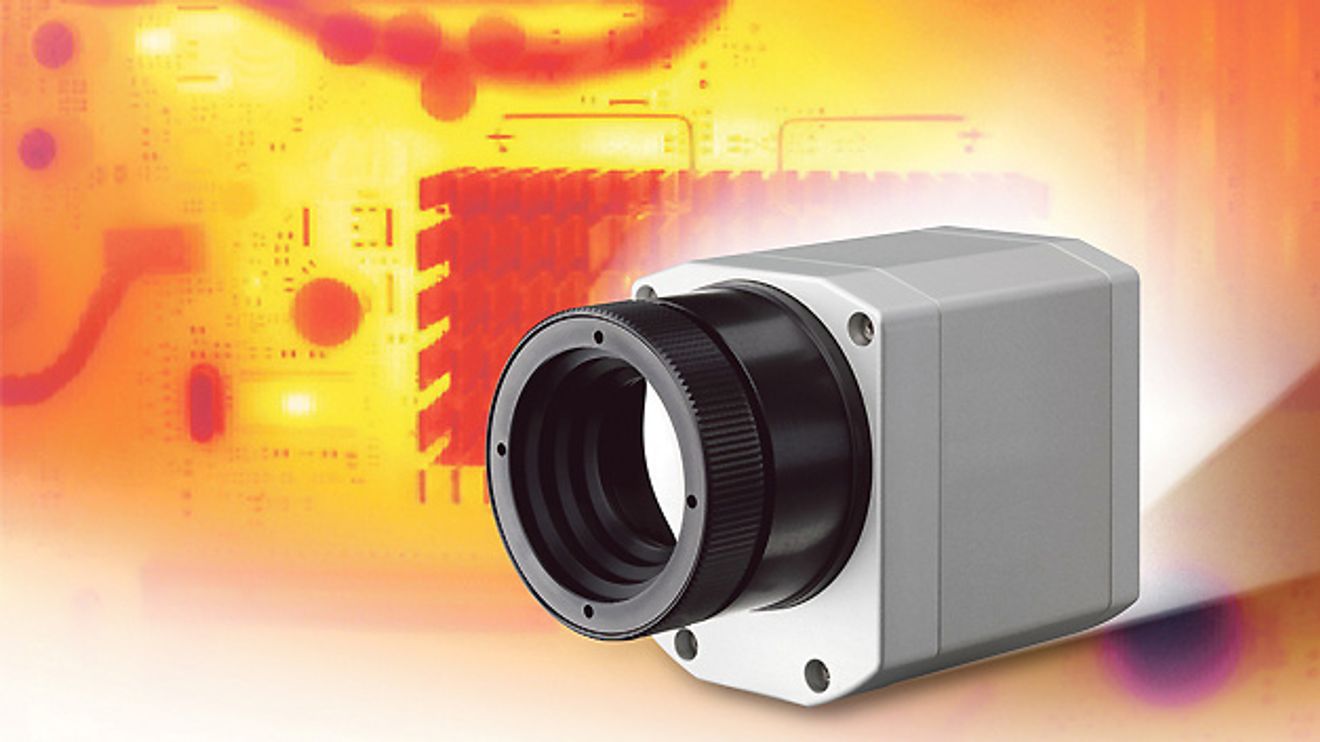
A 100% inspection in the production line can only be achieved by combining different methods in order to monitor different inspection points quickly and reliably. In the case of injection molding, for example, a combination of thermography and a color measurement system is ideal.
By using thermal imaging cameras in the production of injection-molded plastic parts, product quality can be monitored, particularly with regard to stability and accuracy of fit. An essential part of this is checking the cooling process: irregularities during cooling can cause different material densities and affect the material properties of the injection molded parts. For monitoring purposes, a component is first moved directly in front of the infrared camera during the production process in order to check it for defects. This is made possible by an automatic handling system for part removal and depositing, which modern injection molding machines are usually equipped with. For example, 'Mold-control' from Micro-Epsilon can be used as an inline thermography system for component inspection. This system enables fast, constant quality inspection of injection-molded plastic parts directly on the production line. The system solution consists of a thermal imaging camera from the 'ThermoImager' series, a ready-to-use Net PC and the Mold-control software.
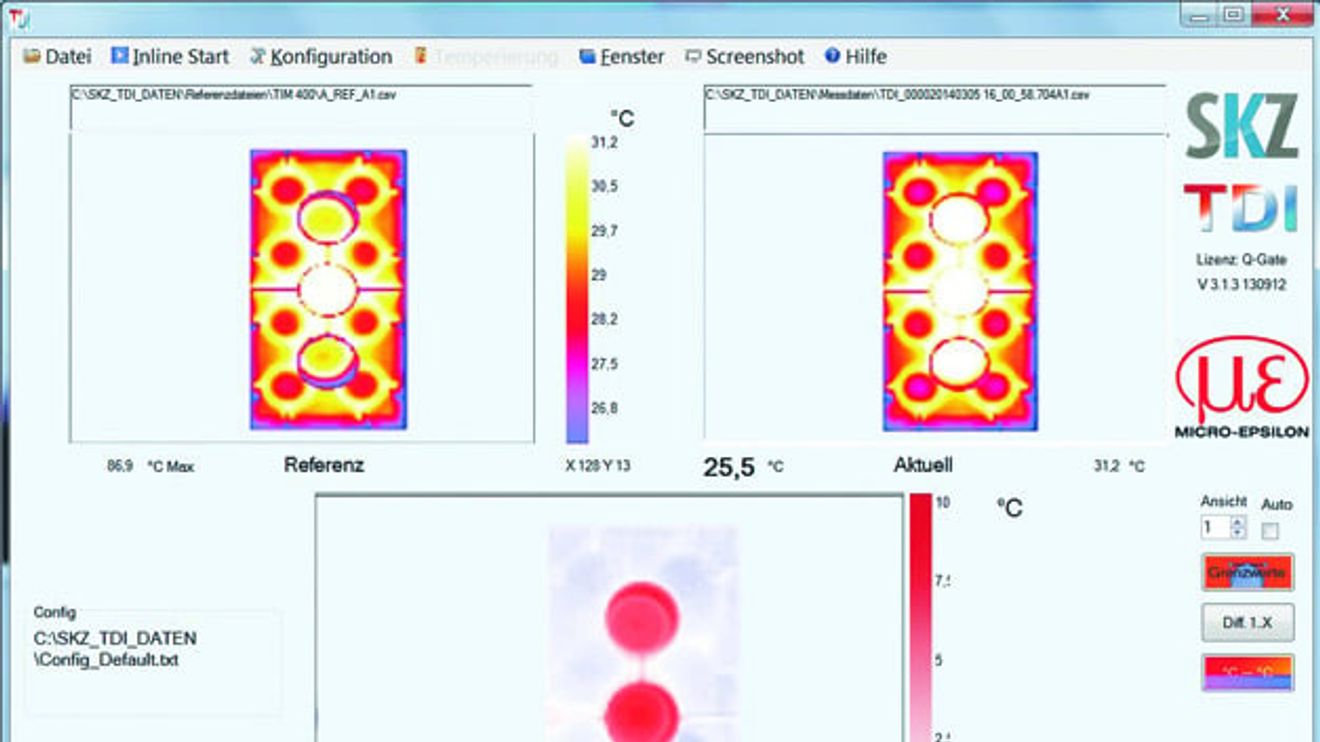
Infrared thermal images for fault detection
Where conventional image processing methods reach their limits and have difficulties detecting defective components due to geometry, color and reflectivity, infrared cameras, which also offer the option of logging, score points. Using thermography, even incompletely molded components that remain undetected during visual inspection can be detected immediately. Inline thermography systems enable the early detection of quality fluctuations and, based on the measured values, a faster production start-up and optimized mould temperature in order to reduce rejects. The entire component can be recorded, inspected and evaluated according to predefined parameters using an infrared thermal imaging camera. The system then makes a good/bad part selection based on defined reference values.
By positioning the component in front of the camera, an exact time window can be maintained for taking the thermographic images, which ensures the comparability of the thermal images from shot to shot. With automated removal, a good/bad part selection must be made in the shortest possible time. The aim is to prevent problems during further processing and to initiate corrective measures as quickly as possible.
Thanks to the non-contact technology, measurement objects can be inspected precisely and wear-free without any physical impact, and large areas can be measured in millisecond intervals. The camera can be used in a line monitoring mode for continuous process monitoring of ongoing processes. The infrared camera registers the entire component from up to six different views and inspects it. The miniaturized industrial thermal imaging camera records and visualizes the infrared radiation emitted by the workpiece. The temperature distribution provides a global quality statement about incorrect temperature control of the workpiece, malfunction of the tool temperature control, visible geometry errors and hidden errors. The system minimizes start-up rejects after downtimes or tool changes, as the first good part after restarting is reliably detected. The evaluation takes place in the dead time between two shots. The software displays the reference image, the IR image of the component and the difference between the two images. The identified temperature differences serve as the basis for differentiating between good and bad parts. The temperature alarm limits can be freely defined via the operating software. Faulty components are sorted out according to these settings.

The 'Colorcontrol' inline color measurement system identifies a color not only by comparing it to the reference value, but also via the reflectance spectrum.
© Micro-EpsilonIt is also possible, for example, to warn operators of error events using a traffic light or to shut down the machine in extreme cases. Limit values for various components can be stored and retrieved in a component database. In addition to the immediate sorting of the components, an IR image of the part is saved to the hard disk or a network drive for each shot, thus ensuring 100% traceability of a component.
If the Moldcontrol system has previously verified that a component is a good part, its color can be checked directly afterwards in the line using the 'Colorcontrol ACS 7000'. Until now, a 100% automatic color check on the freshly injection-molded component was not possible due to the thermochromic effect: As a result, warm components have a different color than when cooled. This effect is particularly pronounced with red dyes and color differentiation is difficult. Even a temperature difference of 20 °C can result in color deviations of more than 2 ∆E units, depending on the coloring.
The color measurement system from Micro-Epsilon determines the exact color of the molded part that has just been injected - the color is derived in the cooled state based on taught-in measured values that reflect the color change over the temperature.
Automatic color check
In contrast to conventional technologies, this inline color measurement system with a measurement accuracy of ΔE ≤ 0.08 clearly identifies a color not only by comparing it to the reference value, but also via the reflectance spectrum. The system works with the spectral method: First, the sample is illuminated with homogeneous white LED light. The spectrum of the reflected light is then offset against a white reference. From this, the coordinates in the CIE-XYZ color system are determined for all wavelengths of visible light (from 390 to 780 nm) and output in the desired color space. The controller takes into account various observation conditions such as illuminant and normal observer. Three operating modes are possible: In the first, the color distance ΔE to the reference is measured. The system works with up to 15 taught-in values. In the second mode, the reflectivity spectrum of the sample is determined and output. In the third mode, color locations are determined and displayed in the desired color space. For quality testing, the trend analysis of the color values can be carried out over any period of time in either L*a*b*, XYZ or L*c*h. In all modes, measurements can be carried out at speeds of up to 2 kHz. Operation and display are carried out via a web interface, and light/dark correction can also be carried out using buttons on the controller or the user interface. Ethernet/Ethercat, RS422 and digital I/Os are available for data output.
A sensor for every surface
The Colorcontrol ACS 7000 optical measuring system has three different sensor heads for different measuring tasks: The 360° ring head is particularly suitable for structured, highly reflective and shiny metallic surfaces. In the sensor, 24 illumination optics are arranged around the receiving optics and ensure constant illumination of the surface. This means that the measurement can be carried out regardless of the rotational position of the measurement object. The angle head is suitable for color measurement on matt and finely structured materials. Here, the illumination and receiver are arranged at a 30°/0° or 45°/0° angle to each other.
Author:
Manfred Pfadt is Product Manager Sensors at Micro-Epsilon Messtechnik in Ortenburg.


You might also be interested in
Confocal chromatic precision sensor
The confocal chromatic sensor 'IFS2407-1.5' expands Micro-Epsilon's 'confocalDT' sensor portfolio and is used for high-precision displacement and thickness measurement. The sensor has a measuring range of 1.5 mm with a base distance of 17 mm.
 read more...
Confocal sensors for series integration
The 'confocalDT IFD2410' and 'confocalDT IFD2415' confocal compact sensors represent a new generation of sensors from Micro-Epsilon.
read more...The e-paper special: looking for products of the year 2024
They've earned it: all 96 nominated products from 12 categories in their own e-paper. Browse through the individual areas and make your personal selection. You can also find out more about the companies and their solutions in the accompanying video...
read more...Geometry inspection of long products in the metal industry
The 'DimensionControl Metal Profile Gauge (MPG)' from Micro-Epsilon is used for automatic profile measurements of long products made of steel, aluminum and non-ferrous metal and can be easily integrated into the production line thanks to its...
read more...The e-paper for the special issue
Sensor & Vision 2023
Intelligent sensor technology always requires smooth interaction with software and surrounding systems. The examples in this e-paper demonstrate what this can look like in individual cases. This shows that team play counts - in sensor technology as...
read more...Real 3D from a single source
3D sensors alone are no guarantee for highly accurate 3D measurements - a coordinated interaction of hardware and software is essential.
read more...Complete 3D solution with standardized software
Micro-Epsilon's '3DInspect' software enables the parameterization and acquisition of measurement data from the new generations of the 3D product portfolio for precise geometry, form and surface inspection - Surfacecontrol, Reflectcontrol and...
read more...Measurement technology - The winners
Whether it's heat, pressure or flow, measurement technology allows the system operator to keep an eye on everything. The winning products in the 'Measurement technology' category show which measuring principles can help with this.
read more...Laser sensors for the battery industry
The optoNCDT 1900-6 and 1900-6LL laser sensors expand the Micro-Epsilon laser triangulation sensor portfolio.
read more...