

RFID reader
Identification systems speak OPC UA
Together with the Fraunhofer Application Center Industrial Automation, Turck has taken up the cause of developing an interface for OPC UA communication between RFID readers and controllers.
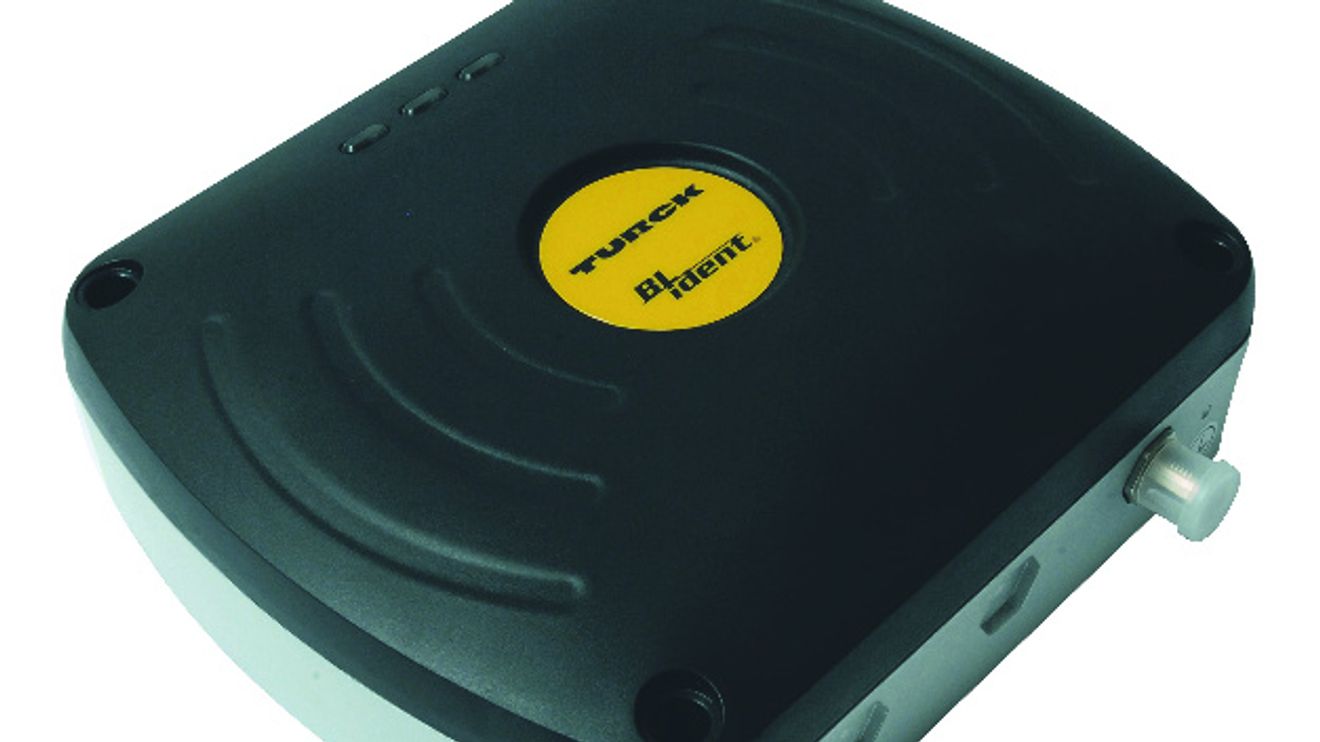
Thanks to the OPC UA classification of identification devices, read/write heads can be parameterized and operated uniformly on different systems in future.
© TurckThe connection of identification devices was not initially mapped by the OPC Foundation in the OPC UA protocol. The Association for Automatic Identification, Data Acquisition and Mobile Data Communication (AIM) therefore decided in 2014 to close this gap and develop an OPC UA classification for identification systems. The protocol should standardize the transmission of data and standard commands between RFID read/write heads (OPC UA servers) and controllers or PCs (OPC UA clients). Using this classification, RFID systems or other identification systems such as barcode readers can be connected to controllers or other OPC UA clients in the future. The user benefit: If they have connected an RFID interface to their controller that transmits its data in accordance with this OPC UA classification, they can simply replace the RFID interface with another manufacturer's interface without having to make any changes to their controller or industrial PC.
While a prototype of the classification was presented at Hannover Messe 2015, the final version 1.00 was released this year. The classification maps the most important and general commands for communicating with RFID read/write heads, including commands such as identifying a device and reading or writing to a data carrier. In addition to the evaluation of process data, the classification also includes standard parameters of the identification devices. A data area has been reserved in the protocol for specific commands, which does not affect the function of the generally valid standard commands.
OPC UA for RFID readers from Turck
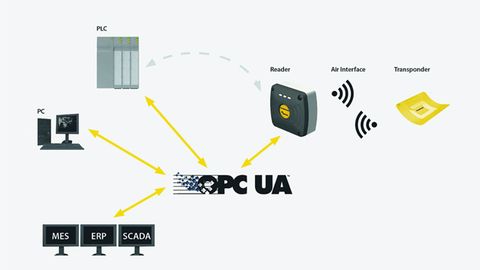
Proprietary interfaces between the PLC and RFID reader, which were previously common (gray dashed line), are no longer necessary with OPC UA.
© TurckIn order to be able to offer users RFID products with the standardized OPC UA classification as quickly as possible, Turck has developed a defined interface with the Fraunhofer Industrial Automation Application Center (IOSB-INA) that translates the Turck RFID language for the OPC UA classification. As the Fraunhofer IOSB-INA already had experience with OPC UA from an earlier project in which an OPC UA nano server was integrated on a sensor, the hardware requirements that an OPC UA RFID interface must fulfill could be quickly derived. Turck has defined the hardware of future RFID interfaces accordingly: The core of the devices will be a Texas Instruments ARM Cortex-A8 processor with a clock rate of up to 700 MHz. The main memory of the system requires 256 Mbytes, and Linux OS is envisaged as the operating system.
The interface is not integrated directly on the read/write heads, but is integrated in the RFID interfaces in line with the modular concept of the 'BL ident' RFID system - i.e. on the I/O components to which the RFID read/write heads are connected. Users will therefore continue to connect sensors and actuators in parallel to RFID read/write heads in the future; trigger signals can still be connected to the same interface or I/O module next to the readers.
A proprietary language will continue to be spoken over the last meter from the RFID interface to the reader. Nevertheless, communication is completely transparent for the user. The RFID devices of the manufacturers that integrate the OPC UA classification are parameterized uniformly from OPC clients. The RFID readers are initialized automatically after connection to an OPC UA client. Users can then configure the readers via a PLC or a PC. It is also possible to browse an OPC UA server (RFID interface) via the OPC UA client. As OPC UA also has an interface to SAP, connection to ERP and MES systems is also possible without complex programming.
Author:
Bernd Wieseler is Head of Product Management RFID Systems at Turck in Mülheim.


You might also be interested in
Parallel to SPS IPC Drives 2016
The 'Automation 4.0 Summit'
Since 2015, the editorial teams of WEKA FACHMEDIEN have been organizing the summit accompanying the trade fair in the Convention Center East of the Nuremberg exhibition grounds. The 'Automation 4.0 Summit' addresses four topics in the Industry 4.0...
 read more...
TSN and OPC UA in the industry
Is OPC UA in conjunction with the real-time Ethernet variant TSN "the" communication standard for Industry 4.0-based manufacturing? The speakers at the "Industrial Ethernet TSN" congress on September 27 in Stuttgart will get to the bottom of this...
read more...The first steps towards digitization
Real-time transparency in the material flow: this was the goal set by Miba when it set out to digitalize its internal logistics processes. But how successful was the close link between ERP and MES in the end? - A field report.
read more...How will the IoT change companies in 2020?
How will network technology in companies change in 2020? Axel Simon, Chief Technologist at HPE Aruba, takes a look into the crystal ball
read more...Digital twin revolutionizes maintenance
As virtual representatives of real machines, digital twins open up new possibilities for maintaining and servicing complex industrial plants and systems. A project report.
read more...You can't do without Edge and Swarm
The IoT has changed the requirements for processing data provided by machine sensors and actuators. This needs to happen as quickly as possible - preferably where the data is generated. Edge nodes and swarm computing systems take on this task.
read more...Online machine data under control
Turning huge amounts of data into valuable information - how can this smart industry approach be implemented? Linking PC-based controllers with Matlab and a cloud-based IoT analytics service can be a viable approach.
read more...From modeling directly into the PLC
Despite digitalization and I4.0, the technical functions in a process plant do not become simpler if you break them down to the smallest detail. Nevertheless, the high level of difficulty can be overcome by combining the right tools in the right way.
read more...Where are the new business models?
The necessary new business models are repeatedly cited as the hallmark of an Industry 4.0 environment. But to date, very few companies have seen any of this. Schneider Electric now has a few models up and running.
read more...