
Sensors
Cloud-enabled in an instant
How can industrial sensors and actuators be easily connected to cloud platforms? How can connected IO modules and sensors be recognized and configured fully automatically? - An approach from an IT perspective.
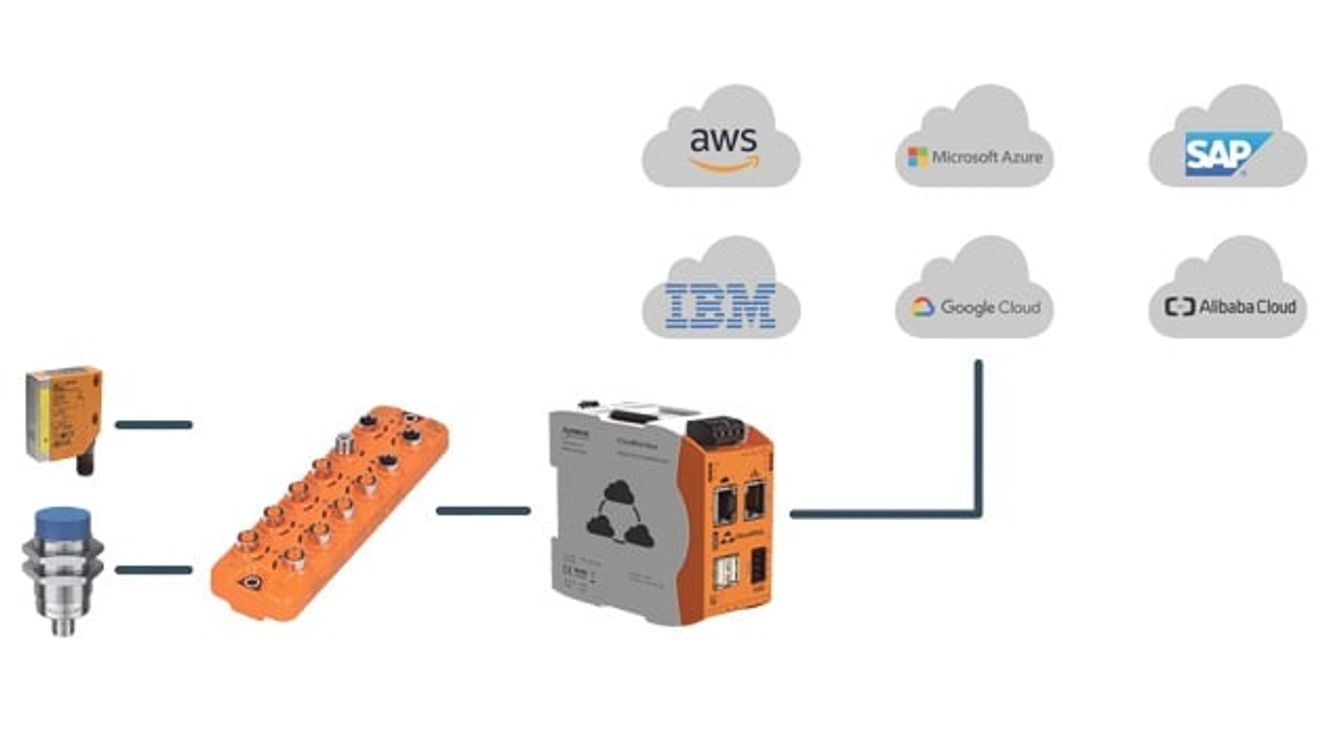
A precise definition of the Industrial Internet of Things (IIoT) is very difficult due to its countless forms and possible applications. However, what can be found in almost every description is the close interaction between automation (OT) and IT. Instead of operating in parallel and with just a few points of contact, the IIoT or Industry 4.0 is characterized by very close integration. This places completely new demands on OT manufacturers.
To approach the topic, it helps to look at the core competencies of the respective worlds in relation to the IIoT. The automation world is characterized above all by the highly reliable generation of data. Modern sensor technology is able to detect even the smallest physical conditions with a high degree of accuracy. The industry also has a wealth of knowledge about how data can be recorded reliably even under extreme conditions.
The evaluation of the data and the associated algorithms, on the other hand, are the classic domain of IT. Although specialist knowledge of the respective process is required to interpret the data correctly, the underlying techniques, such as machine learning, are considered to be the domain of IT.
Cloud platforms
Cloud platforms such as Amazon Web Services or Microsoft Azure have significantly changed the IT landscape in recent years. These very universally applicable 'construction kits' enable almost any software developer to implement even complex applications quickly and easily. Computing capacities are practically available at the touch of a button, complex technologies such as machine learning are encapsulated in 'building blocks' and are therefore accessible to everyone, even without in-depth specialist knowledge. For these reasons, IT is increasingly moving to the cloud - and cloud platforms also play a central role in the context of IIoT. It is important to understand that 'cloud' is not just any dashboard, but a very powerful tool for processing data and providing corresponding applications.
At a simplified level, the division of responsibility between OT and IT is therefore as follows: OT reliably generates data, which is then processed by IT. From the perspective of industrial sensor technology, the question therefore arises as to how far data needs to be prepared for transfer to the cloud and where the perfect transfer point to IT is.
Access without specialist knowledge
Most software developers know the cloud platforms very well and basically only need data from the field - they are ultimately looking for cloud-enabled sensors. For example, a distance sensor that is directly compatible with Amazon Web Services (AWS). However, this is either not yet technically feasible or would drive up costs. The status quo is that an IO module - such as an IO-Link master - is required to forward the data to a controller or an edge gateway via fieldbus. However, software developers are generally not familiar with IO modules, fieldbuses or controllers. Most edge gateways also require specialist knowledge of automation. As a result, a system integrator is usually hired to implement a connection between OT and the cloud for the respective customer. However, as this is time-consuming and cost-intensive, many IIoT projects are currently failing due to a lack of return on investment.
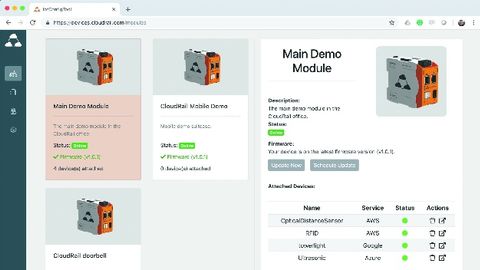
Overview of the connected CloudRail.boxes in the Device Management Cloud. From here, for example, remote firmware updates can be installed, new sensors connected or errors identified.
© CloudRailThe aim must therefore be to give IT easy access to the OT without the need for specialist knowledge. This is where CloudRail comes into play with its 'CloudRail.Box', which connects IO modules and sensors plug & play with any cloud platform. The box automatically recognizes connected IO-Link masters from a wide range of manufacturers, for example, and configures them completely independently. This means that the user does not need to familiarize themselves with how IO-Link works, the configuration interfaces of the masters or the fieldbus. Several masters, even from different manufacturers and different fieldbuses, can be connected at the same time.
The same applies to connected sensors. The CloudRail.Box recognizes a temperature sensor directly as such and connects it to the desired cloud platform in less than a minute. The transmitted data is transferred as a JSON object in an IT-compliant format - in the case of the temperature sensor, not as a series of bits, but as '64 °C', for example.
The data is tapped either via fieldbus or via Y-switches, such as with IO-Link masters from ifm's 'Dataline' series. CloudRail uses a central database for the automatic detection and configuration of IO modules and sensors, from which the boxes can also load definition data for current models at any time.
The CloudRail.boxes are configured via a cloud-based device management portal. This allows all boxes and associated devices to be managed centrally and from anywhere in the world.
Securely encrypted
As every 'CloudRail.Box' is connected to the internet, IT security plays an important role. This is why every connection between the boxes, the device management cloud and the customer's cloud platform is securely encrypted. Remote firmware updates can be used to quickly close security gaps and roll out new features.
CloudRail thus serves as a bridge between OT and IT, making industrial sensors cloud-capable and therefore accessible to traditional software developers. A typical area of application is retrofitting, i.e. additional sensors attached to existing systems. These so-called secondary sensors make up a large proportion of current IIoT projects. However, the aforementioned Y-switches can also be used to collect data from existing systems.
Why the big platforms?
The question remains as to how sensible it is for sensor manufacturers to connect to the major cloud platforms. There are two main concerns expressed by the industry:
- "The customer doesn't know what exactly to do with the data in the cloud. Complete solutions are therefore needed that extend from the sensor to the application in the cloud."
This assumption is certainly correct for a certain customer target group. There are customers, primarily from the traditional mechanical engineering sector, who have little or no expertise in the cloud. Complete solutions are a good approach here. However, these are mostly isolated solutions for a specific problem, which has little to do with the idea behind the IoT - a networked world. After all, just because calculations are performed in the cloud instead of locally, as was previously the case, does not make it IIoT. The true added value of the IIoT lies in the networking of different systems and devices, regardless of whether they are currently classified as OT or IT. The IIoT is too complex for specialized stand-alone solutions; it requires generic platforms such as AWS or Azure. This does not mean that complete offerings do not make sense. There is definitely a market for this, but it should not be the only strategy in this area. The big opportunity in the IIoT market lies in the close integration with IT, i.e. opening up industrial sensor technology to the 'software developer' target group and thus completely new markets. This target group is usually much more agile, is already thoroughly familiar with IT and the cloud and is just waiting for the right data to implement IIoT projects. In large companies in particular, IIoT projects are already being driven primarily by IT or innovation departments with an IT background.

Overview of the connected CloudRail.boxes in the Device Management Cloud. From here, for example, remote firmware updates can be installed, new sensors connected or errors identified.
© CloudRail- "Most cloud platforms are operated by US companies, so data protection is a problem."
Almost all large companies in Germany already use cloud platforms for their IT systems and now have a lot of experience. Data protection issues can be regulated by appropriate contracts and are rarely seen as a problem. Cloud platforms offer a level of security and reliability that can only be achieved by investing considerable resources in local installations.
Cloud technologies have revolutionized IT and will continue to do so with OT. There is no question that time-critical control tasks will continue to be carried out locally - but the analysis and processing of data and the interaction with IT systems will take place in the cloud.
Author:
Felix Kollmar is Managing Director of CloudRail in Mannheim.


You might also be interested in
The first steps towards digitization
Real-time transparency in the material flow: this was the goal set by Miba when it set out to digitalize its internal logistics processes. But how successful was the close link between ERP and MES in the end? - A field report.
 read more...
How will the IoT change companies in 2020?
How will network technology in companies change in 2020? Axel Simon, Chief Technologist at HPE Aruba, takes a look into the crystal ball
read more...Digital twin revolutionizes maintenance
As virtual representatives of real machines, digital twins open up new possibilities for maintaining and servicing complex industrial plants and systems. A project report.
read more...You can't do without Edge and Swarm
The IoT has changed the requirements for processing data provided by machine sensors and actuators. This needs to happen as quickly as possible - preferably where the data is generated. Edge nodes and swarm computing systems take on this task.
read more...Online machine data under control
Turning huge amounts of data into valuable information - how can this smart industry approach be implemented? Linking PC-based controllers with Matlab and a cloud-based IoT analytics service can be a viable approach.
read more...From modeling directly into the PLC
Despite digitalization and I4.0, the technical functions in a process plant do not become simpler if you break them down to the smallest detail. Nevertheless, the high level of difficulty can be overcome by combining the right tools in the right way.
read more...Where are the new business models?
The necessary new business models are repeatedly cited as the hallmark of an Industry 4.0 environment. But to date, very few companies have seen any of this. Schneider Electric now has a few models up and running.
read more...Why predictive maintenance?
Investments in predictive maintenance systems are worthwhile in order to proactively detect damage. Not only does this increase the service life of a machine, it also opens up new business models for machine manufacturers.
read more...First customer projects via BaSys 4.0
The BMBF project 'Basissystem Industrie 4.0' expired at the end of June 2019. Together with NetApp and Objective Partner, Fraunhofer IESE now offers Industry 4.0 solutions with support and adaptation to customer systems on the basis of this project....
read more...