
Grossenbacher systems
Red card for IoT devices?
Just over a year ago, the EU enacted a new version of the "Radio Equipment Directive" - with stricter requirements for the cyber security of embedded systems. OEMs and embedded developers should react today to the requirements of tomorrow.

From August 2024, the EU Radio Equipment Directive, or RED for short, will require the majority of all devices with a radio data link to be more cyber-secure. Devices capable of radio communication must not endanger or restrict the operation of a network; instead, they must actively protect personal data and counteract fraud. In fact, update capability will be a must. However, the method is not predetermined, so manual solutions such as USB sticks are also conceivable. For practical reasons, however, over-the-air (OTA) updates via existing or newly created cloud portals are likely to prevail, at least if the wireless technology used offers sufficient bandwidth. Either way, update capability will become a basic requirement for CE marking - with all the consequences that entails.
Time to act
Even if details will probably not be announced until the end of the year, providers of devices that fall under the RED should therefore react quickly. A sensible first step is to check their own products for conformity with existing standards such as ETSI EN 303 645 (consumer products) or IEC 62443 (industrial products) and adapt them if necessary. The RED refers to these standards, which many experts believe are the likely basis for future harmonized specifications. There is also much to suggest that end customers, as device operators, will demand compliance with these standards: After all, interest in cybersecurity is growing due to an increasing number of hacker attacks.
For those responsible for embedded developments - whether in development or product management - it is worth taking a look at both standards, as many of the regulations for industrial and consumer products can also be applied to embedded security. However, the risk-based approach of IE 6244 deserves particular attention. The security mechanisms of this standard build on each other like layers: If one layer is compromised, the subsequent one takes effect. The aim of this approach is to gradually reduce the attack surface. However, as this can only be implemented to a limited extent in practice, a systematic approach to the topic of embedded security is advisable.
Systematically to safety
Embedded security includes all tools, processes and best practices for protecting the software and hardware of embedded devices. A secure embedded system is therefore characterized by the following features:

Container software is also dependent on access to the system and hardware input data. Application and system developers must therefore pull together for a holistic security concept.
© Grossenbacher systems- Trusted Execution Environment (TEE), also known as TrustZone in the ARM environment: Only specially enabled applications can be executed in a TEE, but no hacker programs, for example, which by their very nature do not have the necessary enabling.
- Partitioned hardware resources: Separation of CPU, cache, memory and interfaces in order to provide their functions as independently and separately as possible. This enables mutual protection in the event of errors.
- Memory blocking: Executable space protection explicitly marks certain memory areas as not legally usable. Misuse triggers an alarm or countermeasures, preventing unwanted hacker code from finding a place.
- Secure Boot: Every embedded device boots in a similar way to a PC and searches for its smallest start-up program (boot), in which the correct start-up process, including the applications to be started and their sequence, is defined. Manipulation at this point would allow the entire device to be misused. With the Secure Boot feature, the boot program is checked using cryptographic algorithms at every start.
- Protection of stored data (Protect Data at Rest): This includes application data, configuration data, security keys, but also usernames, user rights and passwords. These must be explicitly encrypted and should be protected, encrypted and stored in special security hardware available in the controller.
Recognize and eliminate weak points
An analysis of frequently occurring vulnerabilities in the software is also helpful in the development of secure embedded systems - five points come to mind here, the first of which is particularly critical:
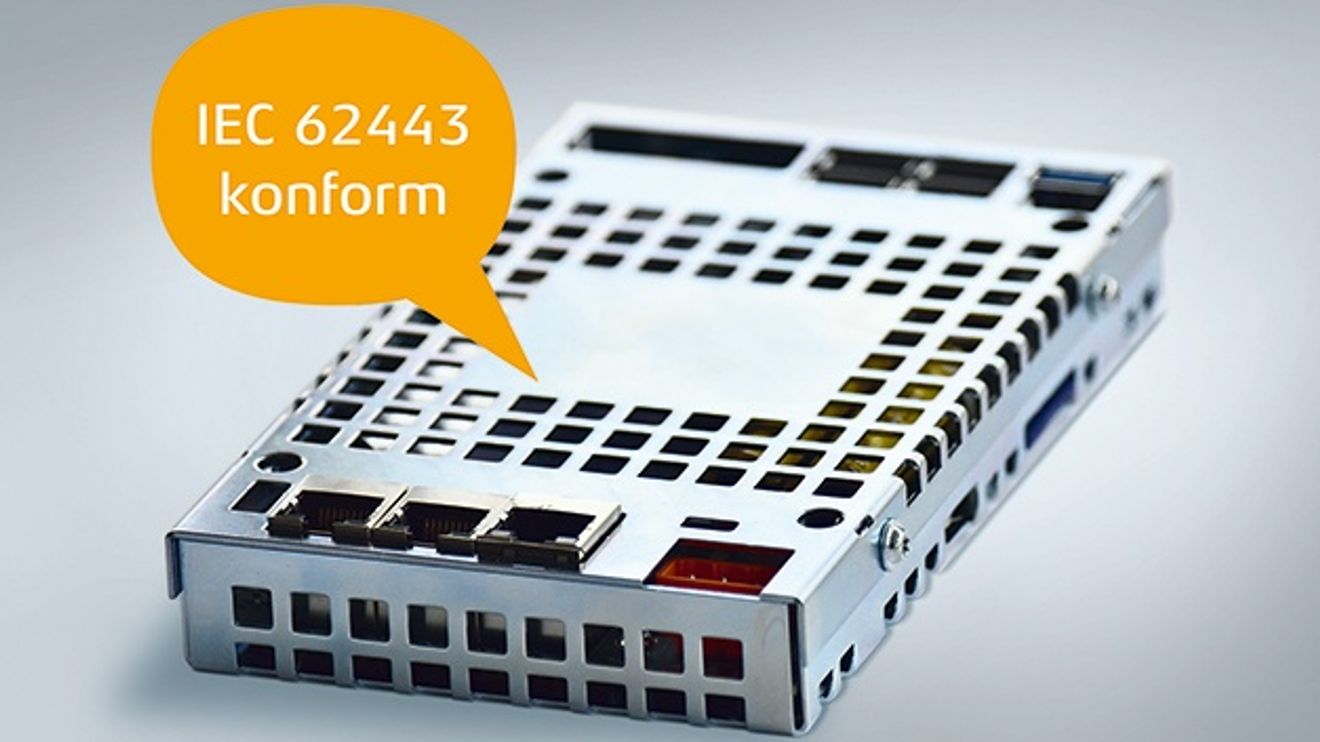
Grossenbacher Systeme has implemented cybersecurity for the Universal Controller in accordance with IEC 62443 - including secure communication mechanisms between the application and system.
© Grossenbacher systems- Buffer overflow: Buffer overflow attacks occur when an attacker writes data or code into a memory buffer, exceeds the limits of the buffer and begins to overwrite neighboring memory addresses. To prevent damage or a takeover of the system, the application must not process new data or new executable code under any circumstances.
- Improper Input Validation: If an embedded system requires user input, a malicious user or process may provide unexpected input that causes an application to crash, consume too many resources, expose sensitive data, or execute malicious commands. Textual inputs or input values may therefore only be processed within the valid or plausible value range.
- Improper authentication: Authentication proves that users or processes are who they claim to be. Improper authentication can allow an attacker to bypass authentication, repeatedly attempt to guess a password, use stolen credentials or change a password with a weak password recovery mechanism.
- Improper Restriction of Operations within the Bounds of a Memory Buffer: If the programming language or operating system allows a program to access unauthorized memory locations, a threat actor may be able to take control of the system or cause it to crash. Each program may therefore only access permitted memory areas, none of which have root rights.
- Information Exposure: Sensitive information must not be accessible to any threat actor, communication and storage must be encrypted.
- But how does this inventory benefit OEMs and embedded developers? First of all, hopefully a better awareness of cyber security. OEMs should make sure that their development partners are at home with the topic and not dismiss relevant information as obstacles or annoying cost factors. Developers, on the other hand, must not lose sight of economic efficiency despite the necessary focus on security.
Security is crucial - competence even more so
If you want to play it safe in the medium and long term, you should make sure that your embedded systems have at least a trusted execution environment (TEE), secure boot functionality and protected memory areas.

The author: Jonas Schuster is a member of the management team at Grossenbacher Systeme AG.
© Grossenbacher systemsExisting deficits can be compensated for under certain circumstances by updating the firmware and software. In many cases, however, RED 2024 should be an opportunity to critically scrutinize old embedded systems and, if necessary, replace them with new, secure and marketable systems - which can affect a large number of controllers in an industrial environment.
| The basics for secure embedded software |
|---|
|
Consequence for updates: Each update should be transmitted in encrypted form, with a double copy of the OTA signed image, so that a secure rollback is possible in an emergency. The protected memory area of the running code section should always be observed. Use container technology: Whenever possible, use container technology to separate the application software from the system software (operating system, etc.). Only allow specific transactions between containers and the system and specially secure the corresponding interfaces ("doors"). Check ports: Remove or close all unnecessary ports and generally streamline the system as much as possible. Carry out penetration tests: If there is an increased need for security, carry out penetration tests or have them carried out. Passwords: And last but not least: Never use default passwords! |


You might also be interested in
The knowledge hub of the embedded community
The embedded systems industry will meet from March 11 to 13. In seven exhibition halls, exhibitors in Nuremberg will provide information on hardware, software, services and tools. Two accompanying conferences, expert panels and exhibitor forums will...
 read more...
Customized Single Board Computer
Helbling has developed a flexible embedded vision platform based on an ARM processor that can be used as a reference design for the development of customized single board computers (SBC).
read more...Secure embedded PC for industrial applications
According to the manufacturer, the 'ReliaCOR 54-13' embedded PC from Inonet is one of the first embedded computers made in Germany to be certified for AI applications in accordance with IEC 62443-4-2. It therefore meets the requirements of...
read more...Operation via touch, glove, pen or digitizer
Getac launches the next generation of 'F110' and 'K120' tablets: The new F110 is suitable for use in a variety of harsh outdoor and indoor scenarios.
read more...IPC for IIoT gateway
The compact and energy-efficient industrial PC 'DA-1200' from Cincoze is suitable for IIoT gateways in modern industrial applications.
read more...Two new surface-mounted keyboards
Wöhr is expanding its 'Surta' industrial keyboards with versions 15 and 16, which have been specially developed for environments such as medical and dental areas, the pharmaceutical, clean room and food industries, as well as general industry and...
read more...New threat to industrial control systems
FrostyGoop is the name of a new malware variant that specializes in industrial control systems (ICS). It poses a threat to critical infrastructures worldwide. OT cyber security expert Dragos has identified FrostyGoop.
read more...Edge rack server in robust
The trend towards hyper-convergent infrastructures is not stopping at the manufacturing and automation industry. Siemens has now launched the first edge rack server in robust industrial PC quality. How is the inner workings of the server designed?
read more...Available in four sizes
KEB Automation has launched the 'Web HMI C6 X1'. The panel can be flexibly attached anywhere on the machine thanks to various mounting options.
read more...