
Wibu-Systems
Protection for intellectual property
In the industrial environment, extensive data input is generated from a wide variety of sources, which is often processed with the help of artificial intelligence applications. How can the good ideas behind this process be effectively protected?

When machines, systems, robots and people work in an industrial environment, various sources provide extensive data input. This is often processed with the help of artificial intelligence (AI) applications. In addition, machines can use this data to learn and optimize their own algorithms using machine learning (ML). For example, cameras are used to check the quality of a product and deviations can be detected quickly and precisely using AI and ML. To protect the ideas of the developers behind this process, manufacturers of applications for AI and ML, which are often written in the Python programming language, need effective technical protection.
Analyst Slash Data examined the popularity of the various programming languages in a 'State of the developer nation' survey. Over 19,000 developers were surveyed in the first quarter of 2021. One of the results: Software developers work with Python the second most frequently, with the main uses being data science, machine learning and applications for IoT.
Attack on the programming language
Due to the growing importance of AI and ML, attackers will increasingly try to get hold of manufacturers' good ideas and profit from them with little effort. Python is typically a point of attack, as the Python source code is delivered as a simple text file and can be read in plain text, which is common for scripting languages. This means that users can - intentionally or unintentionally - change, manipulate and copy the source code and analyze the idea behind it, for example an AI learning algorithm, and use it without authorization (reverse engineering).
As a protection and licensing expert,Wibu-Systems knows the importance of the Python programming language for manufacturers of AI and ML applications. For this reason, the company has launched the 'AxProtector Python' encryption option on the market.
The provider's 'CodeMeter' technology was already able to protect Python software by pre-compiling the EXE files using the Cython compiler. What is new now is the direct and automatic encryption of Python software via 'AxProtector Python', which extends the existing tools of the CodeMeter Protection Suite.
The basic principle of all CodeMeter tools is: first the manufacturers encrypt their software and then they supply the appropriate license key to the user. Users can then use the encrypted software in accordance with their authorizations. The protection hardware 'CmDongle', the software-based activation file 'CmActLicense' or the 'CmCloudContainer', which is located in the cloud, serve as carriers of the license keys.
Via precompilation to protected software
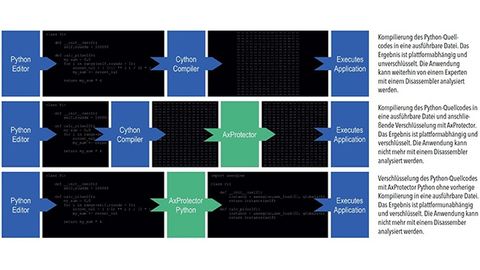
The classic method consists of two steps: pre-compilation and encryption. The Cython compiler is used to convert the Python software into an executable file (EXE) written in C, so that this executable file can then be encrypted using the standard tool 'AxProtector'. This enables manufacturers to encrypt and license their intellectual property contained in the software and thus generate additional revenue under the heading of 'software monetization'. Manufacturers can automatically implement various licensing models - for example, single user licenses, floating licenses within a network or a time-based model. Important data for the Python software can also be encrypted and signed via the CodeMeter Core API. In this way, the manufacturer must create and deliver a specific executable file for each individual platform, which requires technical knowledge.
Direct encryption
The minimum requirements for using 'AxProtector Python' are 'Python 3' and 'CodeMeter 7.30'. The tool encrypts directly, without conversion by 'Cython', and no native code is generated. As the Python software is only encrypted once, there is only a single executable file that runs on the different platforms Windows, Linux or macOS. Only the part that is currently required is loaded into the main memory at runtime and then decrypted, so that the majority of the software remains encrypted. Each function of the 'Python' software is encrypted individually so that manufacturers can generate modular licenses. Users only receive the license keys for what they have purchased. Subsequent purchases are also handled in the same way.
If the manufacturer wants to leave functions and files unencrypted, he can set annotations and control this via entries in the protection definition. The integration of protection is much easier with 'AxProtector Python', as the precompilation step is no longer necessary.
Different encryption tools

Similar to a toolbox, manufacturers can use various encryption tools to encrypt the entire software or only certain parts. There is a choice of different 'AxProtector' variants, which are optimized for different programming languages and ensure automatic protection of an executable file, 'IxProtector' for encrypting individual functions and 'IP Protection' to protect software from reverse engineering, but no license keys are required. 'AxProtector Python' complements the existing variants: the standard 'AxProtector', 'AxProtector Java', 'AxProtector .NET' and 'AxProtector CmE' for embedded software.


You might also be interested in
Zero Trust: 3 questions to ... Wibu-Systems
Like looking after a sack of fleas
Zero Trust in OT environments requires a rethink - in IT, but also in operational departments. Oliver Winzenried from Wibu-Systems explains why it is important that zero trust should not be understood as mistrust of one's own employees.
 read more...
Software for switch cabinet construction
The engineering software clipx Engineer from Phoenix Contact makes it possible to plan and order terminal strips, assembled mounting plates and terminal boxes and seamlessly transfer the data to production.
read more...Generating added value from machine data
iTAC.SMT.Edge from iTAC Software enables the standardization and centralization of machine data, especially in SMT production.
read more...The e-paper of issue 5/2021
Do you know ... what a 'digital keychain' is? ... what the arrival of apps in the world of automation means? ... how robots can be programmed intuitively? ... how deep learning helps quality control? Find out in the e-paper of our issue 5!
read more...Protection and licensing
Wibu-Systems provides users with version 7.20 of the 'CodeMeter' technology.
read more...Individuality with standard tools
iTAC offers MES and IIoT solutions for transparent, automated production processes and provides various services for networking, automating and analyzing manufacturing processes.
read more...The trend is moving towards edge AI
The focus of IoT application development is shifting away from the cloud and towards sensor technology. The associated use of machine learning algorithms directly in the sensor or its environment enables completely new approaches for the Internet of...
read more...'Digital workers' are ready for industrial use
IFS Loops introduces its new agent-based AI platform that can deploy ten 'digital workers' to accelerate industrial processes.
read more...Administer and update devices with one tool
Increasing customer expectations and cyber security requirements make continuous software updates essential in automation technology. Grossenbacher Systeme offers a cloud portal application for this with the 'Grossenbacher Update Tool (GUT)'.
read more...