
Wibu-Systems
Protect production data
By awarding contracts to 3D printing service providers, manufacturers in additive manufacturing are at risk of losing control over data sovereignty and therefore intellectual property. Read how 3D printing data can be protected and licensed in additive manufacturing.
Software manufacturers have long known that they need to protect their software - and thus their intellectual property (IP) - to prevent others from profiting from it, for example through illegal duplication or know-how theft. As laws alone are not sufficient for protection, software manufacturers use technical protection and licensing solutions that they either develop themselves or buy in. Such solutions have been around for decades. However, intellectual property worth protecting is not only found in software products, but also in the production and configuration data of the industry. This data is particularly at risk in the digitalized and networked factories of the still young Industry 4.0, for which secure protection and licensing solutions now exist that are also adapted to the specific needs of industry.
| Safety & Security Forum |
|---|
|
From September 21 to 22, 2022, everything at Landshut University of Applied Sciences will revolve around the topic of safety and security in IT and OT. The program is now online. The keynote speech will take participants into the 'digital underworld' and is dedicated to the 'anatomy of an attack': speaker Tim Berghoff, Security Evangelist at G Data CyberDefense, will take participants on an imaginary journey from the security vulnerability to the blackmail message. Because no one can be safe from attacks. After this prelude, the program continues with two tracks: while one track is dedicated to methods and tools for safety and security, the other dives deep into the security aspects and problems of applications. |
3D printing is still in its infancy in this respect. Manufacturers in additive manufacturing have so far hardly dealt with the protection of 3D print data. On the one hand, technical issues and problems relating to printing were and are often more pressing, and on the other hand, manufacturers often print the objects themselves or protect them when printing off-site by means of contracts with the respective 3D printing service provider. However, the additive manufacturing market is changing: the various production steps are increasingly being distributed to different service providers, meaning that the manufacturer loses control over the 3D print data with the previous type of "protection" - and thus control over its intellectual property. What can the manufacturer do about this? How can they protect the know-how contained in the 3D printing data from theft and prevent a service provider from printing more than the agreed quantities on their own? What does the protection and licensing of 3D printing data look like in practice and what is happening in research? Are there already commercial solutions, such as those available for software manufacturers or operators of smart factories?
Steps in 3D printing
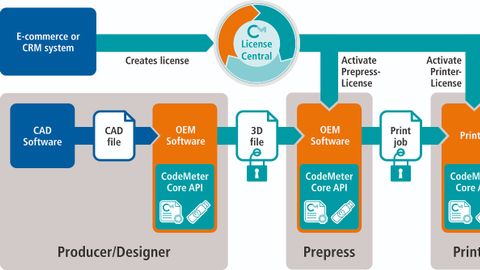
Before an object can be printed, it must be digitally modeled and digitally prepared. To do this, the designer first creates the digital 3D model of an object using CAD software (modeling). Slicer software is then used to convert the 3D model into a digital layer model (preparation). Layer heights, printing temperatures, printing speeds and other factors, such as the properties of the materials used for printing, for example plastic, metal, ceramic, concrete, sand or glass, influence the layer model. The slicer software uses the layer model to calculate the digital printing instructions for the 3D printer, which can then be used to print the object (printing).
Modeling, preparation and printing can be carried out in-house or outsourced to external service providers. Further steps and services such as verification or optimization are conceivable in order to check stability requirements before printing or to save time and material during printing. Along the modeling-preparation-printing process chain, 3D models, layer models and printing instructions generate digital data that is worth protecting, especially if it is handed over to external service providers. Without technical protective measures, there is a risk of know-how theft, illegal additional production due to a lack of quantity control, illegal reprints and sabotage through manipulation of the data.
Protection technology for 3D printing
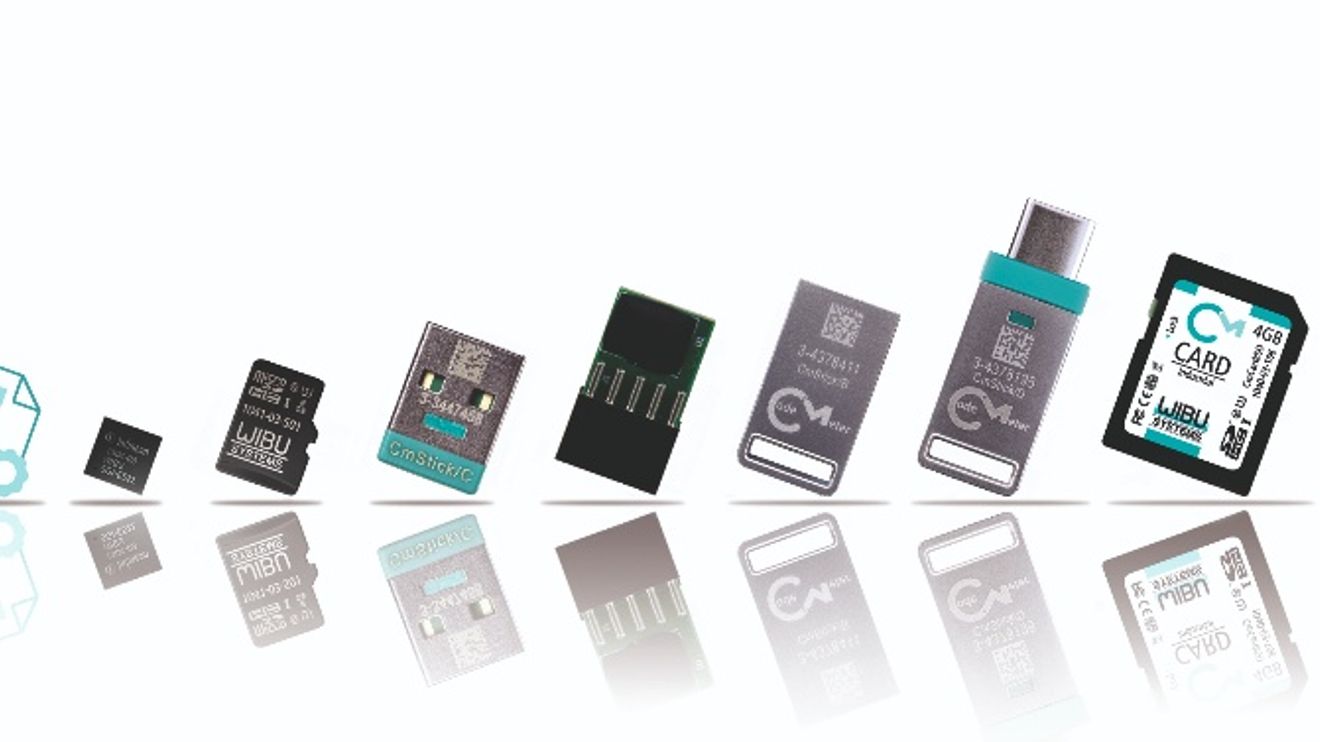
CodeMeter enables the protection and monetization of 3D print data along the entire modeling-preparation-printing process chain. The licenses can be securely stored in the protection hardware CmDongle, the software-based activation file CmActLicense or in the cloud via CmCloud. With CodeMeter License Central, manufacturers can automatically distribute and manage both the licenses and the keys.
© Wibu-SystemsWibu-Systems ' CodeMeter protection technologies have been on the market for over 30 years. Software manufacturers and manufacturers of intelligent devices and machines use it to protect and license their software or the use of their devices and machines. For the protection of 3D printing data, the company has expanded its CodeMeter protection and licensing solution so that all digital data generated during 3D printing, i.e. 3D models, layer models and printing instructions, are protected along the entire process chain by encryption and are only available to the respective service provider in decrypted form within a controlled framework so that they can complete the task assigned to them. This includes, in particular, the control or limitation of quantities, i.e. the number of objects that a print service provider is permitted to print. Illegal reprints are prevented, as is the manipulation of data for the purpose of sabotage. In addition, legal use of the data can be licensed and billed.
CodeMeter provides the necessary cryptographic functions and tools for license management. For end-to-end protection along the entire process chain, CodeMeter must be integrated into CAD and slicer software as well as into the 3D printer control system. Due to the availability for many programming languages and convenient tools, software manufacturers and manufacturers of embedded solutions, for example 3D printer controllers, can integrate the protection technology into their solutions.
CodeMeter provides various CodeMeter license containers as secure storage for cryptographic keys: the protection hardware CmDongle, the software-based activation file CmActLicense or the CmCloudContainer for use in the cloud. The license containers differ in terms of security and flexibility and can therefore meet the different needs of different manufacturers.
Cryptographic keys are stored in the form of licenses. The manufacturer can configure these freely and thus determine which software features can be used or how many copies of an object can be printed. If necessary, they can subsequently adapt the license to changing customer requirements. The cloud-based tool "CodeMeter License Central" can be used to automatically manage and distribute licenses and thus also the keys. Licenses can be delivered either online or offline. CodeMeter License Central offers various interfaces for connecting to existing store or backend systems, which enables a high degree of automation across a company's entire process chain.
Example - Purchase and printing of an accessory

In order to obtain an urgently needed accessory quickly, a company commissions a manufacturer that offers it for 3D printing and a 3D printing service provider. It is a rarely requested accessory. The company goes to the manufacturer's store system and buys the corresponding print file, or more precisely, the right to use the file to print the desired number of the accessory part. The company receives the encrypted print file and usage rights from the manufacturer. The company passes this on to the 3D printing service provider, who prints the accessory in the agreed quantity. The process ends with the delivery to the company and can be restarted if required.
| The Sino-German research project ProCloud3D |
|---|
|
In the Sino-German research project "ProCloud3D", industrial companies and research institutions from both countries are working together to develop and test a cloud-based platform on which all steps for the preparation and implementation of 3D printing processes are decentralized and encrypted. Both the German Federal Ministry of Education and Research (BMBF) and the Chinese Ministry of Science and Technology are funding the project. Wibu-Systems and the other industrial companies and research institutions involved in the project are pursuing the goal of protecting all digital data generated during 3D printing across the entire process chain and all service providers involved - from theft, manipulation and license misuse. The aim is also to work towards establishing the interfaces and encryption technologies developed as part of the project as standards. In a demonstrator, which will show the results by the end of the project on 30 September 2023, the steps required for 3D printing will be decentralized, automated and encrypted - from the digital 3D model via the cloud to the 3D printing service provider. Each service provider involved receives exactly the data it needs for its task and only for as long as necessary. As part of the project, a web front end, a technology database with process parameters, the post-processor for generating the system code, corresponding hardware and software interfaces for communication between the platform and the 3D printers and a higher-level security infrastructure are being developed. This creates a value chain with comprehensive license management to authorize, control and monitor all necessary data transfer and process steps between the parties involved. Wibu-Systems is contributing its CodeMeter encryption technology to the project. |


You might also be interested in
Encryption for Javascript
The software protection, licensing and security solution CodeMeter from Wibu-Systems has become more universal and versatile thanks to 'AxProtector JavaScript'.
 read more...
Zero Trust: 3 questions to ... Wibu-Systems
Like looking after a sack of fleas
Zero Trust in OT environments requires a rethink - in IT, but also in operational departments. Oliver Winzenried from Wibu-Systems explains why it is important that zero trust should not be understood as mistrust of one's own employees.
read more...Protection for intellectual property
In the industrial environment, extensive data input is generated from a wide variety of sources, which is often processed with the help of artificial intelligence applications. How can the good ideas behind this process be effectively protected?
read more...Study on the working world of tomorrow
Merging technical skills and soft skills
AI is profoundly changing jobs, but at the same time it is making human skills indispensable. The new Skills Economy Report 2026 from SkyHive by Cornerstone shows that roles in the future will require both technical skills and soft skills.
read more...Making shadow AI controllable
Cycode is expanding its platform to include an AI inventory and an AI parts list. The aim is for companies to recognize which AI tools, models and assistants developers use throughout the entire software lifecycle, including shadow AI.
read more..."Crash test" for LLMs in AI agents
Lakera and the UK AI Security Institute have launched 'b3', a new open source benchmark. b3 is an open source security evaluation project specifically designed to protect Large Language Models (LLM) in AI agents.
read more...AI coding is becoming the risky norm
AI-supported software development is profoundly changing the security situation, according to the new report "Future of Application Security in the Era of AI" by Checkmarx. 81% of companies knowingly deliver insecure code.
read more...Vulnerability with high CVSS value discovered
A vulnerability with a particularly high CVSS (Common Vulnerability Scoring System) score of 9.8 affects several Fortinet products and allows unauthenticated attackers to execute arbitrary code or commands, Censys has announced. Up to 2,878...
read more...APT Group has energy facilities in its sights
According to recent analyses by Kaspersky, the notorious advanced persistent threat (APT) group SideWinder has adapted its attack strategies and expanded its geographical targets. SideWinder is now also targeting nuclear power plants and energy...
read more...