
Huawei and Festo cooperate
Robotics control is outsourced to the cloud
Is 5G the piece of the puzzle between cloud technology and robotics as a service? Festo and Huawei are now cooperating to investigate the technical feasibility.
These days, industrial manufacturing has one motto: moving away from mass production and towards mass customization. One prerequisite for this is the digitalization of the manufacturing industry. In this context, suppliers of production technology have the opportunity to introduce new business models, such as robotics as a service (RaaS). Here, robot control functions are made available via the cloud. Data transmission between the robot and the cloud must meet real-time requirements, meaning that 5G technology can be seen as an integral part of implementing RaaS models.
Memorandum of understanding for cooperation signed
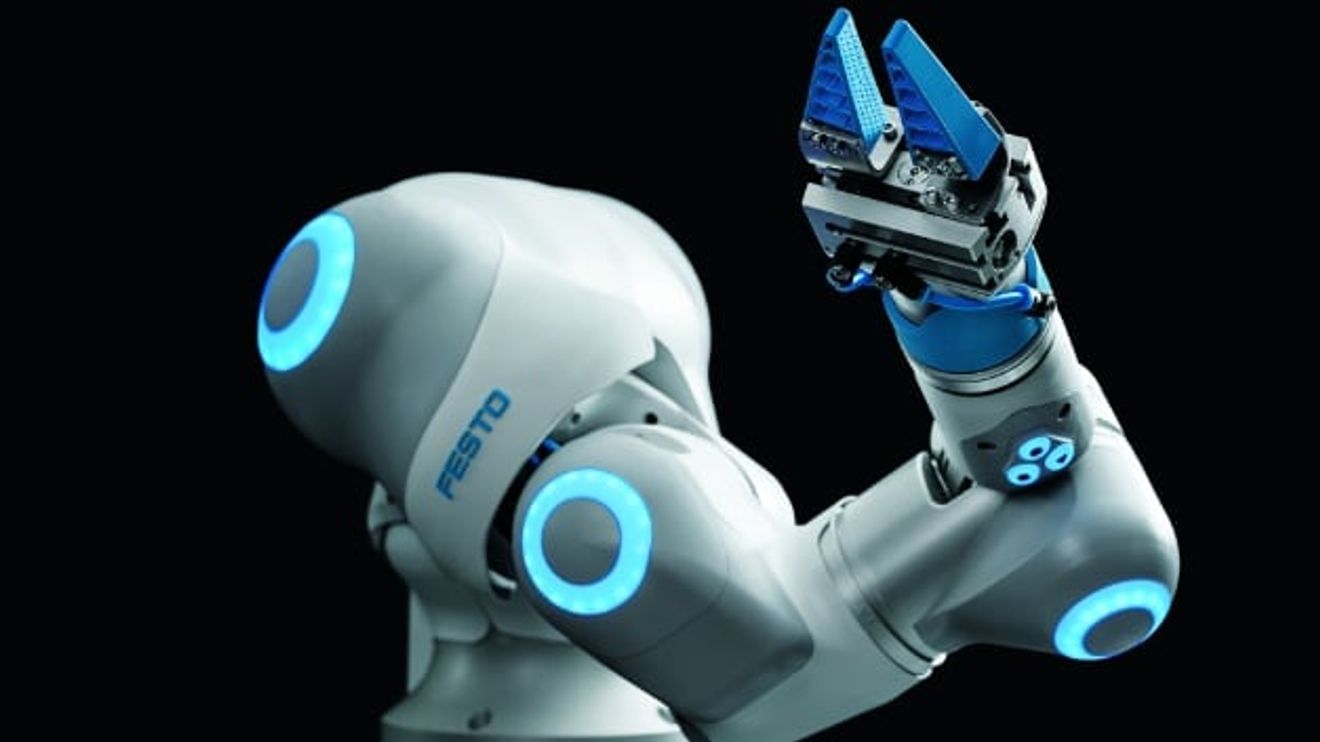
Festo and Huawei are now evaluating whether 5G technology is suitable for robotics in this form. Both parties recently signed a letter of intent for a corresponding 5G cloud robotics project. A mobile robot platform with a robot arm (six degrees of freedom) is being developed. The cloud servers calculate movement paths and control signals and transmit them to the robot platform via 5G slicing technology. The real-time requirements are to be met using uRLLC technology (Ultra Reliable and Low Latency Communications).
The advantage of the RaaS approach is a significantly shorter learning curve for robot programming. In addition, some of the hardware for robot control is outsourced from the production robot to the data center. According to the providers' calculations, this would make robot-based production systems significantly more scalable and the capability of the individual robot would no longer depend on its local computing power.
Cooperation to advance 5G in the industry
The Festo-Huawei cooperation is also intended to pave the way for 5G in industrial manufacturing. According to Dirk Pensky, Head of Software Development at Festo, 5G will become the dominant communication technology for intelligent manufacturing "and in this cooperation we are working towards proving this".


You might also be interested in
Act economically
Festo presented new concepts at SPS IPC Drives 2017 - from handling systems and drives to a new automation system.
 read more...
Business figures and outlook for SPS IPC Drives
The Lenze Group recently had every reason to celebrate: its 70th anniversary on the one hand, and a record turnover in the past financial year on the other. At SPS IPC Drives 2017 in November, a new generation of servo inverters will be launched...
read more...International Federation of Robotics
Plus 1.7 million industrial robots by 2020
The global stock of industrial robots will increase from around 1.83 million units in 2016 to over 3 million units in 2020, according to the International Federation of Robotics (IFR) in its recently published World Robotics Report 2017.
read more...China becomes R&D hub for autonomous robotics
Siemens has announced that it is locating its global research into autonomous robotics in China. The company is also entering into a partnership with Tsinghua University and is jointly establishing a research center for robotics in Beijing.
read more...The maintenance cloud
Huawei and General Electric (GE) presented a cloud-based solution for predictive industrial maintenance at Hannover Messe 2017.
read more...5G in the factory
What about the successor to LTE? What application scenarios in the factory are conceivable using the next generation of mobile communications? The first impressions of this could already be seen at the Hannover Messe.
read more...5G for intelligent manufacturing
Ericsson and robot manufacturer Comau have signed a cooperation agreement. Together, they want to explore the potential of 5G technologies in the context of Industry 4.0 and smart manufacturing.
read more...First CloudEdge solution for 5G
On September 20 in Munich, Huawei presented the first 5G-based Mobile Edge Computing (MEC) solution called MEC@CloudEdge.
read more...Pneumatics makes technological leap
With Festo's 'Controlled Pneumatics' compressed air technology, the 'VTEP' proportional valve terminal achieves sensitive pressure control down to less than 1 mbar. According to the supplier, the technology also uses piezo valves to reduce...
read more...