
Packaging technology
Palletizing by robot - more efficient by the dozen!
The final palletizing of finished products is still manual work in many production facilities. For a long time, this was also the case at a large spice manufacturer - until twelve robots were integrated into the packaging process at the beginning of the year.

For more than 20 years, Ecoma Maschinenbau has specialized in the development of systems and special machines for numerous industries. The company, which is based in Weyhe-Dreye near Bremen, has a particular focus on the (animal) food sector and the transport and handling systems used in this environment. Robots have become an important part of the product and service portfolio in recent years: Customized solutions for customers such as Aldi Nord, Vitakraft, Böklunder and Heinen are developed in the company's own 1200m2 robot laboratory.

Twelve identical double palletizing cells were delivered to the spice manufacturer by Ecoma in spring 2018.
© KawasakiIn autumn 2017, Ecoma received an order from a leading German producer of spices to systematically modernize and automate its in-house production and packaging system - starting with the palletizing of products, which had previously been handled manually. A short time later, the special machine manufacturer commissioned the first four individual palletizing cells based on the Kawasaki RD80N robot. This five-axis robot, specially developed for palletizing tasks, can carry up to 80 kg and has a reach of up to 2100 mm.
In order to further increase the efficiency of the palletizing units, Ecoma was commissioned to further develop the cells into 'double palletizing cells' at the beginning of 2018. Ultimately, twelve of these cells were to be implemented in the packaging system. The key advantage of the new cells: By using two pallets in parallel, the process-independent loading and unloading of the cell causes no delays and doubles the overall capacity of the system. In addition, two pallets can be loaded in parallel with different products using just one robot if required. Last but not least, the increased capacity per robot means a significantly lower investment for the user.
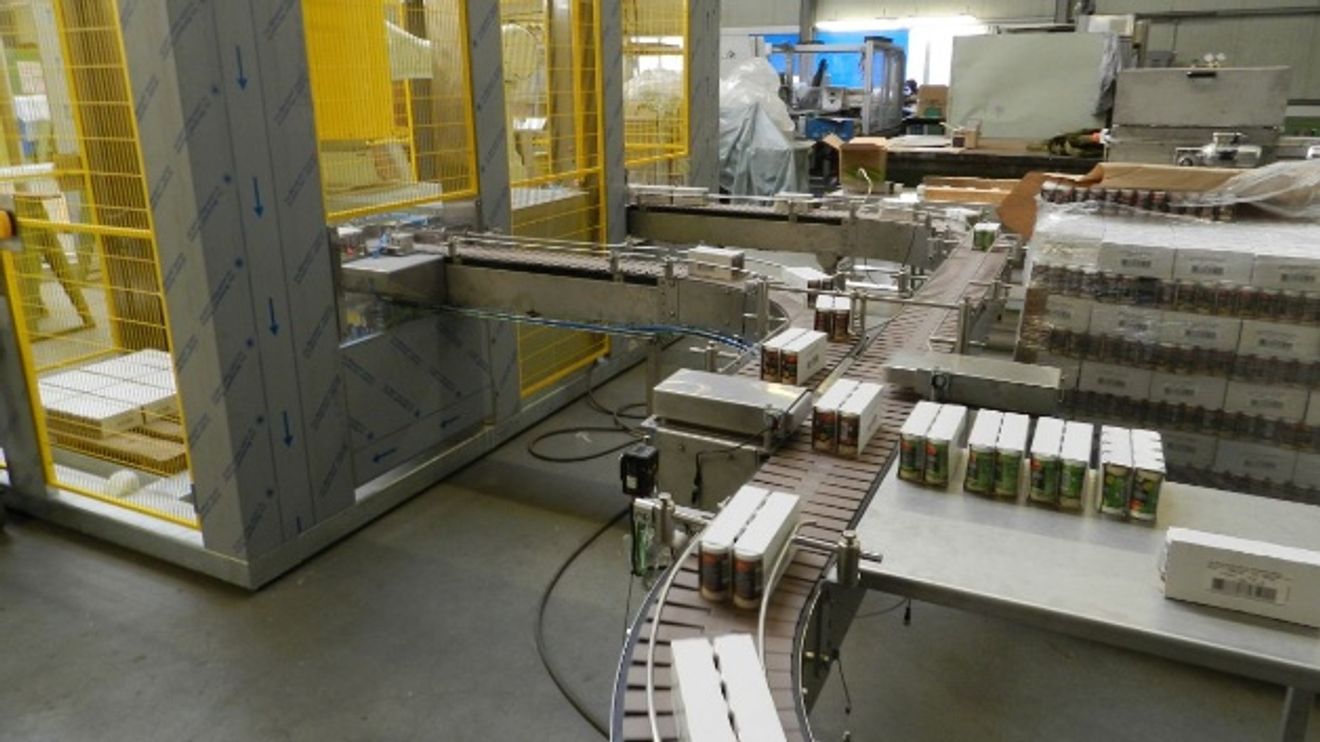
The double cells went into operation at the spice manufacturer for the first time back in March 2018. Each of them is not only able to process two product types in parallel, but also to sort them automatically. The trays, each packed in units of five spice tins, are still loaded manually onto the infeed conveyor belt by employees. A barcode reader identifies the product type and automatically feeds it to the correct conveyor belt via a pusher - unreadable or incorrect items are immediately sorted out by the system.
The trays are then fed to the pre-assigned pallet and positioned on a table in groups of four for the robot's gripper. At alternating intervals, the gripper packs the four trays onto the pallet provided and loads them up to the intended capacity limit. As soon as this limit is reached in one half of the cell, this is indicated. The cell operator can then remove the finished pallet and replace it with a new one - a semi-automatic cell concept.

As soon as the door of one half of the cell is opened, the robot immediately stops its activity and continues working in the other half without interruption. The Cubic-S safety system from Kawasaki ensures that robots and workers can work together without hesitation or danger. The software makes it possible to set up particularly space-saving applications and safety areas without the need for complex external safety measures. Cubic-S combines eight individual safety functions - including an individual definition and precise limitation of the available workspace, which the robot cannot exceed at any time. The individual axes of the robot are also monitored electronically: predefined axis values form the limits of possible movements. If a predefined speed is exceeded, previously stopped axes are moved or tools leave their intended orientation, Cubic-S automatically switches the robot off. Also practical for maintenance and ongoing operation: despite the space savings created by Cubic-S, additional safe zones for employees can also be set up within the work area.
Up to 14 cycles per minute
The robot currently performs eight cycles per minute. Steffen Siol, Head of Electrical Engineering at Ecoma, still sees potential for optimization here: "We are still looking for ways to improve the programming and save valuable seconds - for example by leaving the robot in waiting positions." Siol and his team's aim is to use the installed Multipack palletizing software to carry out 14 packs or cycles per minute and cell half and to expand the trays to eight cans each. The aim is to have a total of 28 packs on the belt at any one time.
But that's not all: once the twelve double palletizing systems have been successfully implemented, the next step is to fully automate the loading of the cells using robots. This means that where employees currently feed the trays manually, an automatic filling system will ensure significantly faster and more efficient processes. While the palletizing systems currently place the trays directly onto Euro pallets, the system is soon to be converted for use with plastic containers in accordance with the European standard. A feeder installed between the two halves of the cell will ensure that the containers are constantly replenished so that the robot can automatically move them into the correct position.
Author:
Carsten Stumpf is General Manager Sales and Marketing at Kawasaki Robotics.


You might also be interested in
International Federation of Robotics
U.S. Robotics Industry Sees Double-Digit Growth
In the U.S., sales of industrial robots rose by 11% compared to the previous year: 38,000 units were newly installed in 2025. This significant recovery is driven by robust growth in the food industry and other non-manufacturing sectors. However, the...
 read more...
Hans Seifert to Become Chief Sales Officer
Sigmatek has appointed Hans Seifert as Chief Sales Officer (CSO). His area of responsibility includes international sales, marketing, application engineering, and support.
read more...International Federation of Robotics
The 2026 IERA Award was presented
The 2026 “Award for Innovation and Entrepreneurship in Robotics & Automation” (IERA) goes to the Swiss deep-tech company Verity for its fully autonomous indoor drone system. The flying robots support the logistics and retail sectors by...
read more...Quantum-resistant hardware security for Nvidia robotics platform
Infineon Technologies integrates the hardware security module 'Optiga TPM SLB 9672' into Nvidia's 'Jetson Thor' computing platforms for robotics and autonomous systems. The module secures cryptographic keys directly at chip level and thus protects...
read more...6 Criteria for the objective comparison of humanoid robots in industry
A new benchmark from Fraunhofer IPA is intended to enable the first standardized and neutral analysis of humanoid robots for industrial use based on six key criteria.
read more...Regulation and safety slow down robotics projects in Germany
QNX has published the study "Inside the Robot: Architecture Benchmark Report". The results of the global survey of 1000 robotics developers show that software and safety requirements are increasingly becoming the central bottleneck for innovations...
read more...'Physical AI' as a turning point for robot use?
Physical AI - AI that can act more freely in the physical world beyond predefined processes - is regarded as the next evolutionary stage of artificial intelligence. Companies see great potential in this, especially for robotics, in the coming years....
read more...Schaeffler cooperates with VinDynamics
Schaeffler and VinDynamics, a company of the Vietnamese Vingroup, have agreed on a strategic partnership in the field of humanoid robotics. The collaboration focuses on the development and supply of planetary gearboxes, central components of...
read more...International Federation of Robotics
China puts AI robotics at the center of its national strategy
With its 15th five-year plan, China has placed robotics at the center of its new industrial strategy. The aim is to focus AI research on physical applications and use robotics as the main driver of economic growth.
read more...