
International Federation of Robotics
U.S. Robotics Industry Sees Double-Digit Growth
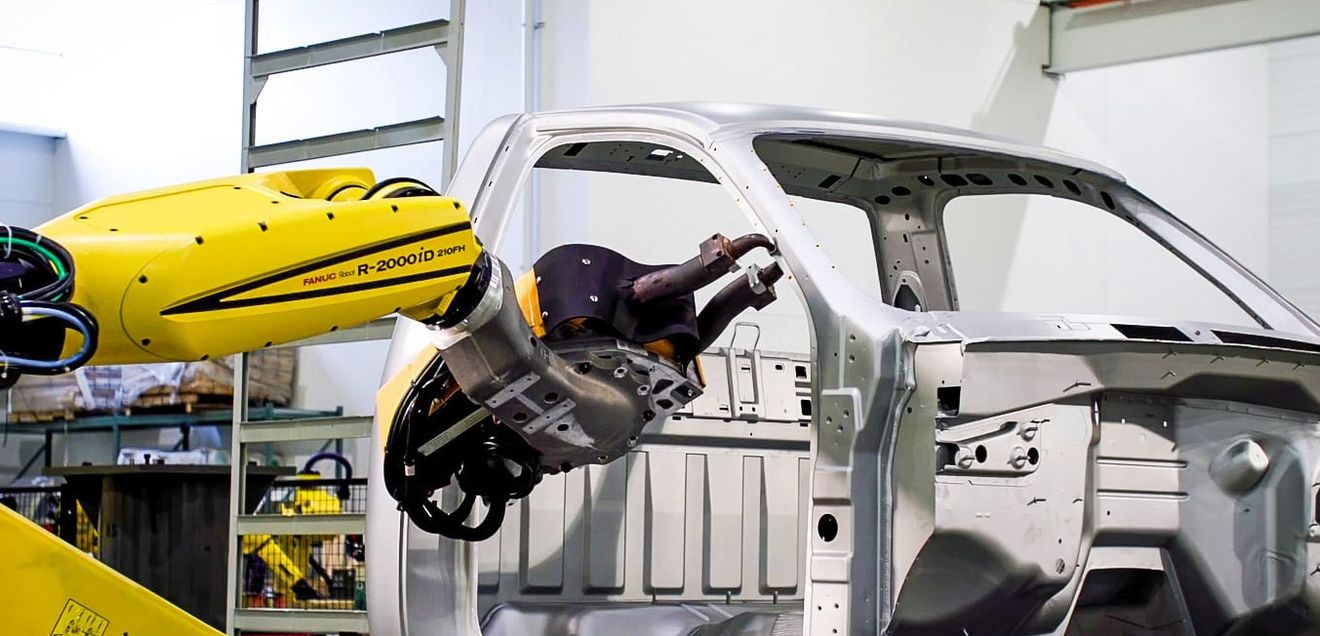
In the U.S., sales of industrial robots rose by 11% compared to the previous year: 38,000 units were newly installed in 2025. This significant recovery is driven by robust growth in the food industry and other non-manufacturing sectors. However, the automotive industry remains the largest customer sector.
“The United States is back on track for growth,” says Takayuki Ito, president of the International Federation of Robotics. “While the automotive industry posted its third-best result in seven years, the data also shows rising demand for flexible automation in the food industry: In this sector, installation figures rose by 30%, putting it on par with the metal and machinery manufacturing and electronics industries. These sectors are all projected to record around 3,000 installations each in 2025.”
The level of automation in the U.S., as measured by robot density, stands at 307 units per 10,000 manufacturing workers. This ranks the United States eighth globally, two spots higher than the previous year. With this result, the country trails more highly automated nations such as South Korea (1,220 robots), Germany (449 robots), and Japan (446 robots), but ranks ahead of China (166 robots).
However, China significantly outpaces the rest of the world in terms of market size: 295,000 industrial robots were installed in China in 2024, representing a 54% global market share. Preliminary results for 2025 are not yet available for China, but according to IFR estimates, installations are likely to be about ten times higher than in the United States. This success story is based on the country’s national robotics strategy, which was launched ten years ago. China’s recently published 15th Five-Year Plan (2026–2030) now even places robotics at the center of its industrial strategy. The goal is to focus AI research on physical applications, with robots serving as the main driver of economic growth.
National Robotics Strategy
A3, North America’s largest association for the automation industry, has now officially published its “Vision for a National Robotics Strategy” and presented it to legislative bodies. The association is thus advocating for the creation of a federal office for robotics and a national commission to coordinate the strategy. The goal is to harmonize government research and promote public-private partnerships. The paper also calls for market-oriented tax incentives, an expansion of retraining programs for skilled workers, updated safety standards, and a nationwide requirement to purchase domestic robotics technology in order to accelerate commercial adoption.
Outlook
The outlook for industrial modernization in North America and the United States remains extremely positive. This is due to the increasing reshoring of production facilities and the ongoing shortage of skilled workers. The IFR forecasts stable, long-term growth for the region’s automation sector, as manufacturers increase their investments in automation to offset structural labor shortages. In addition, demand is diversifying beyond traditional sectors.


You might also be interested in
Development Collaboration for Humanoid Robotic Hands Launched
Schunk is entering into a new development partnership with Robert Bosch Robotics. Their shared goal is to develop an industrial-grade robotic hand that can be integrated into various humanoid robot systems.
 read more...
Quantum-resistant hardware security for Nvidia robotics platform
Infineon Technologies integrates the hardware security module 'Optiga TPM SLB 9672' into Nvidia's 'Jetson Thor' computing platforms for robotics and autonomous systems. The module secures cryptographic keys directly at chip level and thus protects...
read more...6 Criteria for the objective comparison of humanoid robots in industry
A new benchmark from Fraunhofer IPA is intended to enable the first standardized and neutral analysis of humanoid robots for industrial use based on six key criteria.
read more...AI-supported lighting robot wins German Innovation Award 2026
Ledvance, provider of innovative lighting solutions, was named "Winner" in the Excellence in Business to Consumer Lighting category at the German Innovation Awards 2026. With the AI Companion Lighting Robot 'Elix', the company presents an...
read more...Regulation and safety slow down robotics projects in Germany
QNX has published the study "Inside the Robot: Architecture Benchmark Report". The results of the global survey of 1000 robotics developers show that software and safety requirements are increasingly becoming the central bottleneck for innovations...
read more...International Federation of Robotics
China puts AI robotics at the center of its national strategy
With its 15th five-year plan, China has placed robotics at the center of its new industrial strategy. The aim is to focus AI research on physical applications and use robotics as the main driver of economic growth.
read more...Humanoid robots as a means to combat the skills gap
Humanoid robots are already performing various tasks in industrial production. A representative survey commissioned by the digital association Bitkom shows how the industry views this overall.
read more...Physical AI with virtual twins and robotics
Dassault Systèmes and Neura Robotics announce partnership
Dassault Systèmes and Neura Robotics combine virtual twin technologies and cognitive robotics to scale physical AI. The partnership combines virtual planning, AI training and real automation in a continuous end-to-end pipeline.
read more...RobCo at the Hannover Messe 2026
Robotic system for dynamic environments
RobCo is presenting a new industrial robotics system for dynamic tasks in industry at the Hannover Messe. With 'Autonomous Alfie', the company is opening up a new category of robotic solutions. This allows tasks in which processes, objects and...
read more...