
World Robotics 2021
China leads economic recovery
In China, the number of industrial robots sold increased by 19% in 2020, as reported by the International Federation of Robotics (IFR) with the preliminary figures for World Robotics 2021.
"The outlook for the robotics industry is optimistic," says Milton Guerry, President of the International Federation of Robotics. "In China, where the coronavirus lockdown first came into force, the economic recovery of the robotics industry already started again in 2020. A total of 167,000 industrial robots were delivered."
The dynamic market in China is also having a clearly positive effect on the economy of foreign suppliers. With an increase in sales of 24%, 123,000 industrial robots were sold by foreign companies. Japanese companies have a dominant market share. Chinese suppliers delivered 44,000 units to their home market. This corresponds to an increase of 8% compared to 2019.
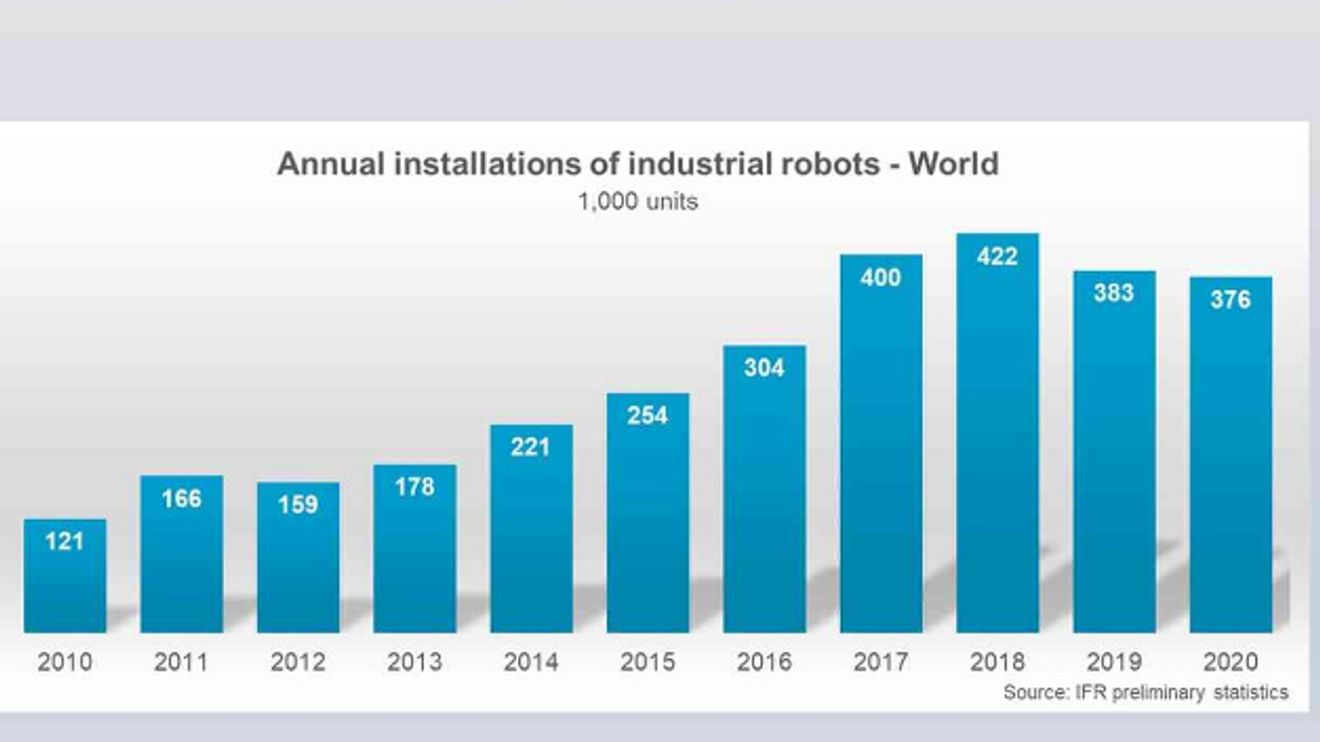
Global robot installations fell by 2% in 2020, particularly due to the coronavirus pandemic. The result was therefore more moderate than expected.
For 2021, the OECD is forecasting global GDP growth of 5.5% in 2021 and 4% in 2022. However, the situation in the various economies is mixed.
Incoming orders in the robotics industry suggest strong growth for North America and Europe in 2021. Order books in the USA are already filling up quickly. In Germany, the forecast shows a strong recovery for the current year and signals a turnaround for the industry. Even better sales figures can be achieved if the current supply bottlenecks for key components can be overcome quickly.
Reducing the CO2 footprint
In addition, the global path to climate neutrality is generating new business. In order to achieve ambitious climate targets, economies have begun to scale up renewable energies and environmental technologies on an unprecedented scale. Robotics and automation are enabling companies of all sizes to produce the necessary components. These include, for example, fuel cells for hydrogen-powered cars, batteries for the transportation sector and solar cells in the energy segment. A new generation of easy-to-use robotics is helping to optimize production processes and bring manufacturing closer to regional markets at competitive costs.
"Robotics has proven that it makes it possible to adapt production quickly and react flexibly to changes in demand and smaller batch sizes," says Milton Guerry. "The benefits of increased productivity secure jobs and keep companies competitive."


You might also be interested in
Robot density in Germany at record high
Germany is the most automated economy in Europe: according to the IFR, robot density - i.e. the number of industrial robots per 10,000 employees - has risen to a record 371 units (2020).
 read more...
International Federation of Robotics
Double-digit growth forecast for 2021
The number of industrial robots in factories worldwide has risen by 10% to a new record of around 3 million units - as reported by the International Federation of Robotics (IFR) in the new 'World Robotics 2021' yearbook.
read more...International Federation of Robotics
Mobile robots are revolutionizing the industry
Mobile robots are booming worldwide. A recent IFR white paper called 'A Mobile Revolution' explains how mobility is impacting robotics and why it is a ground-breaking development.
read more...B-Human wins another world championship
For the eighth time now, B-Human, the team from the University of Bremen and the German Research Center for Artificial Intelligence (DFKI), has won the World Robot Soccer Championship.
read more...Robotics and automation back on course for growth
The robotics and automation industry in Germany will generate an 11% increase in turnover in 2021 to €13.4 billion - according to the forecast by the VDMA Robotics + Automation Association. In contrast, 2020 was a clearly negative year.
read more...Combining technology and art
An industrial robot is one of the main actors in a play at the Staatstheater Augsburg, which audiences can watch from home as a 360-degree production using virtual reality goggles. Man and machine dance together on the virtual ballet stage.
read more...IFR World Robotics Report 2024
Record number of robots in use worldwide
Over four million robots are in use in factories worldwide, reports the IFR in the current "World Robotics Report 2024" - a record number. However, sales of industrial robots have fallen.
read more...International Federation of Robotics
Beijing wants to use robots to drive growth
During the third plenary session of the Central Committee, China repositioned its economic policy and announced a technology-centered approach. Chinese robot manufacturers are strategically preparing for this.
read more...Realtime Robotics honored
The 'Award for Innovation and Entrepreneurship in Robotics & Automation' (IERA) 2024 goes to Realtime Robotics. The US company from Boston received the prestigious award for its program that plans the movements of industrial robots fully...
read more...