
Process optimization
ABB robots in protective mask production
A robot helps with the production of respiratory masks. The result: faster production with increased quality.
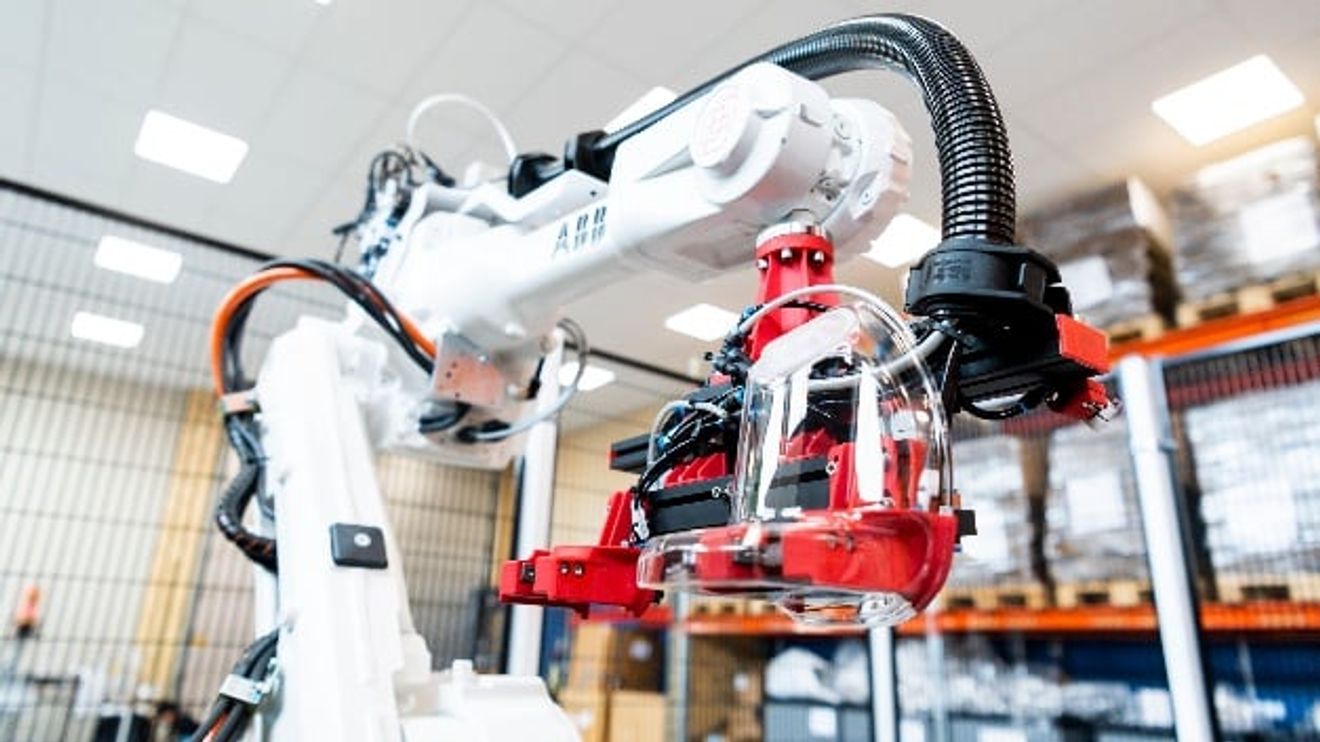
Tiki Safety in Bro, Sweden, outside Stockholm, manufactures respiratory protection solutions. In the wake of the coronavirus pandemic, demand for the company's respirators has increased exponentially both in Sweden and worldwide. To meet the high demand, production was equipped with a robot solution from ABB.
"By using the ABB robot, we have been able to speed up the throughput time tenfold. This enables us to fulfill our orders and deliver to hospitals in Sweden and around the world as quickly as possible," says Mikael Klockseth, CEO of Tiki Safety.
The respirators from Tiki Safety are positive pressure masks with a small blower on the top. However, there was still a need for optimization in the production of the respirators themselves. In order to increase production capacity and improve product quality at the same time, the 3Button Group worked with ABB to develop a new production cell that forms the rubber sealing strip around the respirator. The 6-axis IRB 2600 robot is responsible for loading and unloading the masks.
"Thanks to the collaboration with the 3Button Group and ABB, we received a turnkey solution in record time that works perfectly. We were up and running the day after commissioning and were producing masks at a completely different speed than in the past," says Klockseth.
Faster into production with programming and simulation software
Before the optimization, the production step took around six minutes; with the new production cell, it now only takes 40 seconds. "We expect to be able to do it in under 20 seconds in future - that's simply incredible! What's more, no special skills are required to work on the new line. And: less manual work than before ensures better product quality," says Klockseth about further possible increases in efficiency.
RobotStudio was an important element in the fast and successful commissioning of the robot. ABB's programming and robot simulation software allows a complete robot installation to be created, simulated and tested in a virtual 3D environment. Once the robot cell, including Tiki Safety's programming, was added to RobotStudio, the experts were able to use the simulation to quickly identify new possibilities and make decisions.
"In RobotStudio, we immediately saw that the robot in the cell had enough time to take on additional tasks. We will therefore integrate our test station into the same cell so that the robot tests the masks while the plastic parts are being produced and molded. It saves us an enormous amount of time if we don't have to test manually," explains Klockseth.
Improved working environment and more production capacity
Increased production capacity, higher quality and more parts in the same cell - replacing old machines with a modern robot brings many benefits. It is also a boost for the working environment at the Swedish company. "The ABB robot has solved a lot of the machine problems we had before. Thanks to the robot, production runs smoothly. In addition, our employees are now much better able to manufacture the product. They enjoy working with the new, 'cool' machines!"
The company is now better equipped to meet the high demand for respiratory protection solutions. According to Mikael Klockseth, they are already thinking about the next step: "As the technology has proven to be so good, we are considering using another ABB robot. This would allow us to double production."


You might also be interested in
Disinfection robot acts independently
In order to contain the spread of the coronavirus, the Stuttgart-based Fraunhofer IPA has developed a prototype of a mobile cleaning and disinfection robot that autonomously travels to potentially contaminated objects such as door handles and...
 read more...
ABB acquires Codian Robotics
ABB has acquired the Dutch company Codian Robotics, a supplier of delta robots, which are primarily used in high-precision pick & place applications.
read more...Programming even by non-professionals
The TracePen from Wandelbots makes it possible to assign tasks to robots easily and without programming knowledge. According to the provider, even non-experts can use it to train robots for a task.
read more...EXPECT research project launched
Robots learn to understand humans
The research project Expect (Exploring the Potential of Pervasive Embedded Brain Reading in Human Robot Collaborations) will investigate the extent to which EEG contributes to flexible context-sensitive human-machine interaction.
read more...Value stream kinematics research project
Revolution in production?
Together with industrial partners, KIT scientists are developing a production planning system that combines the precision of specialized machines with the flexibility of industrial robots.
read more...Drive technology in growth
Reducing costs and thus increasing resilience was ABB's declared aim. These efforts led to a better quarterly result than expected.
read more...International Federation of Robotics
Starting the upswing with robotics
The IFR is certain that robotics is necessary for the economic upturn. However, there is a lack of suitable training and further education opportunities.
read more...'Second life' for used robots
Instead of scrapping inactive or older robots and leaving them unused in the production hall, existing customers can sell them to ABB via a buy-back service. The robots are reconditioned there.
read more...AI robotics solution for logistics work
ABB and Covariant, an AI start-up from Silicon Valley, are working together to develop AI robotics solutions. The first solution is an autonomous gripper application for order processing in logistics centers
read more...