

Universal Robots
5 Automation forecasts for 2023
Many companies have introduced technology-based changes at a rapid pace in recent years. In our increasingly digital society, openness to technology and the effective implementation of new processes are the keys to success.
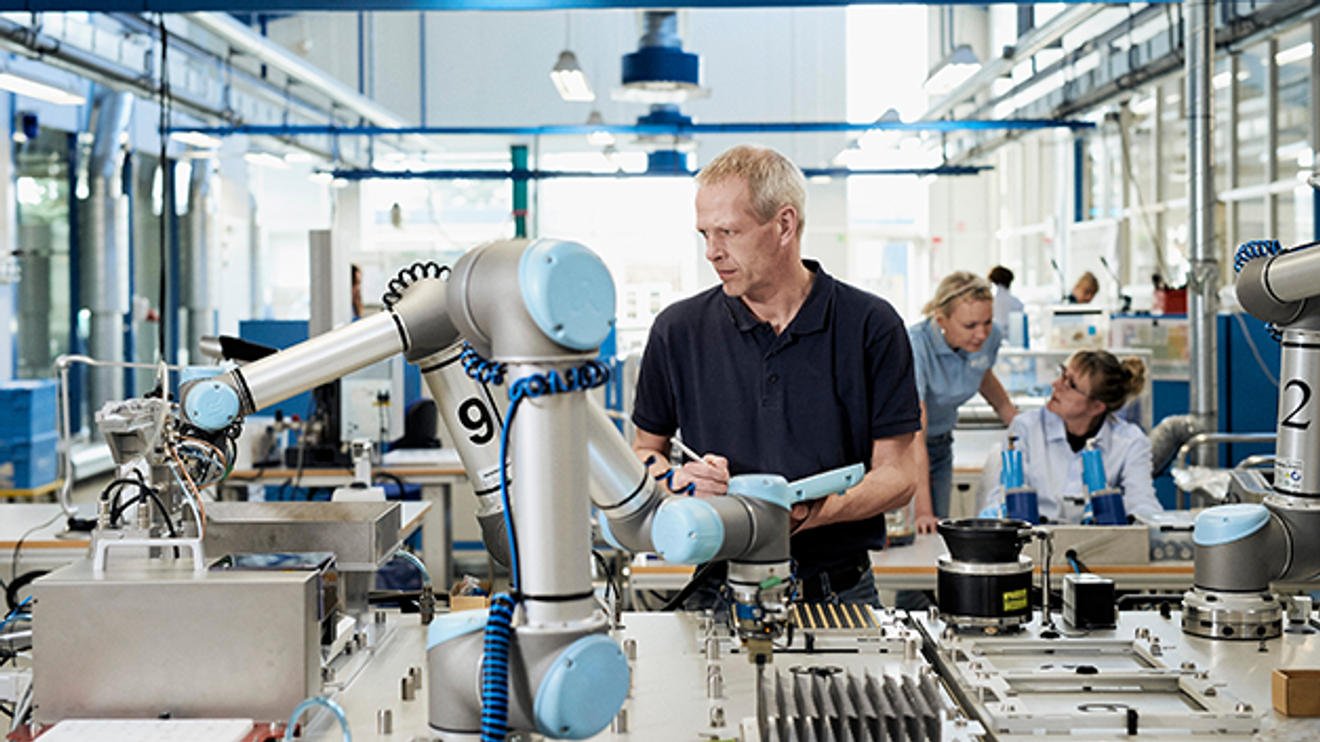
Rapid changes in the workplace can be observed in all industries, whether it's the switch to hybrid working or the introduction of new technologies. So what can we expect in 2023? Universal Robots has five predictions for the new year.
1. turnkey solutions will make automation more accessible than ever before
Numerous sophisticated technologies have been developed in recent years. Advances in robotics, machine learning and other areas have multiplied the pace of this change. Although these advances promise to change or even revolutionize the business world, all technology companies face the same challenge: they cannot be equally good in all areas.
This also applies to robotics. An automation solution based on robots requires the development of hardware, software, applications, sensors and interfaces, to name just a few aspects. This is why 2023 will be the year of turnkey solutions. Original equipment manufacturers (OEMs), i.e. companies that develop new applications and products based on existing technologies, such as robots, will play a central role in this. They will be able to drive innovation by combining technologies to deliver complete solutions for the most common applications, such as welding and palletizing. The result? Automation will be more sophisticated yet easier to use than ever before.
A good example of how this works is Enabled Robotics, an OEM based in Denmark. Since 2016, the company has been combining two types of cutting-edge technology by mounting collaborative robotic arms (cobots) on autonomous mobile robots (AMRs). This hybrid technology is now being used in industry, warehouse management and production, bringing robotics into service applications and hospital intralogistics.
Ultimately, these "out-of-the-box" solutions make it easier for companies to integrate key technologies, and the possibilities for companies increase many times over when it comes to having robots working alongside humans.
2. manufacturers will increasingly rely on modular production
Traditional industrial robots continue to play an important role in some areas of manufacturing. However, there is an emerging trend towards more flexible production models. This is mainly due to the fact that conventional industrial robots are usually space-consuming and permanently mounted, making installation and operation complex.
In contrast, cobots can perform a similar range of activities as conventional industrial robots - but they are smaller, lighter and much easier to install. The collaborative robots are designed to work alongside humans after successfully completing a risk assessment and are particularly suitable for environments that require flexibility and adaptability. They are also extremely cost-effective for companies looking to deploy automation technology - an important consideration for 2023.
The cobot industry is expected to grow to USD 2.2 billion by 2026 , according to a study. Cobots continue to change the way packaging, palletizing, welding and assembly tasks are performed. In 2023, it will therefore become clear that larger companies are also using cobots to make their production more flexible. The weight and versatility of robots will be key factors for those looking for new automation solutions - making reconfigurable robotic work cells more important.
3. cobots with higher payloads and greater reach expand the range of applications
Even though more and more companies are using cobots in automation, they will still want to handle high payloads. Manufacturers are taking this development into account and are launching cobots with higher payloads and greater reach onto the market. These will continue to change areas of the manufacturing industry in 2023 and improve the working lives of many employees.
One example of a particularly powerful cobot is the UR20, which Universal Robots will be delivering from 2023. With its excellent motion control, high payload capacity of 20 kg and a reach of up to 1750 mm, it is predestined for use in palletizing and welding applications.
4. the increase in the installation of industrial robots will continue despite global uncertainties
The IFR World Robotics Report 2021 shows that the installation of industrial robots reached an all-time high in 2021, increasing by 31% compared to the previous year. Overall, global annual robot installations more than doubled between 2015 and 2021. The slower growth in 2022 across the industry is largely due to global uncertainties caused by the pandemic and the shortage of electronic components.
The upward trend in robot automation is expected to continue in 2023. Why? Because companies around the world are facing a shortage of labor and skilled workers. And because we are in the midst of the transition to Industry 5.0, where collaboration with robots will create more sustainable and resilient businesses - with humans at the center.
5. the customer will be at the center of product development
Although we talk extensively about collaboration with robots in the workplace, human collaboration is the engine of innovation.
Customers know their own requirements better than anyone else. This means that robotics companies will involve end customers in product development even more than before. For this reason, Universal Robots, for example, has restructured its product development teams and is focusing on understanding customers' problems first and developing new solutions on this basis.
Joint projects, where robotics companies and customers work together to develop specific solutions, will also increase in 2023 and beyond. Ultimately, this will allow customers to directly influence the product they buy, while providing valuable feedback to manufacturers - who will be able to develop a product that benefits the entire market.
The future of cobots

The author: Anders Beck is Vice President of Strategy and Innovation at Universal Robots.
© Universal RobotsMore than ever, companies will need to demonstrate their willingness to evolve and their ability to adapt in order to survive and expand in the market. As we move into 2023, they will increasingly rely on technology and innovation, with turnkey solutions at the heart of this, to break new ground - all of which makes 2023 an exciting time for automation!


You might also be interested in
International Federation of Robotics
China overtakes the USA in terms of robot density
The global average robot density has more than doubled within six years (2015: 69 units). China has become the global leader and has overtaken the United States for the first time thanks to huge investments in industrial robotics.
 read more...
Openness and app operation as goals
Integrating robotics into the automation system
Keba is in the process of integrating the drag&bot robotics software from the company of the same name, which was acquired in February 2022, into its modular automation platform Kemro-X. Filip Miermans, explains the background and gives an...
read more...International Federation of Robotics
Service robot sales increase by 37% worldwide
The market for professional service robots grew by 37% worldwide in 2021. The strongest growth came from Europe, according to the annual report 'World Robotics 2022 - Service Robots' by the International Federation of Robotics (IFR).
read more...EUnited Robotics and VDMA Robotics + Automation merge
EUnited Robotics and VDMA Robotics + Automation are joining forces to form a joint platform for the European robotics industry. From January 2023, the members of EUnited Robotics will be represented by VDMA R+A.
read more...Germany is European champion in industrial robots
The number of industrial robots installed in Germany in 2021 rose by 6% year-on-year to 23,777 units. With a total of 245,908 units, the German industry ranks first in Europe.
read more...Robot density in Germany at record high
Germany is the most automated economy in Europe: according to the IFR, robot density - i.e. the number of industrial robots per 10,000 employees - has risen to a record 371 units (2020).
read more...IFR International Federation of Robotics
ABB receives Robotics Award 2021
The 2021 'Award for Innovation and Entrepreneurship in Robotics & Automation' (IERA) goes to ABB with 'PixelPaint'. This technology makes vehicle painting more efficient and sustainable.
read more...These 5 trends will shape robotics in 2021
Robot density is increasing rapidly in all industries worldwide. With new application possibilities, robots are also learning new tricks and helping to reduce the CO2 footprint. The 5 top trends in robotics.
read more...Joint solution from Siemens, Universal Robots and Zivid
Siemens, Universal Robots (UR) and Zivid have jointly developed an AI-based solution to automate picking work in fulfillment centers and improve processes.
read more...